How to raise your prices: confident steps for women entrepreneurs

TL;DR:
- Raising prices confidently ensures business sustainability and reflects the true value of services.
- Conduct a thorough cost audit to identify opportunities for pricing adjustments and internal savings.
- Clear, honest communication with clients about price increases builds trust and minimizes relationship loss.
You already know your prices need to go up. You’ve known it for months, maybe longer. But every time you get close to actually doing it, something stops you. Fear of pushback. Fear of losing the clients you worked so hard to build. Fear that raising your prices somehow makes you the bad guy. Here’s the truth: staying underpriced isn’t loyalty to your clients. It’s a slow drain on everything you’ve built. The good news is that raising prices well, with clarity and confidence, almost never costs you the relationships you’re afraid of losing. This article walks you through exactly how to do it.
Table of Contents
- Understand why price increases are necessary
- Assess internal costs and price opportunities
- Communicate price changes transparently and with confidence
- Manage client relationships and handle objections
- Our take: Why raising your prices is an act of leadership, not just economics
- Next steps: Build wealth and impact with strategic pricing
- Frequently asked questions
Key Takeaways
| Point | Details |
|---|---|
| Raising prices is normal | Most small businesses are implementing increases to stay profitable during rising costs. |
| Start with non-core offers | Begin adjustments on add-ons or premium options before your main products or services. |
| Communicate with confidence | Transparent explanations and advance notice help maintain client trust during price changes. |
| Strategic pricing boosts wealth | Well-planned increases support business growth, close funding gaps, and protect your well-being. |
Understand why price increases are necessary
Let’s start with the reality on the ground. Costs are rising across every industry. Supplies, software, contractors, insurance, rent, all of it costs more than it did two years ago. If your prices haven’t moved, your margins have quietly shrunk while you were busy delivering results for clients.
You’re not alone in facing this. 48% of small businesses are planning price increases of 2.1% to 5%, with some industries seeing justified increases of 12% or more. That’s not businesses being greedy. That’s businesses doing the math and staying solvent.
For women entrepreneurs specifically, the numbers tell an important story. Women-owned businesses have seen 15% revenue growth, with average revenues reaching $520K in 2024, and the funding gap is closing. But expenses are also climbing. A growing top line means nothing if your cost structure quietly eats the difference.
Here’s what’s driving the pressure most business owners feel right now:
- Inflation on inputs: Raw materials, digital tools, and professional services all cost more
- Labor and contractor rates: Skilled talent commands higher rates, and rightly so
- Import and supply chain shifts: Tariffs and logistics costs have pushed up prices across sectors
- Client expectations: As your work improves, the value you deliver increases, and your pricing should reflect that
For a deeper look at what’s shifting across industries, pricing trends data can help you benchmark your own adjustments against what’s actually happening in the market.
“A price increase is not a betrayal of your clients. It’s a declaration that your business is built to last.”
That mindset shift is the first thing you need before you touch a single number. Sustainable pricing isn’t about extracting more from people. It’s about making sure you can keep showing up at the level your clients hired you for.
Assess internal costs and price opportunities
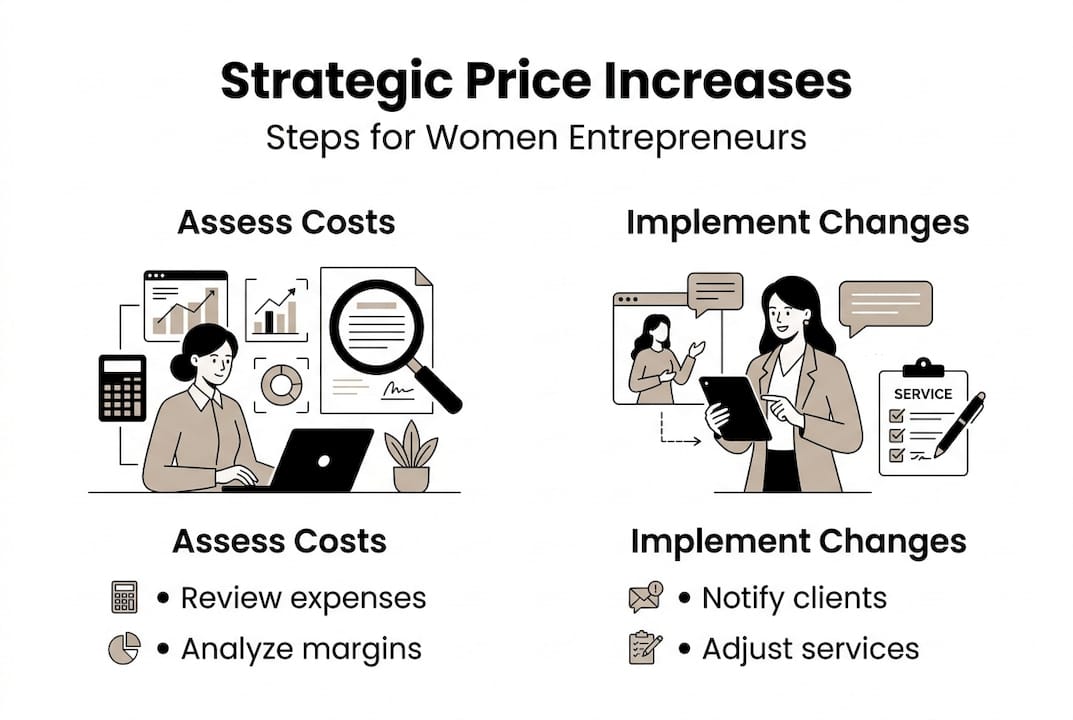
Before you raise a single price, do a clear-eyed review of where your money actually goes. This isn’t just good business practice. Finding and cutting internal costs before passing increases to customers protects loyalty and strengthens your margins from the inside out.
Start with a full cost audit. Look at every tool, subscription, contractor, and overhead expense. You may find savings that reduce how much you need to raise prices externally. You’ll also find places where your pricing hasn’t kept pace with the actual cost to deliver.
Here’s a simple framework for where to look first:
- List every business expense by category: Tools, people, space, marketing, fulfillment
- Flag anything you haven’t reviewed in 12 months: Prices change; your subscriptions and contracts should too
- Identify which services cost the most to deliver: High-touch offerings may be underpriced relative to effort
- Compare margins across your offers: Where are you working hardest for the least return?
- Spot underutilized premium options: If clients aren’t buying your higher-tier offers, the problem might be positioning, not price
Once you have a clear picture, the strategy becomes obvious. Raise prices on non-core offerings first, such as add-ons, premium packages, or standalone services where clients already expect a higher price point. This gives you real-world data on how clients respond before you adjust your core offers.
| Offer type | Margin flexibility | Best approach |
|---|---|---|
| Core retainer or service | Low to medium | Adjust after testing add-ons |
| Add-ons and extras | High | Raise first, low resistance |
| Premium or VIP packages | High | Reprice and reposition simultaneously |
| Low-margin legacy offers | Low | Consider discontinuing or bundling |
Pro Tip: If you have a legacy offer that used to make sense but now costs more to deliver than it earns, this is the moment to retire it. Discontinuing low-margin items is not abandoning clients. It’s creating space to serve them better through profit-focused pricing strategies that actually sustain your business.
Communicate price changes transparently and with confidence
This is where most women entrepreneurs get stuck. Not in the math, but in the message. The conversation feels loaded. You don’t want to sound defensive, or greedy, or like you’re putting your needs above the client’s.

Here’s the reframe: explaining the cost realities behind a price increase, without excuses or apology, is one of the most trustworthy things you can do. Clients don’t expect you to absorb rising costs forever. They do expect you to be honest with them.
When you communicate a price change, keep these principles in mind:
- Be direct. Say what’s changing, when it takes effect, and why. No hedging.
- Reference real context. You don’t need a dissertation on inflation. A clear sentence or two is enough.
- Give advance notice. Thirty to sixty days is standard for ongoing client relationships.
- Offer current clients a transition. A brief window to lock in the current rate honors the relationship.
- Lead with value. Remind clients what they’ve gained from working with you before you name the new number.
Here’s a script you can adapt:
“I wanted to reach out personally to let you know that my pricing is updating effective [date]. This reflects the real increases in my operating costs, as well as the continued evolution of what I bring to the work. Your current rate will remain in place through [date]. I’d love to continue working together and am happy to talk through any questions.”
For help with communicating price changes in a way that feels natural and professional, you don’t have to wing it. There are frameworks built specifically for this conversation.
Pro Tip: Write the message, then read it out loud. If you’d feel embarrassed saying it in person, edit it. Your tone should sound like a calm, confident business owner, not someone bracing for a fight.
Manage client relationships and handle objections
Even with a perfect message, some clients will push back. Expect it. It doesn’t mean you made a mistake.
The key is to respond from a place of clarity, not anxiety. When a client says the price feels high, they’re often testing whether you believe in your own value. Your response teaches them how to treat your pricing going forward.
Here’s how to handle the most common objections:
| Client concern | Effective response |
|---|---|
| “This is more than I budgeted” | “I understand. Let me walk you through what’s included and what we’ve built together.” |
| “Other providers charge less” | “That may be true. Here’s what you get with me specifically.” |
| “Can you make an exception for me?” | “I’m not able to do that, but I’d love to find the right package for where you are.” |
| “I need time to think” | “Of course. Here’s the deadline if you want to lock in the current rate.” |
Women-owned business expenses have risen 38% while the funding gap is closing. You are operating in real market conditions, not a theoretical exercise. That context is always available to you when you need to ground yourself in a hard conversation.
Most clients who genuinely value your work will stay. The ones who leave over a fair, well-communicated increase were likely not sustainable long-term clients anyway. That’s not a harsh take. It’s a protection of your time and energy.
- Remind clients of specific results they’ve seen since working with you
- Reframe the investment by showing them what the return has been
- Offer a bundle if they want to get more for their commitment
- Hold your position calmly without re-negotiating out of discomfort
- Build a plan for attrition so one departure doesn’t destabilize your revenue
For a broader view on sustainable sales strategies that help you grow revenue without chasing every single client, there are better ways to build.
Pro Tip: Use objection conversations as a signal. If clients push back hard on price but stay anyway, your offer needs stronger positioning. If they leave quietly, your pipeline needs work. Both are useful data.
Our take: Why raising your prices is an act of leadership, not just economics
Here’s what most pricing articles won’t say. For women entrepreneurs, resisting a market-aligned price increase is often a form of self-sabotage dressed up as generosity.
Keeping prices artificially low doesn’t protect your clients. It signals to the market, and to yourself, that your work isn’t worth the full rate. That belief has a cost. It bleeds into how you show up in sales conversations, how you negotiate, how much energy you reinvest into your business versus absorb as chronic stress.
Intentional pricing creates margin, literally and figuratively. It gives you resources to hire better support, invest in your own growth, and build a business that doesn’t require you to run on empty. Women business owners set the value standard for entire industries. When you price confidently, you raise the floor for everyone who comes after you.
Look at startup pricing strategies and you’ll notice one consistent pattern: the businesses that grow are the ones that treat pricing as a reflection of their value, not a apology for asking to be paid.
Balancing empathy for clients with clear-eyed strategic decisions is real leadership. Pricing is the tool that makes that leadership sustainable.
Next steps: Build wealth and impact with strategic pricing
If this article clarified something you’ve been circling for a while, that’s the beginning, not the end. Knowing what to do and actually making yourself do it when money and relationships are on the line are two different things.
That gap is exactly what Freedom Sun was built to close. Simone CR and the Women’s Wealth Collective work with women entrepreneurs who are already generating revenue and ready to build something that actually reflects their worth. Whether you need frameworks, community, or direct strategy support, the resources are there. Start with the scale your business guide to see what’s possible when pricing, systems, and mindset align.
Frequently asked questions
How much should I raise my prices in 2026?
Most small businesses are raising prices by 2.1% to 8%, but increases up to 12% or more may be justified depending on your cost structure and market positioning. Review your actual margins before settling on a number.
How do I tell clients about a price increase without losing them?
Communicate the reasons clearly, give at least 30 days’ notice, and focus on the value you’ve delivered to make clients more willing to support the change. Most clients who value your work will stay.
Should I increase prices on all my services at once?
It’s often best to start with non-core or add-on offerings before adjusting your main services. Raise prices on add-ons first to test client response with lower stakes before moving to your core offer.
Do women entrepreneurs benefit more from strategic price increases?
Yes. With business expenses up 38% for women-owned businesses, aligning pricing with real costs is essential to maintaining profitability and closing the funding gap for good.