How to Be the CEO of Your Life: Women Entrepreneurs
TL;DR:
- Women entrepreneurs often excel at business leadership but neglect applying the same strategies to their personal lives.
- Building a CEO mindset involves ownership, decisiveness, adaptability, and clarity, practiced daily to sustain growth.
- True leadership includes seeking support, setting boundaries, and aligning work with personal fulfillment for lasting success.
Most women entrepreneurs building real revenue have mastered the art of running a business while quietly losing the plot on everything else. You know the feeling: decisions pile up, clarity fades, and the version of success you originally chased starts to look nothing like what you’re actually living. The good news is that regaining control does not require working harder or sacrificing more. It requires leading yourself the same way you lead your business — with strategy, intention, and the right tools. This guide breaks down exactly how to do that.
Table of Contents
- What it means to be the CEO of your life
- Building a CEO mindset: The foundations
- CEO-level decision making: Tools and frameworks
- Scaling fulfillment: Beyond profit and productivity
- A fresh perspective: Why most ‘CEO of your life’ advice falls short
- Ready to lead your own life with CEO clarity?
- Frequently asked questions
Key Takeaways
| Point | Details |
|---|---|
| CEO mindset matters | Embracing a CEO mindset drives business growth and personal fulfillment. |
| Structure improves decisions | Using decision frameworks leads to more confident choices for life and business. |
| Support accelerates growth | Seeking guidance and building support systems results in sustainable leadership success. |
| Balance fosters fulfillment | Prioritizing well-being alongside profitability creates lasting satisfaction. |
What it means to be the CEO of your life
The title “CEO” is not just about a corner office or a business card. In the context of your personal life, it means something far more powerful: you are the one making strategic decisions, setting the direction, and owning the results — good and bad. Most women entrepreneurs are already doing this in their businesses. The gap is that they rarely apply the same rigor to their own lives.
Being the CEO of your life means you stop reacting and start leading. You stop waiting for the right moment and start creating it. You take ownership of your choices instead of blaming circumstances. This is not motivational fluff. Self-leadership is a primary driver for sustainable founder success, and it shows up in everything from how you price your services to how you protect your time.
Women entrepreneurs face a specific set of pressures that make this harder. There is the constant pull between business demands and personal responsibilities. There is the internal voice that questions whether you deserve to take up space, charge more, or ask for help. These are not character flaws. They are patterns, and patterns can be changed.
“The most powerful leadership position you will ever hold is the one you hold over your own mind, time, and choices.”
Here is what the CEO of your life actually looks like in practice:
- Accountability: You own your outcomes without spiraling into blame or shame.
- Vision: You know where you are going and why it matters to you personally.
- Decisiveness: You make calls with the information available instead of waiting for certainty.
- Adaptability: You pivot when the data changes without treating it as failure.
- Boundaries: You protect your energy the same way you protect your revenue.
These traits are not personality types. They are skills. And like any skill, they are built through practice, not perfection.
Building a CEO mindset: The foundations
Once you understand what the CEO of your life looks like, the next step is building the mindset that makes that version of you sustainable. A leadership mindset is fundamental to strategic business growth and personal clarity — and it starts with how you think, not just what you do.
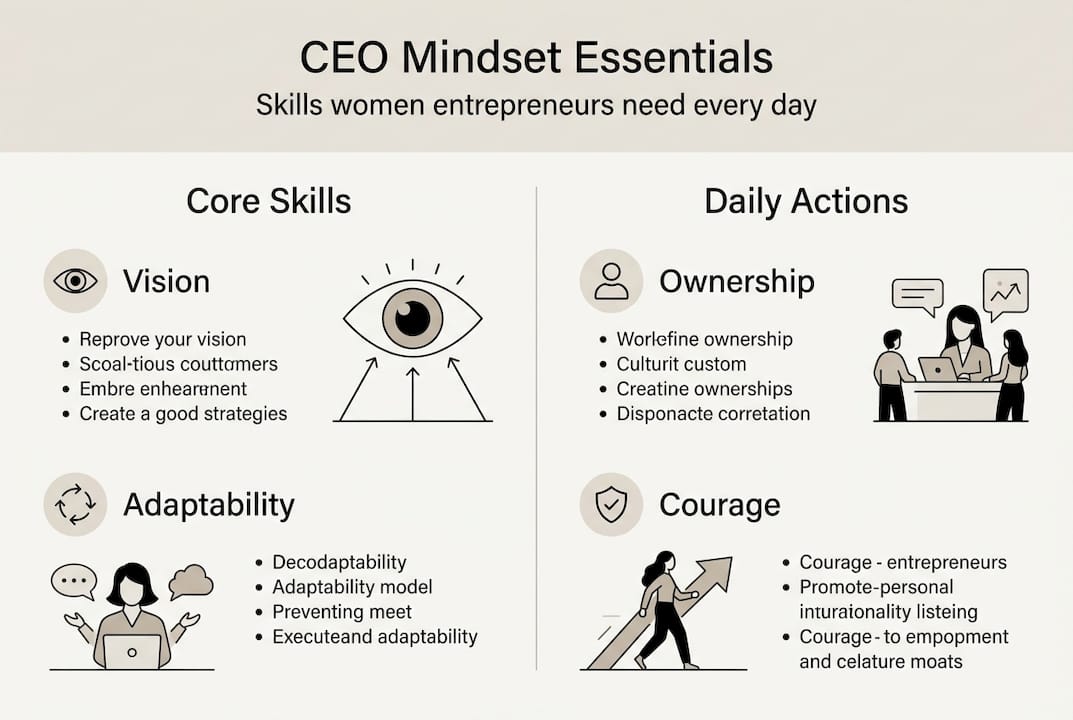
The core attributes of a CEO mindset are vision, adaptability, courage, and ownership. These are not abstract ideals. They show up in daily choices: how you respond to a difficult client, how you handle a revenue dip, how you talk to yourself after a mistake.

| Fixed mindset | CEO mindset | Impact |
|---|---|---|
| Avoids failure at all costs | Treats failure as data | Faster learning and recovery |
| Waits for permission | Acts with available information | Greater momentum and confidence |
| Blames external factors | Takes ownership of outcomes | Stronger team trust and credibility |
| Resists change | Adapts strategy as needed | Longer-term business resilience |
| Ties worth to results | Separates identity from performance | Better decisions under pressure |
Building this mindset is not a one-time event. It is a practice. Here is how to start:
- Set a clear personal vision. Not a business goal. A life vision. What does your ideal day look like in three years? Start there.
- Embrace learning over looking good. Every mistake is a feedback loop. The CEO of your life reviews the data and adjusts.
- Reframe setbacks as strategy. When something does not work, ask: what would I tell a client in this situation? Then take your own advice.
- Study growth mindset examples from other founders. Pattern recognition accelerates your own shifts.
- Audit your inputs. What you consume daily shapes your thinking. Choose accordingly.
Pro Tip: Commit to one small CEO-level decision every morning before you open your inbox. It could be a boundary you set, a task you delegate, or a goal you write down. These micro-commitments compound into massive self-trust over time.
CEO-level decision making: Tools and frameworks
Even with the right mindset, decision-making can still feel paralyzing. Fear of failure and analysis paralysis are two of the most common barriers women entrepreneurs face when scaling. The antidote is not more confidence — it is a better system. A structured decision-making framework streamlines success for leaders and coaches by removing the emotional weight from each individual choice.
Here are three frameworks worth knowing:
| Framework | Best use case | How it works |
|---|---|---|
| Eisenhower Matrix | Prioritizing tasks and time | Sorts decisions by urgency and importance into four quadrants |
| OODA Loop | Fast-moving or competitive situations | Observe, Orient, Decide, Act — then repeat |
| Rapid response matrix | High-stakes, time-sensitive calls | Weighs risk vs. reward with a simple scoring system |
Knowing the framework is step one. Using it consistently is where most people stall. Here is how to implement a CEO decision framework in your actual life:
- Name the decision clearly. Vague problems produce vague solutions. Write it out in one sentence.
- Choose the right framework for the situation. Not every decision needs the same tool.
- Set a decision deadline. Give yourself a specific time to decide and honor it.
- Limit your options. More choices create more paralysis. Narrow it to two or three.
- Debrief after. Review what worked and what you would do differently. This builds your decision-making muscle over time.
Overthinking is not a thinking problem. It is a trust problem. The more you practice structured decisions, the more you trust yourself to get it right — or to recover quickly when you do not.
Scaling fulfillment: Beyond profit and productivity
Profit matters. Productivity matters. But neither one is the full measure of a CEO life. Fulfillment is. And fulfillment is not something you find after you hit your revenue goal. It is something you build into the architecture of how you work and live right now.
Adopting an executive mindset leads to sustainable wealth and inner peace — not just business gains. This is the part most scaling advice skips entirely. You can optimize your calendar, nail your pricing, and still feel hollow at the end of the week if your work is disconnected from what actually matters to you.
Here are daily practices that align your business goals with your personal values:
- Start each week with a values check. Ask: does what I have planned this week reflect what I actually care about?
- Schedule non-negotiables first. Rest, relationships, and creative space are not rewards. They are inputs.
- Review your energy, not just your time. Some tasks drain you disproportionately. Identify them and minimize or delegate them.
- Celebrate progress, not just outcomes. The CEO of your life recognizes growth, not just results.
- Build in white space. Unscheduled time is not wasted time. It is where your best thinking happens.
Pro Tip: Redefine your success metric to include a well-being score alongside your revenue number. At the end of each month, rate both on a scale of one to ten. If your revenue is climbing but your well-being is dropping, that is a signal your strategy needs adjusting, not just your mindset.
The CFO mindset for fulfillment is about treating your personal well-being like a balance sheet. What are you investing in? What is depleting your reserves? Pair this with leadership habits for sustainable success and you have a system that compounds over time.
A fresh perspective: Why most ‘CEO of your life’ advice falls short
Here is the uncomfortable truth: most self-leadership content is built for optics, not outcomes. It tells you to “own your power” and “think like a CEO” while quietly reinforcing the idea that you should be able to do it all alone, faster, and with a perfectly curated personal brand to show for it.
That is not leadership. That is performance.
Real authority does not come from doing more. It comes from building the support systems that make sustainable leadership possible. The women who genuinely operate as the CEO of their lives are not the ones with the most discipline. They are the ones who ask for help without apologizing for it, who set boundaries without guilt, and who invest in leadership coaching for founders as a strategic move, not a last resort.
Asking for support is not a sign that your strategy is broken. It is a sign that you are serious about results. The most effective leaders in any context — business, sports, politics — have coaches, advisors, and systems behind them. Expecting yourself to self-lead in isolation is not strength. It is a gap in your infrastructure.
If the strategies in this article resonate but feel hard to implement alone, that is not a personal failure. That is useful data. Use it.
Ready to lead your own life with CEO clarity?
You already have the drive. What you need now is the structure, the support, and the community to make self-leadership stick. At Freedom Sun, we work with women entrepreneurs who are already generating revenue and ready to stop leaving their potential on the table. Our business leadership training is built around the four pillars of sustainable growth: Profit, Sales, Communication, and Leadership — because real CEO clarity requires all four working together. If you are ready to lead your business and your life with the same level of intention and strategy, Freedom Sun is where that work happens.
Frequently asked questions
What is the first step to becoming the CEO of your life?
Self-leadership is foundational for founder success, and the first step is taking full ownership of your choices and setting clear, achievable goals that guide both your personal and professional decisions.
How can women entrepreneurs overcome self-doubt while scaling their business?
A growth mindset combined with proven decision frameworks reduces self-doubt by replacing emotional guesswork with structure. Leadership mindset drives clarity and frameworks improve decision quality so confidence builds through repeated, structured action.
What tools help make better CEO-level decisions in business and life?
Decision matrices and structured tools like the Eisenhower Matrix support more confident choices by organizing complexity into clear priorities. Frameworks streamline decision-making for leaders at every stage.
Why is fulfillment an important part of being the CEO of your life?
Without fulfillment, success becomes unsustainable. A CFO mindset supports lasting wealth and peace by treating personal well-being as a core business asset, not an afterthought.
Recommended
- Self-Leadership: Unlocking Sustainable Success for Founders
- Business Coach Leadership Training: Transforming Founder Success
- 7 Leadership Habits for Founders to Achieve Lasting Success
- Welcome to Freedom Sun: Business Training
- New Year, New You: How to Start a New Business in 2023
- Korp.ph | How to Incorporate a Corporation Online in the Philippines (Step-by-Step Guide)