Role of CFO Mindset: Driving Lasting Wealth and Peace

Every founder knows that scaling a tech startup brings a constant flood of decisions, stress, and shifting priorities. When financial clarity gets lost in the chaos, even the smartest teams face blind spots that threaten growth and well-being. The CFO mindset bridges operational leadership and financial mastery, turning uncertainty into actionable insight and resilience. This approach helps financial executives and entrepreneurial founders transform their businesses by connecting strategic management, systems thinking, and emotional intelligence—building a foundation for clarity and long-term success.
Table of Contents
- Defining The CFO Mindset For Founders
- Key Differences From Traditional Finance Leadership
- CFO Mindset In Building Financial Clarity
- Strategic Systems Thinking And Automation Benefits
- Leadership Resilience: Preventing Burnout And Overload
- Risks, Common Pitfalls, And Misalignments
Key Takeaways
| Point | Details |
|---|---|
| CFO Mindset Shift | Founders should transition from focusing solely on revenue to understanding the financial impacts of decisions, emphasizing long-term sustainability over short-term gains. |
| Importance of Clarity | Financial clarity is essential; tracking a few key metrics weekly enables faster decision-making and enhances overall business understanding. |
| Collaborative Leadership | Embrace a role as a strategic partner across departments, fostering collaboration rather than acting as a gatekeeper for financial decisions. |
| Systematic Automation | Implement automated financial systems to improve accuracy and speed, allowing more time for strategic thinking and decision-making. |
Defining the CFO Mindset for Founders
The CFO mindset is not about memorizing accounting rules or obsessing over spreadsheets. It’s about developing a strategic perspective on how money flows through your business and how financial decisions ripple across every department. For founders, this mindset bridges the gap between daily operations and long-term wealth building.
At its core, the CFO mindset combines two critical capabilities. First is financial stewardship - understanding your numbers with enough depth that you can spot problems before they become disasters. Second is strategic business leadership that connects financial outcomes to company strategy. You’re not just tracking revenue and expenses; you’re asking how capital allocation decisions shape your growth trajectory.
Most founders get this backwards. They focus on hitting revenue targets and assume profitability will follow naturally. The CFO mindset flips this. You start by understanding what drives unit economics, cash conversion cycles, and sustainable margins. Then you build the operational machine around those financial realities. This prevents the painful discovery at scale that your business model breaks when you triple headcount.
What makes this different from typical accounting knowledge? The CFO mindset includes emotional intelligence and cross-functional collaboration alongside financial acuity. You need to communicate financial constraints to your sales team without killing their momentum. You need to push back on hiring plans while maintaining team morale. You’re balancing financial discipline with leadership judgment calls that no spreadsheet can make for you.
This mindset also means adopting a systems-based approach to financial management. Rather than crisis-mode budgeting or reactive expense cuts, you build sustainable financial infrastructure that doesn’t require constant intervention. Your systems should answer questions automatically: How much cash do we burn monthly? What’s our runway? Which products are actually profitable?
The shift from founder thinking to CFO thinking requires perspective. You stop asking “Can we afford this right now?” and start asking “What does this decision cost us in opportunity? In cash flow? In future flexibility?” This mental framework transforms how you allocate resources and make trade-offs.
Pro tip: Start tracking your three most important financial metrics every single week, not monthly or quarterly. For most tech founders, this means cash position, monthly recurring revenue, and cash burn rate. This weekly rhythm builds CFO-level awareness faster than any course.
Key Differences From Traditional Finance Leadership
Traditional finance leaders focused on one job: keeping the books clean and controlling costs. They answered to the CFO, reviewed reports, and made sure expenses stayed within budget. That’s it. The CFO mindset is fundamentally different because it starts with a completely different question.
Instead of “How do we reduce spending?” the CFO mindset asks “How do we create value?” This shift moves you from a cost-cutting accountant role to a strategic business partner. You’re not just protecting the company from financial mistakes. You’re actively shaping which opportunities get funded, how resources flow to high-impact areas, and whether the business model actually works at scale.
Traditional finance leadership is reactive. You wait for problems to surface in the monthly close, then scramble to fix them. The CFO mindset is predictive. You build systems that surface risk early through weekly metrics, dashboards, and forward-looking cash flow models. You spot the cash crunch coming in three months and adjust now, not in crisis mode.
Another critical difference involves your relationship with other departments. Traditional finance people are gatekeepers. Sales wants to hire? Finance says no. Marketing needs tools? Finance questions if it’s justified. This creates friction and slows decisions. The CFO mindset flips this. You become a collaborative partner who says “Yes, and here’s how we fund it responsibly.” You understand digital transformation priorities and strategic partnerships that drive growth, not just expenses that need cutting.
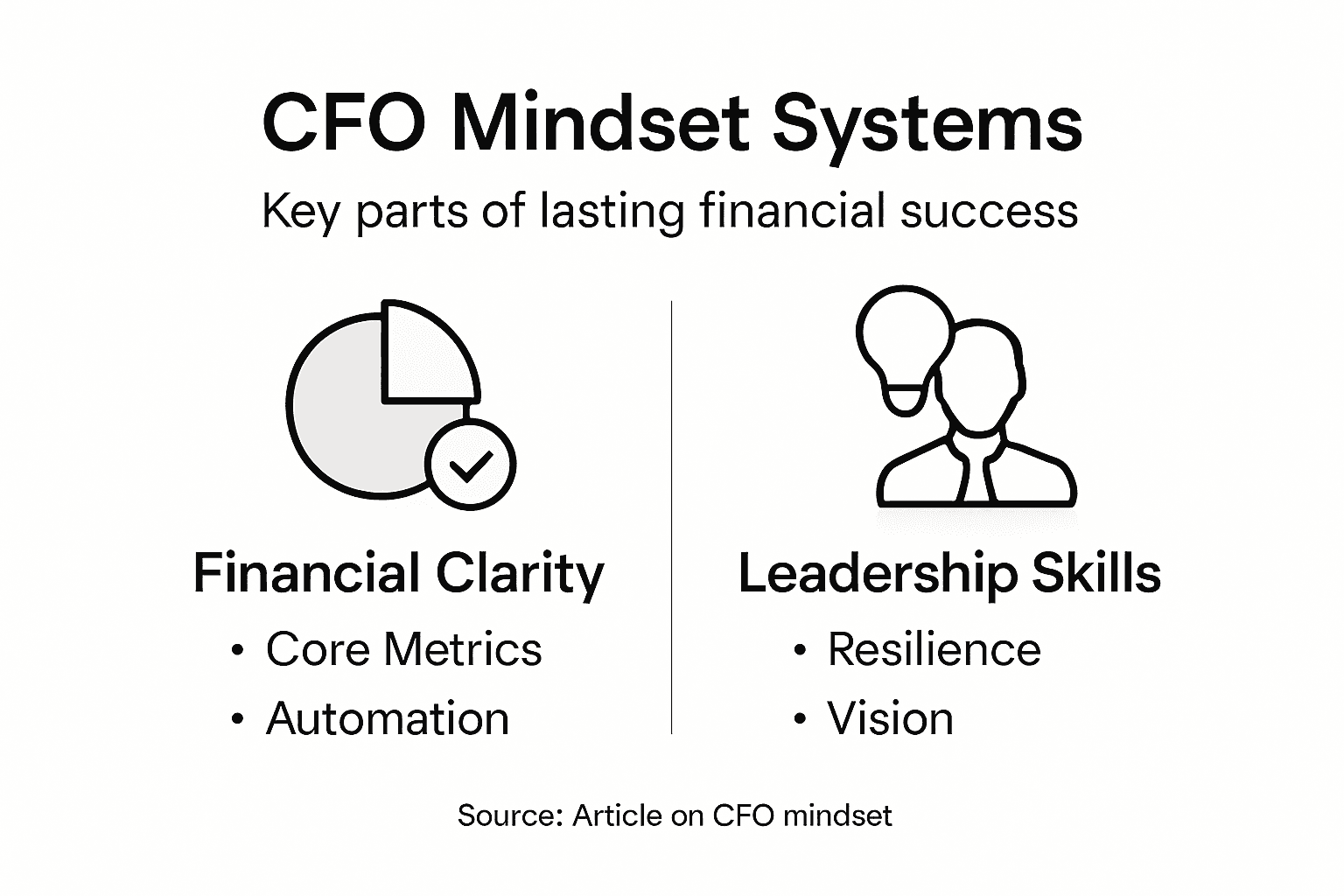
Personally, the CFO mindset requires stronger people leadership skills. You need emotional intelligence to communicate trade-offs without demoralizing teams. You need vision to articulate why certain financial decisions matter to the mission. Traditional finance people often avoided these soft skills. Modern CFOs know they’re non-negotiable.
The final difference is time horizon. Traditional finance manages quarterly or annual results. The CFO mindset balances short-term health with long-term sustainability. You might say no to a quick win that damages future runway, or invest in infrastructure that costs money today but saves millions tomorrow.
Pro tip: Stop measuring yourself by expense reduction alone. Instead, track how much revenue you’re protecting, how many months of runway you’ve extended, and which decisions you made faster because financial information was clear.
Here’s how traditional finance leadership compares to the modern CFO mindset:
| Aspect | Traditional Finance Leader | Modern CFO Mindset |
|---|---|---|
| Focus | Cost control and compliance | Value creation and strategy |
| Decision Approach | Reactive, after-the-fact | Predictive, proactive |
| Department Role | Gatekeeper, approval-focused | Collaborative business partner |
| Time Horizon | Quarterly/annual results | Short- and long-term growth |
| Leadership Skills | Technical, limited soft skills | Strong emotional intelligence |
| Resource Allocation | Expense reduction | Strategic investment |
CFO Mindset in Building Financial Clarity
Financial clarity is the bedrock of peace. Without it, you’re flying blind. The CFO mindset treats clarity as non-negotiable because unclear finances create constant friction, bad decisions, and stress that never goes away. Building clarity isn’t about creating prettier reports. It’s about designing systems that answer critical questions instantly.

The first step is understanding what clarity actually means. It’s not perfection or exhaustive detail. Clarity means you can answer these questions in minutes, not days: What’s our cash position right now? Which products make money? What’s our true profitability after all costs? Which departments are burning cash? Most founders can’t answer even one of these without digging through spreadsheets for hours.
The CFO mindset starts by identifying your core metrics. Not dozens of KPIs that nobody looks at. Five to seven numbers that tell the real story of your business. For tech startups, this typically includes monthly recurring revenue, customer acquisition cost, lifetime value, cash position, monthly burn rate, and runway. These metrics create financial clarity as a pathway to growth because they show what actually matters.
Next is automation. Manual reporting kills clarity because it’s slow, error-prone, and takes up your team’s time. The CFO mindset builds systems that pull data automatically from your accounting software and update dashboards without human intervention. When your team spends three days monthly on reporting, clarity suffers. When numbers update automatically, everyone sees reality in real time.
Clarity also requires honest accounting. Many founders use creative definitions of profitability or hide costs in different line items. The CFO mindset flips this. You account for everything: team salaries, infrastructure costs, customer acquisition, support, everything. This brutal honesty is uncomfortable but essential. You can’t make good decisions based on false numbers.
Finally, clarity means accessibility. If only you understand the financials, that’s not clarity for the business. The CFO mindset documents how the numbers work and shares them with leaders who need to understand them. Your head of sales needs to understand unit economics. Your product team needs to see what features drive profitability. Transparency builds better decision-making across the organization.
Pro tip: Create a simple weekly financial dashboard with your five core metrics and share it with your leadership team every Monday morning, no exceptions. This single practice builds clarity faster than monthly deep dives because consistency beats perfection.
Below are critical financial metrics for founders and why they matter:
| Metric | What It Measures | Why It Matters |
|---|---|---|
| Cash Position | Available cash on hand | Reveals solvency and runway |
| Monthly Recurring Revenue | Predictable, repeating income | Indicates stable growth |
| Customer Acquisition Cost | Cost to gain each customer | Guides marketing efficiency |
| Lifetime Value | Total revenue per customer | Helps evaluate profitability |
| Burn Rate | Net cash spent per month | Shows sustainability speed |
| Runway | Months before cash runs out | Assesses operational leeway |
Strategic Systems Thinking and Automation Benefits
Most founders treat their financial systems like a patchwork quilt. A spreadsheet here, accounting software there, some data in email, more data in Slack. Then they wonder why nobody understands what’s actually happening. The CFO mindset starts with systems thinking, which means seeing how every financial piece connects to every other piece.
Systems thinking reveals something powerful: changing one thing affects everything else. Cut customer acquisition spending, and your new customer numbers drop three months later. Hire more support staff, and your customer satisfaction improves, but cash flow tightens immediately. A systems thinker sees these connections in advance and plans accordingly. Most founders only see them after the damage is done.
Automation is where systems thinking becomes powerful. When you can reduce manual financial tasks through automation, your team stops drowning in spreadsheet maintenance and can focus on strategy. Imagine your accounting closing in two hours instead of two days. Imagine payroll running automatically. Imagine invoicing customers without manual entry. This is not fantasy. Most of this can happen with basic automation.
Here’s what automation actually delivers. First, accuracy improves dramatically because humans aren’t retyping data. Second, speed increases, so you see real numbers faster and make decisions quicker. Third, your team has mental bandwidth for thinking instead of task execution. They can analyze why numbers moved, not just update them.
But here’s what most founders miss: automation only works if your systems are designed first. You can’t automate chaos. Before you automate anything, you need clarity on what data flows where, which systems own which truth, and how everything connects. This is where strategic system design drives transformation across your entire operation.
The CFO mindset embraces both pieces. First, design your financial system as an interconnected whole. What information does each team need? How should money flow? What’s the source of truth for each number? Second, automate ruthlessly. If a task is repeatable, it should be automated. This combination gives you speed, accuracy, and the mental space to actually think about strategy.
Pro tip: Start by mapping your three most critical financial processes (like invoice to cash or payroll), identifying every manual step, and automating the top three most time-consuming steps this quarter. Small wins compound into massive time savings.
Leadership Resilience: Preventing Burnout and Overload
Burnout is the silent killer of founder success. You can have the best business model, the smartest team, and perfect financial systems, but if you’re burned out, nothing works. The CFO mindset includes building personal resilience because leadership without it becomes unsustainable. Burnout doesn’t just hurt you. It cascades through your entire organization.
Most founders equate hard work with commitment. You grind until you collapse, then grind some more. The CFO mindset flips this. It recognizes that sustainable success requires sustainable effort. When you’re exhausted, your decision-making suffers. You make poor hiring choices, cut costs in the wrong places, and miss obvious opportunities. Worse, your team watches you burn out and burns out themselves.
The first step is accepting that burnout happens from overload, not from work itself. The solution isn’t less work. It’s systems that prevent overload from accumulating. This is why the previous sections matter. When you automate tasks, you free mental space. When you have clarity, you stop second-guessing every decision. When you delegate properly, you stop trying to do everything yourself.
Managing stress through emotional intelligence and purpose creates the foundation for long-term leadership success. Emotional intelligence means understanding what drains you and what energizes you. Purpose means connecting daily work to something bigger than yourself. Without both, you’re just grinding.
Practically, this means setting boundaries. You can’t be on call 24/7. You need time to think without interruptions. You need recovery time. Many founders view this as weakness. Actually, it’s strategic. A rested brain makes better decisions. A focused hour beats ten distracted hours.
You also need to build a culture where people don’t hide problems. When your team is struggling, you need to know. When a project is falling apart, early warning beats crisis management. This requires psychological safety where people can admit problems without fear. Strong leadership cultures prevent burnout across teams, not just at the top.
Finally, remember this: taking care of yourself isn’t selfish. It’s essential leadership. Your team needs you healthy, focused, and present more than they need you grinding yourself to pieces.
Pro tip: Block one uninterrupted hour every morning for strategic thinking before checking email or messages. This single practice prevents reactive firefighting and lets you stay ahead of problems instead of constantly reacting.
Risks, Common Pitfalls, and Misalignments
Adopting the CFO mindset is powerful, but it’s not automatic. Founders often stumble on the way, creating the exact problems the mindset is designed to prevent. Understanding these pitfalls helps you avoid them.
The biggest pitfall is short-term thinking dressed up as strategy. You cut costs aggressively to hit quarterly numbers, but you destroy long-term capacity. You eliminate training to save money, then wonder why your team underperforms. You defer infrastructure investment to boost profit margins, then scramble when everything breaks. The tension between short-term cost-cutting and long-term investment derails founders constantly. The CFO mindset balances both. You make cuts strategically, protecting what drives future growth.
Another major risk is isolation in financial decision-making. You build the perfect financial system, but your team doesn’t understand it or buy into it. You make decisions based on data nobody else trusts. Misalignments from inconsistent vision and poor communication across leadership teams kill execution. The CFO mindset requires transparency. Your team needs to understand why decisions matter, not just accept them.
Many founders also underestimate transformation ambition. They adopt some financial tools but avoid the deeper mindset shift. They build dashboards but don’t change how they think about money. This creates halfway implementations that frustrate everyone. Real transformation requires changing your beliefs about what matters, not just your tools.
A subtle but critical pitfall is neglecting system health. You focus on financial metrics but ignore whether your actual systems are sustainable. You push your team to exhaustion to hit numbers. You automate without proper planning. You measure results without asking if the path to those results is sustainable. System health requires constant attention to operational resilience alongside financial performance.
Finally, many founders misalign expectations with reality. You promise transformation too quickly or set unrealistic financial targets. When reality hits, credibility erodes. The CFO mindset is honest about timelines and trade-offs. You tell stakeholders what’s actually possible, then deliver it.
Pro tip: Before implementing any major financial initiative, map out explicitly what trade-offs it creates and what it costs elsewhere in the business. If you can’t articulate the trade-off clearly, you probably haven’t thought it through enough.
Unlock the CFO Mindset With a Proven Operating System
If you relate to the challenges highlighted in the article around developing lasting financial clarity, preventing burnout, and building resilient leadership you are not alone. Many founders struggle to shift from reactive hustle to strategic wealth creation. The article stresses the importance of adopting a CFO mindset that combines financial stewardship with systems thinking and emotional intelligence. These concepts align perfectly with Freedom Sun’s approach. Our Operating System framework focuses precisely on transforming your business through the three pillars of MATH (financial clarity), MECHANICS (system infrastructure), and MIND (leadership resilience).
By embracing this framework you stop winging it with spreadsheets or short-term fixes and begin building automated, sustainable financial and leadership systems modeled after Fortune 500 CFOs. This means more confidence in your numbers, faster decision making, and peace of mind that your business is truly scalable without burning you out. You can experience tangible growth without compromising wellbeing.
Ready to stop guessing and start owning your financial future with systems trusted by high-growth entrepreneurs and executives If you want to harness the power of the CFO mindset and embed it deeply into your leadership style explore Freedom Sun’s platform for interactive training, diagnostics, and a supportive community. Discover how to elevate your leadership and operational stability through Freedom Sun Operating System today. Take your first step towards profitable peace and strategic management by visiting Freedom Sun. Don’t wait until overwhelm strikes act now and build the foundation for lasting wealth and peace.
Frequently Asked Questions
What is the CFO mindset and why is it important for founders?
The CFO mindset involves developing a strategic perspective on financial management, focusing on how financial decisions impact growth and operations. This mindset is crucial for founders as it helps bridge the gap between daily operations and long-term wealth building.
How can founders transition from traditional finance thinking to a CFO mindset?
Founders can transition by shifting their focus from merely reducing costs to creating value. They should adopt a proactive approach to financial management, emphasizing resource allocation, risk management, and collaboration with other departments.
What are the key financial metrics that founders should track?
Founders should track key metrics such as cash position, monthly recurring revenue (MRR), customer acquisition cost (CAC), lifetime value (LTV), burn rate, and runway. These metrics provide essential insights into the health and sustainability of the business.
How does emotional intelligence play a role in the CFO mindset?
Emotional intelligence is vital for CFOs as it enables them to communicate financial constraints effectively, maintain team morale, and lead with vision. This skill helps in making informed decisions that align with the company’s strategic goals while fostering a positive organizational culture.