What is the financial thermostat and why it's keeping you broke

You’re working harder than ever, yet your revenue keeps hitting the same ceiling. You raise your rates, land bigger clients, and still find yourself stuck at a familiar income level. The culprit isn’t your strategy or work ethic. It’s your financial thermostat, a subconscious program that sets invisible limits on how much money you allow yourself to earn and keep. This psychological barrier operates beneath your awareness, sabotaging growth even when opportunities appear. Understanding and resetting this thermostat is the difference between perpetual struggle and sustainable wealth.
Table of Contents
- Key takeaways
- What is the financial thermostat and how it controls your income
- Why your financial thermostat might be keeping you broke
- How to reset your financial thermostat for lasting wealth growth
- Common misconceptions and nuances about the financial thermostat
- Discover financial freedom with personalized coaching
- FAQ
Key Takeaways
| Point | Details |
|---|---|
| Subconscious money limit | The financial thermostat is a subconscious program that sets invisible limits on how much money you allow yourself to earn and keep. |
| Childhood money beliefs | Deeply ingrained beliefs formed early in life drive emotional reactions to money that keep you operating within a fixed income range. |
| Signs of a low thermostat | You feel anxious or guilty when money comes easily, doubt yourself after success, or sabotage opportunities before breakthroughs. |
| Resetting strategies exist | There are actionable strategies to reset the thermostat for financial growth by addressing nervous system responses and underlying blocks. |
| Mindset and awareness matter | Lasting change requires awareness and mindset shifts in addition to any practical business tactics. |
What is the financial thermostat and how it controls your income
Your financial thermostat represents the subconscious psychological set point that determines how much money feels safe, acceptable, and deserved in your life. Just as a home thermostat maintains a specific temperature, this internal mechanism keeps your income within a predetermined range. When you exceed that range, discomfort triggers behaviors that pull you back down. When you fall below it, you might hustle harder to return to familiar territory.
Simone Cimiluca-Radzins, CPA explains that this thermostat operates through deeply ingrained beliefs formed during childhood and reinforced through years of financial experiences. These beliefs create emotional responses to money that feel automatic and true, even when they limit your potential. Your nervous system treats exceeding your thermostat setting as a threat, activating stress responses that make growth feel dangerous rather than exciting.
Most women entrepreneurs experience this as a plateau effect. You hit a certain revenue level, stay there for months or years, then mysteriously find yourself back at that number even after brief spikes. The thermostat isn’t about what you’re capable of earning. It’s about what your subconscious believes you’re allowed to have. This distinction matters because capability and permission operate on entirely different psychological levels.
Internal beliefs maintaining your thermostat include unworthiness, fear of judgment, guilt about having more than others, and anxiety about increased responsibility. Emotional triggers activate when you approach your upper limit: imposter syndrome intensifies, sudden crises demand attention, or you make uncharacteristic financial mistakes. These aren’t coincidences. They’re your nervous system protecting you from the perceived danger of expansion.
Signs you have a low financial thermostat:
- You feel anxious or guilty when money comes easily
- Success triggers immediate self-doubt or fear of losing it all
- You sabotage opportunities right before breakthrough moments
- Charging premium rates feels impossible despite your expertise
- You create financial emergencies that drain unexpected windfalls
- Growth feels threatening rather than exciting
“Your relationship with money is not about the numbers in your bank account. It’s about the nervous system response you have when those numbers change. Until you address the underlying programming, no strategy will create lasting transformation.”
Exploring financial psychology insights reveals how these subconscious patterns form and persist. The thermostat doesn’t care about your business plan or revenue goals. It cares about maintaining emotional equilibrium, even if that equilibrium keeps you broke.
Why your financial thermostat might be keeping you broke
A low financial thermostat creates persistent struggle because it operates beneath conscious awareness, making your own psychology your biggest obstacle. You can have perfect strategy, incredible offers, and a solid client base, yet still find yourself unable to break through to the next level. The thermostat enforces its limits through fear-based decision making, chronic undercharging, and elaborate avoidance patterns that feel rational in the moment.

Fear manifests as worst-case scenario thinking that paralyzes action. You imagine clients rejecting higher prices, competitors judging your success, or the IRS auditing increased income. These fears aren’t based on evidence. They’re your thermostat’s defense mechanism against expansion. Guilt operates similarly, convincing you that wanting more money is selfish, that you should be grateful for what you have, or that financial success will damage important relationships.
Limiting money beliefs sound like truth because you’ve believed them for decades. “Money doesn’t grow on trees.” “Rich people are greedy.” “I’m not good with numbers.” “There’s never enough.” These statements create a reality that confirms their validity, trapping you in a self-fulfilling prophecy. Your brain seeks evidence supporting existing beliefs while dismissing contradictory information, making the thermostat incredibly resistant to change.
Subconscious behaviors maintaining these limits include procrastinating on revenue-generating activities, underpricing services to avoid sales conversations, and creating busy work that feels productive but generates no income. You might avoid following up with prospects, delay launching new offers, or refuse to examine your actual numbers. Financial coaching benefits for founders often begin with recognizing these self-sabotage patterns.
Typical symptoms of being stuck in a low financial thermostat:
- Consistently undercharging despite increased expertise and demand
- Avoiding money conversations with clients and partners
- Creating elaborate justifications for staying small
- Experiencing physical anxiety when discussing rates or revenue
- Refusing to track income and expenses accurately
- Making impulsive purchases that drain business profits
- Attracting clients who can’t afford to pay properly
Pro Tip: Track your emotional responses during financial transactions for one week. Notice when you feel relief, anxiety, guilt, or excitement around money. These patterns reveal your thermostat’s current setting and the specific triggers maintaining it. The awareness alone begins shifting your relationship with wealth.
The thermostat keeps you broke not through lack of opportunity but through inability to receive and hold onto money when it arrives. You might land a big contract, then immediately face an unexpected expense. You raise your rates, then offer discounts to the first person who hesitates. You hit a revenue goal, then take your foot off the gas until income drops again. These aren’t random events. They’re your nervous system restoring equilibrium.
How to reset your financial thermostat for lasting wealth growth
Resetting your financial thermostat requires deliberate mindset work combined with strategic behavioral changes that prove new beliefs true through experience. You can’t think your way to a higher thermostat. You must act your way there while simultaneously addressing the psychological resistance that surfaces. This process feels uncomfortable because growth always does, but discomfort is the price of expansion.
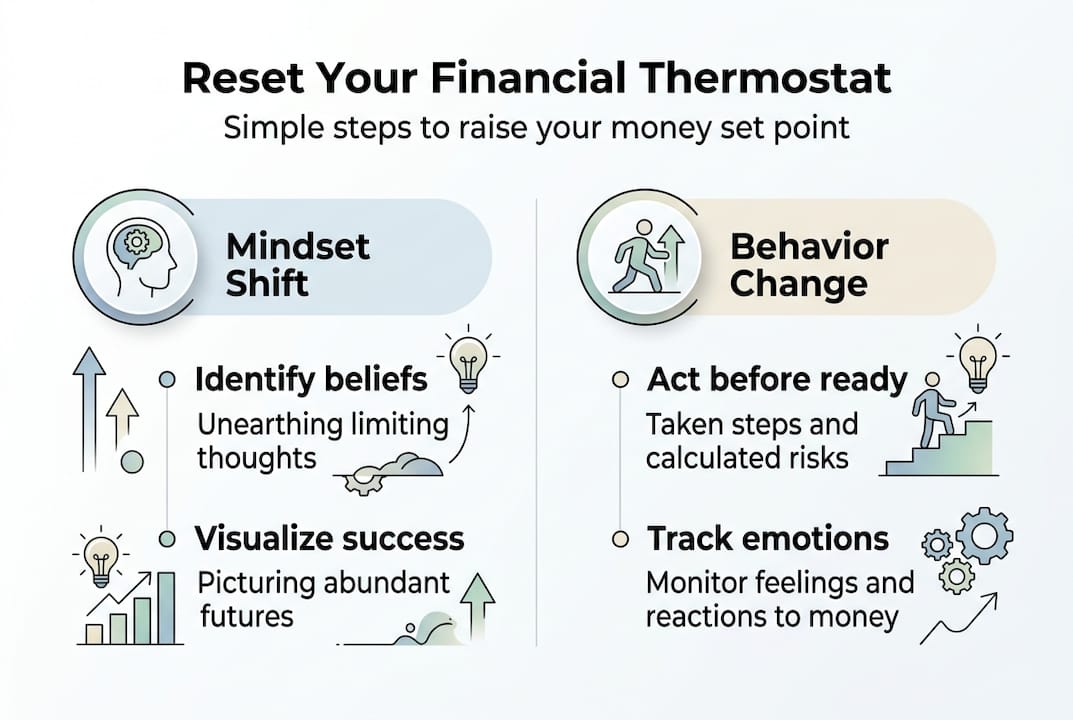
Mindset shifts begin with identifying the specific beliefs limiting your current thermostat setting. Write down every thought you have about money, wealth, and what you deserve. Don’t filter or judge. Just capture the raw programming. Then examine each belief for evidence. Is it universally true, or is it a story you inherited? Most limiting beliefs crumble under honest scrutiny, revealing themselves as outdated protection mechanisms rather than current reality.
Practical steps to reset your financial thermostat:
- Define your new financial set point with specific numbers and timelines
- Identify the beliefs and behaviors maintaining your current thermostat
- Create evidence for new beliefs through small actions outside your comfort zone
- Practice receiving money without immediately spending or sabotaging it
- Surround yourself with people operating at your desired financial level
- Track wins and progress to reinforce new neural pathways
- Address nervous system responses through somatic practices and coaching
Behavioral change means acting before you feel ready. Raise your rates even when imposter syndrome screams. Have the sales conversation even when your voice shakes. Keep the unexpected income even when guilt whispers you don’t deserve it. Each action that contradicts your old thermostat setting sends new information to your nervous system, gradually expanding what feels safe and possible.
| Mindset Trait | Before Reset | After Reset |
|---|---|---|
| Money beliefs | Scarcity-based, fear-driven | Abundance-oriented, opportunity-focused |
| Pricing confidence | Chronic undercharging | Value-based rates |
| Revenue patterns | Plateau effect, inconsistent | Steady growth, expansion |
| Response to success | Anxiety, self-sabotage | Celebration, building momentum |
| Financial decisions | Reactive, emotion-driven | Strategic, aligned with goals |
Learning financial coaching strategies accelerates this reset process by providing external accountability and expert guidance through the discomfort. Your brain will manufacture elaborate reasons to return to familiar patterns. A coach helps you recognize resistance for what it is rather than accepting it as truth.
Pro Tip: Create a “thermostat reset fund” where you deposit a percentage of every payment received without touching it for 90 days. This practice trains your nervous system to hold onto money rather than immediately finding ways to spend it. The psychological shift from this simple action often creates breakthrough moments in your relationship with wealth.
Sustaining a higher thermostat requires ongoing attention because old patterns reassert themselves during stress or uncertainty. Build support networks with other entrepreneurs committed to growth. Join masterminds, hire coaches, and invest in environments that normalize the income level you’re moving toward. Your thermostat adjusts to match the financial reality you consistently expose yourself to, making your environment a critical reset tool.
Common misconceptions and nuances about the financial thermostat
Many entrepreneurs misunderstand the financial thermostat concept, treating it as either pure mindset work divorced from practical action or dismissing it entirely as ineffective compared to traditional business strategy. Neither extreme captures the nuanced reality. Your thermostat is one critical component of financial success, not the only component, and resetting it requires both internal work and external behavioral change.
The biggest myth suggests that simply visualizing wealth or affirming abundance will raise your thermostat. Positive thinking without action reinforces the gap between where you are and where you want to be, often increasing frustration rather than creating change. Your nervous system needs proof through experience, not just hopeful thoughts. Affirmations work only when paired with actions that demonstrate new beliefs as true.
Another misconception treats the financial thermostat as entirely about external circumstances or luck. “I can’t earn more because the market is saturated” or “My industry doesn’t pay well” are statements that ignore the psychological component of wealth building. While market conditions matter, countless entrepreneurs thrive in challenging industries by addressing their internal limits first. Blaming external factors keeps you stuck because it removes your agency.
| Concept | Focus | Approach | Limitation |
|---|---|---|---|
| Financial thermostat | Subconscious income limits | Mindset work plus behavioral change | Requires ongoing attention and action |
| General money mindset | Thoughts and beliefs about money | Affirmations, visualization, journaling | Often lacks practical application |
| Budgeting | Tracking and allocating money | Spreadsheets, apps, financial planning | Addresses symptoms not root causes |
Confusing the financial thermostat with general budgeting leads to frustration when traditional money management fails to create growth. You can budget perfectly and still have a low thermostat that prevents you from earning enough to make budgeting meaningful. The thermostat determines how much comes in. Budgeting determines how you manage what arrives. Both matter, but they operate at different levels of your financial reality.
Pitfalls to avoid when changing your financial thermostat:
- Expecting instant results without consistent action over time
- Focusing only on mindset while avoiding practical business growth strategies
- Comparing your progress to others instead of your own baseline
- Giving up when old patterns resurface during stress
- Trying to reset alone without support or accountability
- Using thermostat work as an excuse to avoid necessary business skills
Understanding money mindset misconceptions helps you avoid these common traps. The financial thermostat is not a magic solution that eliminates the need for sales skills, marketing knowledge, or financial literacy. It’s the psychological foundation that allows you to actually implement what you know instead of sabotaging yourself at every turn. Strategy and psychology must work together.
The most important nuance is recognizing that your thermostat setting is adjustable but not infinitely flexible overnight. You can’t jump from $50,000 annual revenue to $500,000 purely through mindset shifts. You can, however, systematically expand your comfort zone in increments that feel challenging but achievable. Each new level becomes the foundation for the next, creating compound growth over time rather than overnight transformation.
Discover financial freedom with personalized coaching
Resetting your financial thermostat is challenging work that becomes significantly easier with expert guidance and community support. FreedomSun financial coaching specializes in helping women entrepreneurs bridge the gap between what they know they should do and what their nervous system allows them to actually execute. The coaching combines financial strategy with the psychological work necessary to implement that strategy without self-sabotage.
Personalized coaching addresses your specific thermostat triggers, limiting beliefs, and behavioral patterns rather than offering generic advice. You receive tailored strategies for expanding your comfort zone at a pace your nervous system can integrate, preventing the overwhelm that causes most entrepreneurs to retreat to familiar patterns. This individualized approach accelerates results because it meets you exactly where you are.
Beyond one-on-one support, you gain access to ongoing education through the Women’s Wealth Collective academy and the Nervous System of Money podcast. These resources reinforce your thermostat reset work between coaching sessions, providing consistent exposure to new financial paradigms. The community aspect normalizes higher income levels and wealth-building practices, helping your thermostat adjust to match your aspirations.
Explore the business growth insights blog to continue learning about the intersection of financial strategy and psychology. Your next breakthrough isn’t about working harder or finding a better strategy. It’s about addressing the internal limits preventing you from executing the strategies you already know work.
FAQ
What is a financial thermostat?
A financial thermostat is the subconscious psychological set point that determines how much money feels safe and acceptable for you to earn and keep. It operates beneath conscious awareness, creating automatic emotional and behavioral responses that maintain your income within a predetermined range. When you exceed your thermostat setting, discomfort triggers self-sabotage that pulls you back to familiar territory. This mechanism formed through childhood experiences and years of financial conditioning, making it feel like truth rather than a changeable program.
How can I identify if my financial thermostat is low?
Look for patterns of self-sabotage, chronic undercharging, and intense discomfort when success arrives or money comes easily. Notice if you create financial emergencies that drain windfalls, avoid revenue-generating activities, or make uncharacteristic mistakes right before breakthrough moments. Physical anxiety during pricing conversations, guilt about earning more than others, and elaborate justifications for staying small all indicate a low thermostat. Track your emotional responses to financial transactions for one week to reveal your specific triggers and comfort zone boundaries. Understanding financial psychology insights helps you recognize these subtle patterns.
What are effective steps to reset my financial thermostat?
Start by identifying the specific beliefs maintaining your current setting, then create evidence for new beliefs through actions outside your comfort zone. Define your new financial set point with concrete numbers, raise your rates even when imposter syndrome protests, and practice receiving money without immediately spending it. Build support through coaching or accountability groups because your brain will manufacture reasons to retreat to familiar patterns. Combine mindset work with behavioral changes, tracking wins to reinforce new neural pathways. Exploring financial coaching strategies provides structured approaches for sustainable thermostat resets.
Can mindset alone fix financial thermostat issues?
Mindset shifts are essential but insufficient without strategic action and consistent behavioral changes that prove new beliefs true through experience. Positive thinking divorced from practical implementation often increases frustration by highlighting the gap between aspirations and reality. Your nervous system needs evidence through action, not just affirmations or visualizations. Sustainable thermostat resets require combining internal psychological work with external business growth strategies, sales skills, and financial literacy. Mindset creates the foundation that allows you to execute what you know instead of sabotaging yourself, but execution still requires practical business competence and ongoing effort.