End startup burnout: sustainable wealth for women founders

Between 54% and 75% of women entrepreneurs report experiencing burnout at some point in their business journey. That is not a personal failure. That is a pattern. And yet the dominant narrative still tells you to push harder, sleep less, and grind your way to success. If that approach were working, you would not be reading this. The truth is that sustainable wealth and genuine wellbeing are not opposites. They are built together, with intention, and with a completely different set of rules than the ones hustle culture handed you.
Table of Contents
- Why is burnout rampant for women founders?
- What’s really driving burnout? Funding gaps, invisible work, and systemic bias
- Hustle culture vs. sustainable wealth: What success actually looks like
- The 7 proven rules for sustaining wealth and wellbeing
- What the thriving 27% do differently: Positive deviants blueprint
- Practical first steps: How to begin building your burnout-proof business
- Next steps: Go further with sustainable business training
- Frequently asked questions
Key Takeaways
| Point | Details |
|---|---|
| Burnout disproportionately affects women | Financial, caregiving, and funding challenges intensify burnout risk for women founders. |
| Hustle isn’t the answer | Sustainable wealth requires energy alignment, boundaries, and support instead of nonstop work. |
| Evidence-based rules work | Seven practical rules help founders reduce stress and build resilient businesses. |
| Support networks boost resilience | Peer coaching and community deliver dramatic reductions in stress and improved wellbeing. |
| Small steps drive real change | Simple actions like automating tasks or scheduling rest yield immediate and lasting benefits. |
Why is burnout rampant for women founders?
To understand and address burnout, let’s clarify why it’s so prevalent among women entrepreneurs. The numbers are striking. Women founders far exceed their male peers in reported burnout rates, and the gap is not small. Up to 75% of women founders describe some level of burnout, compared to significantly lower rates among men in similar roles.
Financial anxiety sits at the center of this crisis. Cash flow uncertainty, revenue unpredictability, and the persistent gender funding gap create a constant low-grade stress that compounds over time. Women between 35 and 54 carry an additional layer: caregiving responsibilities and invisible domestic labor that never appear on a business plan but drain real energy every single day.
| Burnout driver | Impact on women founders |
|---|---|
| Cash flow anxiety | Primary stressor for 60%+ of founders |
| Caregiving responsibilities | Disproportionately affects women 35 to 54 |
| Gender funding gap | Limits financial runway and increases pressure |
| Hustle culture expectations | Normalizes overwork without recovery |
Hustle culture does not account for any of this. It offers a one-size-fits-all prescription that ignores structural realities. Exploring wealth-building strategies designed specifically for founders can help you build a financial foundation that reduces the pressure driving burnout in the first place.
What’s really driving burnout? Funding gaps, invisible work, and systemic bias
With the context clear, let’s pinpoint the forces that put women founders especially at risk of burnout. The funding gap is not a myth. Women receive less than 2% of venture capital, which means most women-led businesses operate with tighter margins, less runway, and more financial stress than their male-led counterparts.
Here is what that looks like in practice:
- Funding scarcity forces women founders to do more with less, often skipping the hires or tools that would reduce their workload.
- Invisible labor at home and at work, including emotional labor, caregiving, and administrative tasks, multiplies the pressure without showing up in any productivity metric.
- Gender bias in investor rooms, client conversations, and even peer networks creates an exhausting layer of extra effort just to be taken seriously.
- Fundraising difficulty is real: 71% of women founders found their last fundraising round harder than expected.
- Role overload means many women are simultaneously the CEO, the marketer, the bookkeeper, and the primary caregiver.
Building financial resilience tools into your business model is one of the most direct ways to reduce the financial anxiety that feeds burnout. Pairing that with stronger leadership habits helps you stop absorbing every problem personally.
Pro Tip: Track every task you complete for one week, including the ones no one sees. Awareness of your invisible workload is the first step toward delegating it.
Hustle culture vs. sustainable wealth: What success actually looks like
These stressors make traditional hustle thinking less viable for women founders, so what does a truly sustainable alternative look like? Hustle culture glorifies constant output. It treats rest as weakness and equates busyness with value. For women founders already carrying disproportionate loads, this mindset is not just ineffective. It is dangerous.

Systemic inequities compound burnout, and sustainable approaches consistently outperform hustle over the long term. The data backs this up: 83% of women founders report high stress, with cash flow pressure and role overload as the core drivers.
| Approach | Hustle culture | Sustainable wealth |
|---|---|---|
| Focus | Time maximization | Energy optimization |
| Goal | Constant growth | Aligned profitability |
| Rest | Seen as weakness | Built into the strategy |
| Wellbeing | Sacrificed for output | Treated as a business asset |
| Long-term result | Burnout and plateau | Compounding wealth and health |
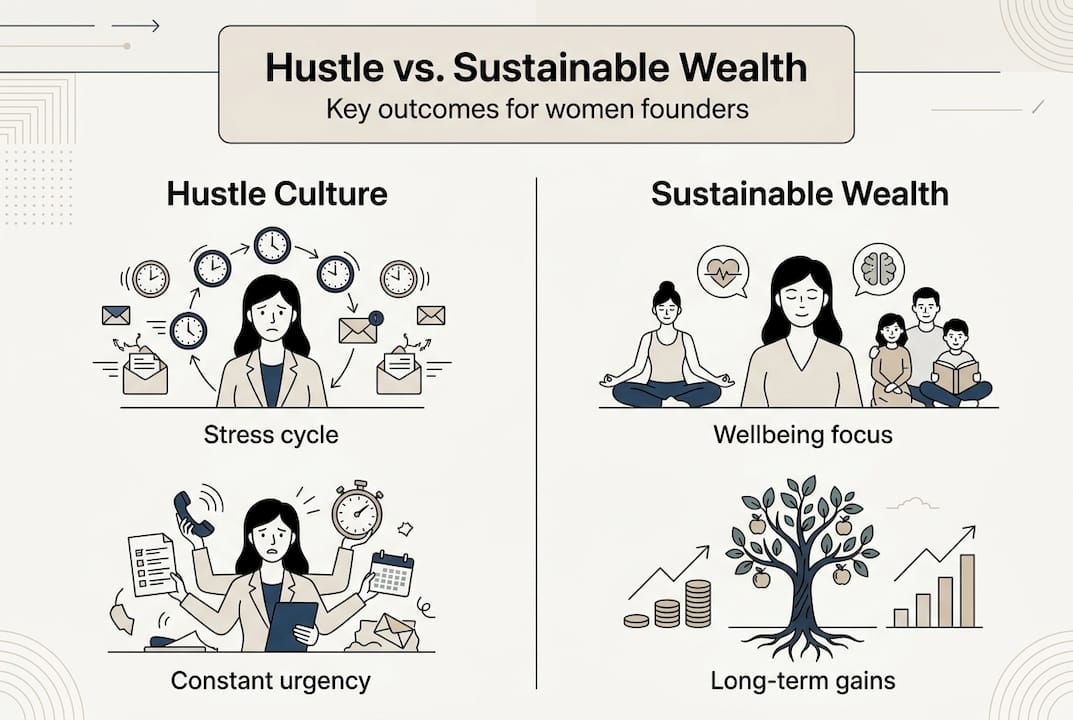
The mindset shifts required to move from hustle to sustainability are real and learnable. And the payoff is not just personal. Founders who operate sustainably build more resilient businesses. Learning how to approach scaling for lasting success means your growth does not come at the cost of your health. You can also explore sustainable business frameworks that have helped other founders make this shift.
The 7 proven rules for sustaining wealth and wellbeing
If hustle is not the answer, what evidence-based rules actually help women entrepreneurs build both wealth and wellbeing? These seven core rules give you a practical framework to start with.
- Know your why. Your reason for building this business is your anchor when everything feels urgent. Return to it often.
- Set non-negotiable boundaries. Boundaries are not preferences. They are operational decisions. Protect your time like a financial asset.
- Work in your energy peaks. Schedule your highest-leverage work during the hours when your focus is sharpest, not just when your calendar is open.
- Automate and delegate. Every task you can hand off or systematize is energy returned to you. Start small and build from there.
- Prioritize rest. Sleep and recovery are not rewards for finishing your to-do list. They are inputs that determine the quality of your output.
- Redefine success. Profit matters. So does how you feel building it. Success that costs your health is not success.
- Lead with spaciousness. Create breathing room in your schedule, your decisions, and your communication. Urgency is often manufactured.
Pro Tip: Use productivity hacks like auto-replies, calendar blocking, and task batching to automate even micro-decisions. Small changes compound fast. Developing the leadership qualities for founders that support this kind of spacious leadership is a skill, and it is one worth investing in.
What the thriving 27% do differently: Positive deviants blueprint
The research highlights a subset of women founders who outperform and sustain their health despite facing the same challenges. What are they doing differently? The answer is both practical and counterintuitive.
Thrivers build what researchers call resilience boards: small, intentional networks of coaches, peers, and mentors who check in regularly. Founders with this kind of support report an 88% boost in wellbeing. That is not a soft benefit. That is a measurable competitive advantage.
Here is what else the thriving 27% do consistently:
- They put their health above business KPIs, not because they care less about results, but because they understand that their health is the engine.
- They take regular nature breaks, even brief ones, to reset their nervous system.
- They prioritize joy and fun as legitimate business inputs, not indulgences.
- They practice daily mindfulness, even in short bursts, to interrupt reactive thinking.
- They skillfully intercept negative thought spirals before those spirals make decisions for them.
“Wellbeing is a business asset, not a soft benefit.”
Building a growth mindset that treats your own resilience as a strategic priority changes how you make decisions under pressure. Investing in mental resilience is not separate from building wealth. It is the foundation of it.
Practical first steps: How to begin building your burnout-proof business
With a blueprint and rules in hand, it’s time to translate insight into action. Here is how to get started today.
- Map your hidden stressors. Write down every source of pressure in your business and personal life. Review the list weekly. What you can name, you can address.
- Start a resilience board. Ask two peers or mentors to check in with you monthly. Keep it simple and consistent. Prevention as a business strategy delivers measurable returns when peer support is activated early.
- Block restoration time. Choose one weekly slot for nature, fun, or mindfulness. Put it in your calendar before anything else. Protect it.
- Automate one draining routine this week. Pick the task that costs you the most energy for the least return. Set up an auto-reply, a template, or a delegation system. One change creates momentum.
- Revisit your wealth-building strategies. Make sure your financial plan supports your energy, not just your revenue targets. You can also look at how other founders manage expenses during slow periods to reduce financial pressure before it becomes a crisis.
These steps are not a complete overhaul. They are entry points. Each one builds on the last, and each one moves you closer to a business that generates wealth without consuming you.
Next steps: Go further with sustainable business training
If you are ready to move from surviving to sustainable thriving, dedicated support and structured training can dramatically accelerate your progress. The strategies in this article are a starting point, but real transformation happens inside a community that holds you accountable and a framework that addresses both the financial and psychological sides of building a business.
Freedom Sun was built specifically for women entrepreneurs who are already generating revenue and ready to stop leaving money and energy on the table. Through the Women’s Wealth Collective academy, the Nervous System of Money podcast, and live events across Europe and the United States, Freedom Sun bridges financial strategy with the mindset work underneath it. Explore wealth-building strategies designed for founders who are done with burnout and ready to build something that lasts.
Frequently asked questions
What are the most common signs of burnout for women entrepreneurs?
Common signs include persistent exhaustion and anxiety, loss of motivation, irritability, and feeling overwhelmed by even small decisions. If your business feels heavier than it used to, that is worth paying attention to.
How can I set boundaries to prevent startup burnout?
Use calendar blocking, automated responses, and clear communication to create non-negotiable downtime. Structural boundaries, not just intentions, are what actually prevent fatigue from accumulating.
Does having a support network really reduce burnout?
Yes. Founders with peer support and resilience boards report an 88% improvement in wellbeing and measurably lower stress levels compared to those going it alone.
How does redefining success help prevent burnout?
When success is measured only by growth metrics, rest and recovery always lose. Shifting toward alignment and wellbeing as success criteria breaks the cycle that keeps founders overextended.
Is startup burnout a systemic problem or just about working too hard?
It is primarily systemic. Funding inequities and structural bias create conditions where burnout is almost inevitable, which means individual habits alone are not enough. Changing the systems around you matters just as much as changing your schedule.