Advanced sales skills training for women entrepreneurs

TL;DR:
- Advanced sales training focuses on practical skills like negotiation, persuasion, and communication.
- Building behavioral competencies leads to measurable growth beyond just mindset shifts.
- Ongoing practice and accountability are essential for long-term sales success.
You’ve already built something real. Revenue is coming in, clients are saying yes, and yet something keeps hitting a ceiling. Most coaches will tell you the answer is mindset. Shift your beliefs, visualize the close, and the sales will follow. But competency-building sales training covering persuasion, negotiation, and communication is empirically shown to help women entrepreneurs overcome persistent growth barriers. Mindset is a starting point, not a finish line. This guide walks you through what advanced, behavioral sales training actually looks like, how to choose the right program, and how to turn new skills into real, measurable growth.
Table of Contents
- Why advanced sales training matters for women-led businesses
- Core components of effective sales skills training
- How to select the right sales skills training for your business
- Turning new sales skills into measurable growth
- Our perspective: What most sales training gets wrong for women founders
- Ready to transform your sales skills?
- Frequently asked questions
Key Takeaways
| Point | Details |
|---|---|
| Skills outweigh mindset | Evidence shows behavioral sales skills drive sustainable growth, beyond mindset training alone. |
| Competency-based programs win | Seek out training that includes active practice in negotiation, persuasion, and communication. |
| Fit training to your needs | Choose courses that match your business challenges for maximum impact. |
| Apply and track progress | Embed new skills in daily routines and monitor key sales metrics to stay motivated. |
Why advanced sales training matters for women-led businesses
There’s a reason so many talented women entrepreneurs plateau at the same revenue level year after year. It isn’t lack of motivation or a broken belief system. It’s a skills gap that no amount of journaling will close. Focusing only on mindset may miss the key behavioral competencies needed for sales success, and that gap quietly costs you deals, clients, and confidence.
The role of mindset in business growth is real, but it functions more like the foundation of a house than the house itself. You still need to build the walls. Those walls are skills: negotiation, persuasion, communication, and strategic networking. Each one is learnable. Each one is trainable. And each one produces results you can actually measure.
Women entrepreneurs face specific barriers that generic sales programs rarely address. These include being socialized to avoid self-promotion, undervaluing their offers, and feeling uncomfortable with assertive negotiation. Advanced training targets these patterns directly, giving you behavioral tools rather than just reframing exercises.
Entrepreneurs who engage in skills-based sales training report significantly higher deal close rates compared to those who rely on mindset work alone. The difference isn’t motivation. It’s practice.
Common barriers blocking business growth:
- Weak negotiation tactics that lead to discounting under pressure
- Underdeveloped persuasion skills that make pitches feel flat
- Difficulty communicating value clearly and confidently
- Limited networking strategy, which shrinks the pipeline
- Over-reliance on relationship warmth instead of structured sales process
“Training that focuses exclusively on internal beliefs, without building external behavioral competencies, leaves women entrepreneurs without the practical tools they need to compete and grow.” This is the gap that advanced, skills-focused programs are designed to close.
If you want to get better at sales strategies that actually move the needle, the shift starts with recognizing that skills training and mindset work are not the same thing, and both are necessary.
Core components of effective sales skills training
Not all sales training is created equal. Some programs dress up motivation as education. Others teach theory without ever asking you to practice. The best programs do something different: they build competency through repetition, feedback, and real-world application.
Effective training for women entrepreneurs must teach persuasion, negotiation, communication, and networking as active skills, not passive concepts. That means you aren’t just reading about how to handle objections. You’re practicing the response until it feels natural.
The 4 pillars of skills-focused sales training:
- Persuasion — Learning how to frame your offer in terms of client outcomes, not features. This includes storytelling, social proof, and anchoring techniques.
- Negotiation — Practicing how to hold your price, counter offers, and navigate pressure without collapsing. This is where most women entrepreneurs lose money.
- Communication — Developing clarity, confidence, and precision in how you present, pitch, and follow up. This includes written and verbal communication.
- Networking — Building a strategic relationship pipeline that generates referrals and opportunities, not just contacts.
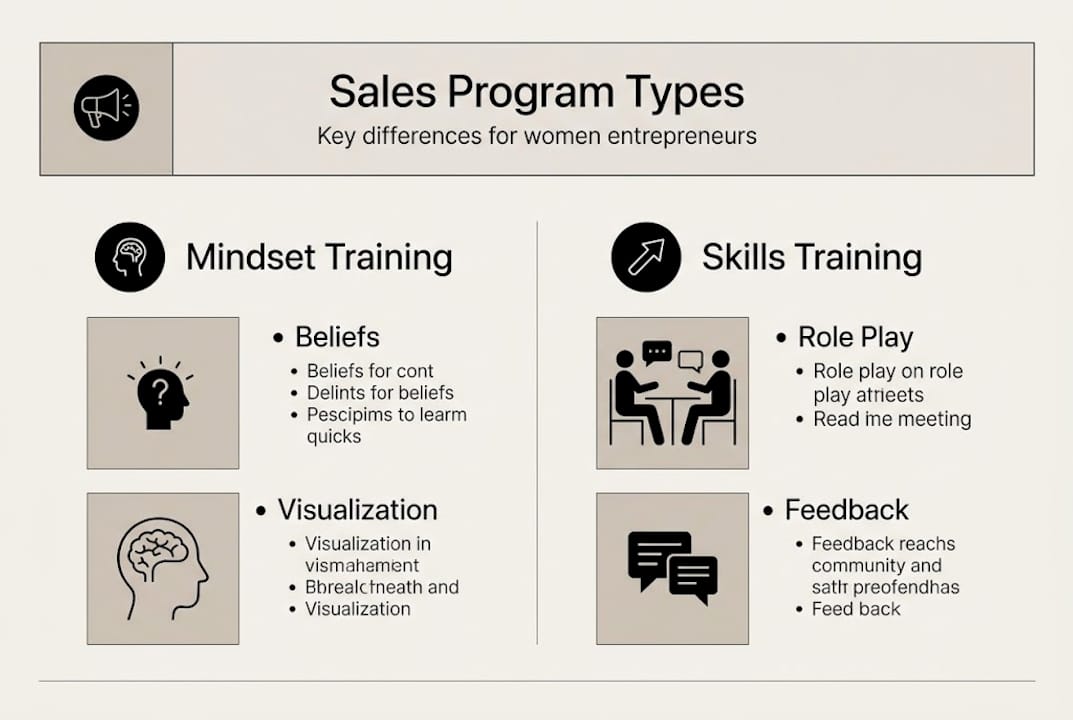
| Feature | Mindset-only training | Skills-focused training |
|---|---|---|
| Content focus | Beliefs, visualization, journaling | Negotiation, persuasion, communication |
| Learning method | Passive listening, reflection | Role play, feedback, practice drills |
| Measurable outcomes | Subjective confidence shifts | Close rates, revenue, deal size |
| Long-term effectiveness | Fades without reinforcement | Compounds with consistent practice |
| Application to real scenarios | Limited | Direct and immediate |
A consultative sales training approach goes even further by teaching you how to listen strategically and position your solution based on what the client actually needs. This is especially powerful for service-based entrepreneurs whose offers require trust before a yes.

Pro Tip: When evaluating a program, ask specifically whether it includes live role play with real feedback. If the answer is no, the program is teaching you about sales, not teaching you to sell. That’s a critical difference.
The consultative sales approach also builds client trust faster because it shifts the dynamic from persuading someone to buy, to helping someone solve a problem. That reframe alone changes how you show up in every sales conversation.
How to select the right sales skills training for your business
Choosing a sales training program is a business investment, and it deserves the same rigor you’d apply to any other strategic decision. The wrong program wastes time and money. The right one accelerates everything.
Training should map competencies to specific business challenges and outcomes. That means before you enroll in anything, you need clarity on what’s actually blocking your growth right now.
Business challenge to competency mapping:
| Business challenge | Recommended sales competency |
|---|---|
| Losing deals at the pricing stage | Negotiation and value framing |
| Low conversion from discovery calls | Consultative communication |
| Stalled pipeline and few referrals | Strategic networking |
| Clients pushing back on scope | Assertive boundary-setting in sales |
| Inconsistent revenue month to month | Structured sales process and follow-up |
Warning signs of ineffective programs:
- Heavy on inspiration, light on instruction
- No practice component or accountability structure
- Generic content not tailored to service-based or women-led businesses
- Outdated tactics that rely on pressure or manipulation
- No way to measure your progress or results
Questions to ask any training provider:
- What specific skills will I be able to demonstrate by the end?
- How is practice and feedback structured?
- What results have past participants reported?
- Is the content designed for my type of business?
- What support exists after the program ends?
For sustainable sales strategies that hold up over time, the program you choose should connect directly to how you sell, not just how you think about selling. Leadership training programs that integrate sales skills tend to produce stronger results because they address how you lead conversations, not just how you close them.
Pro Tip: Prioritize programs that include post-training follow-up, whether through coaching calls, peer accountability groups, or practice sessions. Skills built in isolation fade fast. Skills reinforced in community stick.
Strong communication skills for growth are often the missing link between a great offer and consistent revenue. If you can’t communicate your value clearly under pressure, no amount of strategy will save the conversation.
Turning new sales skills into measurable growth
Learning a skill in a training environment is only the beginning. The real work happens when you take what you practiced and apply it in a live sales conversation with a real client and real stakes.
Ongoing behavioral practice is needed for lasting results beyond mindset. That means building deliberate practice into your weekly routine, not just reviewing your notes and hoping the skills show up when you need them.
Steps to set goals, practice, and measure growth:
- Set a specific skill target — Pick one competency to focus on each month, such as holding your price in negotiation or improving your discovery call structure.
- Practice before performance — Role play the scenario with a peer, coach, or even out loud to yourself before your next real sales conversation.
- Debrief after every sales call — Note what worked, what felt uncomfortable, and what you want to adjust. This is where learning actually happens.
- Track your numbers weekly — Monitor close rates, average deal size, and conversion from inquiry to proposal. Numbers tell the truth.
- Adjust and repeat — Use your data to refine your approach. Growth is iterative, not linear.
Common pitfalls when applying new training:
- Waiting until you feel ready before practicing in real conversations
- Abandoning new techniques after one awkward attempt
- Skipping the debrief and missing the learning opportunity
- Measuring success only by whether you closed the deal, not by skill execution
- Isolating your practice instead of building in accountability
Accountability is not optional. Whether it’s a peer partner, a coach, or a structured program, having someone who checks in on your progress dramatically increases follow-through. Self-leadership for growth means holding yourself to the standard you set, even when no one is watching. That’s the difference between training that changes your business and training that collects dust in your downloads folder.
Our perspective: What most sales training gets wrong for women founders
Here’s the uncomfortable truth most training providers won’t tell you: the sales training industry has a significant blind spot when it comes to women entrepreneurs. Most programs were built by and for a very specific type of salesperson, and women founders, especially those running service-based businesses, have been handed a slightly adjusted version of the same playbook.
The result is a lot of training that teaches tactics without addressing the nervous system responses that get triggered in high-stakes sales conversations. You can know every negotiation technique in the book and still freeze when a client pushes back on your price. That freeze isn’t a mindset problem. It’s a wiring problem.
Empirical evidence shows the need for training that delivers practical results, not just mindset shifts. The best programs combine behavioral skill-building with an understanding of why certain sales situations feel threatening. That combination is rare, but it’s what actually works.
At Freedom Sun, we believe self-sufficiency for coaches and consultants starts with being able to sell your value without apology. That requires both the skills and the capacity to use them under pressure. Demand both from any program you invest in.
Ready to transform your sales skills?
If this article clarified something you’ve been circling for a while, you’re not alone. Many women entrepreneurs we work with already know what they should be doing in sales. The gap is in having the behavioral skills and the internal capacity to actually do it, consistently, even when it’s uncomfortable.
Freedom Sun’s training is built around exactly this combination. Our curriculum inside the Women’s Wealth Collective goes beyond motivation to teach the real competencies: negotiation, persuasion, communication, and strategic networking, all grounded in how women entrepreneurs actually operate. Explore training solutions and take the next step toward sales that feel as strong as the business you’ve already built.
Frequently asked questions
What is the most effective type of sales training for women entrepreneurs?
Programs that blend behavioral skill-building such as negotiation, persuasion, and communication with real-world practice deliver the best results. Competency-building sales training is empirically proven to help women entrepreneurs close more deals and grow revenue.
How do I find sales training that avoids ‘mindset-only’ material?
Look for courses that require practice, feedback, and active skill demonstration, not just motivational sessions. Mindset-only training may miss the competencies proven to drive real growth.
How soon will I see business growth after advanced sales training?
With consistent practice, entrepreneurs often see measurable improvements in sales conversions within one to three months. Skills-based sales training produces higher deal close rates when applied consistently after the program ends.
Is networking an essential part of sales training?
Yes, effective programs include networking strategies because building connections directly impacts new client acquisition. Networking is one of the empirically supported skills for overcoming sales barriers in women-led businesses.