How Women Entrepreneurs Build Unshakable Sales Confidence

TL;DR:
- Women entrepreneurs outperform men in sales metrics such as quota attainment and funding rates.
- Psychological barriers like fear of rejection and imposter syndrome hinder their confidence and bold actions.
- Building nervous system regulation and confidence practices can significantly improve sales performance and leadership.
Despite outperforming men in key sales metrics, most women entrepreneurs still wrestle with self-promotion anxiety and a quiet fear of being seen as too pushy. That gap between what you can do and what you allow yourself to do is not a skills problem. It is a psychological one. This article breaks down the specific barriers holding women back in sales, shows you the real performance data, and gives you evidence-backed strategies to close the gap. By the end, you will have a clear picture of what is actually stopping you and a practical path forward.
Table of Contents
- The unique psychological barriers women face in sales
- What the data reveals: Women’s sales performance and the confidence gap
- Evidence-backed strategies to build lasting sales confidence
- Transforming mindset: From anxiety to authentic sales leadership
- A new lens: Why sales confidence for women is a business growth multiplier
- Get expert guidance for your next sales leap
- Frequently asked questions
Key Takeaways
| Point | Details |
|---|---|
| Confidence gap is real | Despite strong outcomes, most women entrepreneurs underestimate their sales abilities due to internal and societal pressures. |
| Evidence-based strategies work | Techniques like power posing, cognitive reframing, and storytelling quickly boost confidence and results. |
| Mindset drives transformation | Regulating your nervous system and embracing a leadership identity create true, lasting sales confidence. |
| Women outperform men | Women entrepreneurs outperform men in sales metrics, showing that confidence—not innate ability—is the biggest obstacle. |
The unique psychological barriers women face in sales
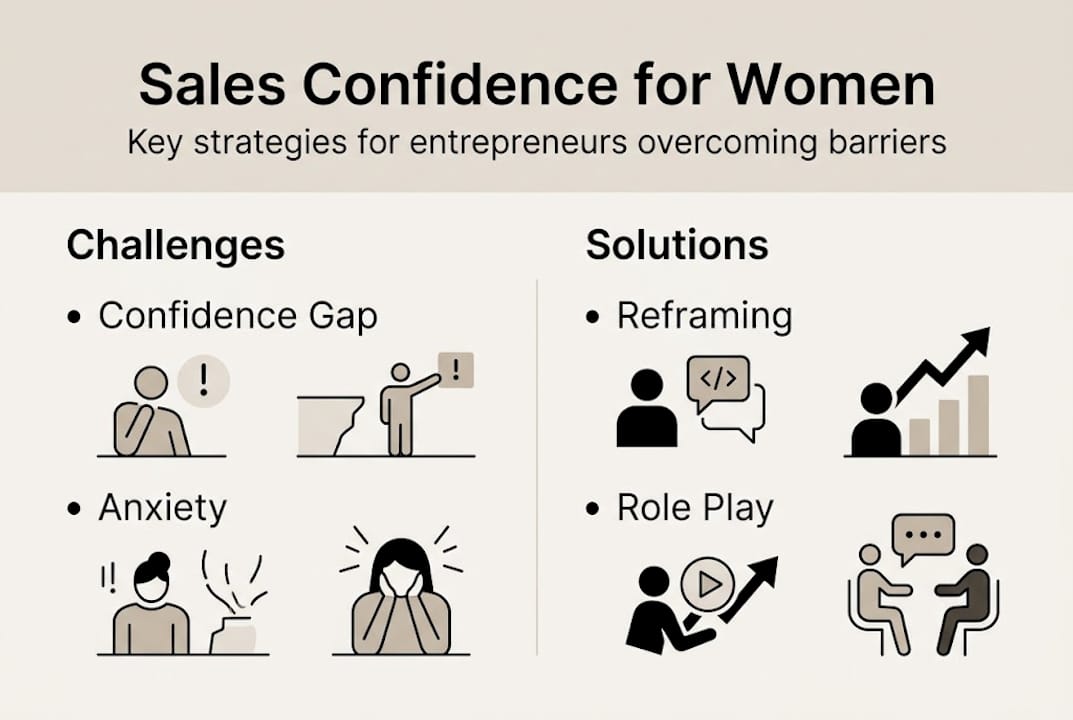
Having established the performance-confidence paradox, let’s unpack the psychological roots of sales anxiety for women entrepreneurs. The barriers are not random. They are deeply wired through years of social conditioning that taught women to be agreeable, modest, and careful not to take up too much space.
Common psychological barriers include fear of rejection, discomfort with self-promotion, and perfectionism. These are not personality flaws. They are learned responses. And they show up at the worst possible moments: right before a discovery call, mid-negotiation, or when it is time to follow up.
Here is what women entrepreneurs most commonly report experiencing in sales situations:
- Fear of being seen as too aggressive or pushy
- Imposter syndrome that dismisses real wins as luck
- Perfectionism that delays action until conditions feel “safe”
- Discomfort with direct self-promotion or stating a price confidently
- Anxiety around follow-up for fear of annoying the prospect
The numbers behind this are striking. 70% of women experience imposter syndrome, and the double bind bias means that when women do show confidence, they risk being perceived as unlikable. When they soften their approach to stay likable, they are seen as unassertive. There is no neutral ground in that trap.
“The confidence gap is not about capability. It is about a nervous system that has been trained to treat visibility as danger.”
This is why authentic self-promotion feels so difficult even for women who are genuinely excellent at what they do. The body reads selling as a social threat. And when the nervous system is in threat mode, the prefrontal cortex, which handles persuasion, creativity, and clear communication, goes offline.
Understanding this is the first step toward overcoming sales anxiety. You are not broken. You are responding to a system that was never designed with you in mind.
What the data reveals: Women’s sales performance and the confidence gap
Understanding the obstacles is only half the story. Let’s see how women are performing in real numbers and where the gaps in confidence remain.
The data is both encouraging and frustrating. Women entrepreneurs are building serious businesses. Women-owned businesses generate $519K average annual revenue in 2024, and they are closing the funding gap faster than most people realize. Yet confidence still lags behind performance in measurable ways.
| Metric | Women entrepreneurs | Men entrepreneurs |
|---|---|---|
| B2B quota attainment | Higher by 3% | Baseline |
| Funding approval rates | Improving year over year | Historically higher |
| Client retention | Consistently strong | Variable |
| Negotiation initiation | Lower frequency | Higher frequency |
| Self-reported confidence | Below actual performance | Closer to actual performance |
Women outperform men in B2B quotas by 3% but struggle with negotiation initiation. That single statistic tells the whole story. Women are winning the game but still hesitate to ask for better terms, raise their prices, or push back on low offers.
A few patterns stand out across the research:
- Women apply for funding at increasing rates and are being approved more often
- Relationship-based selling, a natural strength for many women, drives higher retention and referrals
- Attribution gaps cause women to credit external factors for success instead of their own skill
- The confidence gap leads to fewer negotiations, which directly limits revenue growth
The best practices for B2B sales consistently show that relationship-building and trust are the foundation of long-term revenue. Women are already doing this well. The missing piece is internalizing those wins and letting them fuel bolder action.
The bottom line: Your results are better than your self-assessment. That gap between what you are achieving and what you believe you are capable of is costing you real money.
Evidence-backed strategies to build lasting sales confidence
Now that you see the measurable successes and obstacles, here is how to move from awareness to action with proven confidence-boosting techniques.
Cognitive restructuring, power posing, and storytelling reduce anxiety and build authentic confidence. These are not soft suggestions. They are backed by behavioral science and used by top performers across industries.
Here is a practical sequence to follow:
- Document your internal dialogue before sales conversations. Write down the exact thought, then challenge it with evidence. “I always come across as desperate” becomes “I closed three clients last quarter who specifically mentioned my calm, clear communication.”
- Build a pre-sales ritual. This could be two minutes of confidence-building before high-stakes conversations, a power pose, or reviewing your recent wins. Your nervous system needs a signal that this is safe territory.
- Use storytelling to promote your results. Instead of listing credentials, share a client outcome in narrative form. Stories bypass the “brag filter” and land with far more impact.
- Role-play your pitch and objection responses. Practice out loud, not just in your head. The physical act of speaking the words changes how your body experiences the conversation.
- Track wins and lessons systematically. Not just revenue, but qualitative wins: a tough negotiation you held your ground in, a follow-up that converted, a price you quoted without flinching.
Practical steps like reframing sales as service, clarifying your pitch, role-playing, tracking wins, and building systematic follow-up create compounding confidence over time.

| Strategy | Short-term impact | Long-term impact |
|---|---|---|
| Cognitive restructuring | Reduces pre-call anxiety | Rewires default thought patterns |
| Storytelling | Increases relatability | Builds brand authority |
| Win tracking | Boosts immediate confidence | Creates evidence-based self-belief |
| Role-play | Reduces verbal stumbling | Builds automatic fluency |
Pro Tip: Pair your win tracker with your revenue data. When you can see that your boldest sales conversations produced your best results, the nervous system starts to update its threat assessment.
For sustainable sales growth, these strategies work best when they become habits, not one-time fixes. And building client trust strategies into your process ensures that confidence translates directly into revenue.
Transforming mindset: From anxiety to authentic sales leadership
Proven tactics work best when layered on a foundation of a well-regulated mindset. Here is how to turn strategies into lasting transformation.
The nervous system is not a metaphor. It is the actual mechanism behind why you freeze on a sales call, undersell your offer, or avoid following up. Nervous system regulation and identity rewiring are essential for sustainable sales and wealth-building. Unregulated states cause self-sabotage, not laziness or lack of strategy.
Here is what regulation actually looks like in a sales context:
- Recognizing your personal dysregulation signals (rushing, over-explaining, sudden urge to discount)
- Using breath-based resets before and during high-stakes conversations
- Practicing somatic grounding to stay present when a prospect pushes back
- Separating your identity from the outcome of any single sale
Identity rewiring goes deeper than mindset. It is about changing what you believe is true about yourself as a seller. When you see yourself as someone who serves rather than someone who convinces, the entire energy of a sales conversation shifts.
“The shift from ‘I need to prove my value’ to ‘I am here to help you decide if this is right for you’ is not just a mindset trick. It is a nervous system reset.”
The VISIBLE framework bridges the confidence gap into actionable leadership by focusing on Voice, Influence, and consistent, visible presence. It is a structured way to build authority without performing a version of confidence that does not feel like you.
Pro Tip: When you notice yourself shrinking in a sales conversation, ask: “What would I say if I already knew this client needed exactly what I offer?” That question bypasses the fear response and accesses your actual expertise.
Building self-sufficiency in business means your confidence cannot depend on external validation. A strong follow-up system also removes the emotional weight from each individual interaction, making the whole process feel lighter and more sustainable.
A new lens: Why sales confidence for women is a business growth multiplier
Here is the part most articles skip: the confidence gap is not just a personal problem. It is an economic one. Every time a talented woman entrepreneur undercharges, avoids a negotiation, or talks herself out of a high-value opportunity, the ripple effect is real. Lost revenue, lost innovation, lost representation in rooms where decisions get made.
Confidence is not a personality trait you either have or do not have. It is a practice. And for women entrepreneurs, it is also a multiplier. When you show up fully in a sales conversation, you do not just close a deal. You model what is possible for every woman watching you lead.
The data already shows women are performing. The gap is in how much of that performance gets claimed, leveraged, and compounded. Closing that gap is not about becoming someone else. It is about letting your actual results inform your self-perception.
Visible, confident women leaders shift funding patterns, change buyer expectations, and expand what the market believes women-led businesses can deliver. That is not small. Explore more on the Freedom Sun blog to keep building on this foundation.
Get expert guidance for your next sales leap
You already have the capability. What accelerates growth is having the right support structure around you: training that speaks to the real barriers, a community of women who get it, and resources built for where you actually are in business, not where you started.
At Freedom Sun, we work with women entrepreneurs who are already generating revenue and ready to stop leaving money on the table. Through the Women’s Wealth Collective academy, the Nervous System of Money podcast, and live events, we bridge the gap between financial strategy and the psychology underneath it. If you are ready to sell with more authority and build wealth that lasts, this is where that work happens.
Frequently asked questions
Why do so many women entrepreneurs struggle with sales confidence?
Psychological barriers rooted in fear of rejection, discomfort with self-promotion, and perfectionism combine with societal conditioning and imposter syndrome to create persistent confidence gaps even in high-performing women.
What are the most effective practices to boost sales confidence for women?
Power posing, storytelling, and pre-sales rituals are evidence-based methods that reduce anxiety and build real confidence quickly, especially when combined with systematic win tracking.
Are women entrepreneurs really outperforming men in sales metrics?
Yes. Women surpass men in quota attainment and funding rates while also leading in client retention, despite consistently reporting lower confidence than their results justify.
How does nervous system regulation impact sales outcomes for women?
A regulated nervous system keeps the brain’s decision-making and communication centers online. Dysregulation leads to self-sabotage in sales, including over-explaining, discounting, and avoiding follow-up.