System Health for Entrepreneurs – Building Profitable Peace

Most American startups fail not because of flawed products, but due to fractured organizational systems and burnout among founders. For technology entrepreneurs leading high-growth companies, the health of your systems is the true measure of resilience and innovation. Recognizing that over 65 percent of founders cite operational stress as their biggest challenge, this guide sheds light on holistic system health strategies that drive sustainable success and empower strategic leadership.
Table of Contents
- Defining System Health For Entrepreneurs
- Three Pillars: Math, Mechanics, And Mind
- How System Health Drives Sustainable Growth
- Common Pitfalls Undermining System Health
- Steps To Assess And Strengthen Your System
Key Takeaways
| Point | Details |
|---|---|
| System Health Definition | System health refers to the overall operational capacity of an organization, emphasizing internal dynamics over just financial outcomes. |
| Three Pillars Framework | The interconnected approach of Math, Mechanics, and Mind optimizes financial intelligence, operational efficiency, and leadership for sustainable growth. |
| Impact of System Health on Growth | A focus on system health fosters continuous learning and adaptability, which are essential for navigating complex business environments. |
| Common Pitfalls | Organizational fragmentation and a short-term mindset can undermine system health, leading to inefficiencies and missed growth opportunities. |
Defining System Health for Entrepreneurs
Entrepreneurial system health represents the holistic ecosystem of an organization’s operational capacity, tracking how effectively various components interact, adapt, and sustain performance. Unlike traditional business metrics that focus solely on financial outcomes, system health encompasses a comprehensive assessment of an organization’s internal dynamics, resilience, and potential for sustained growth.
At its core, system health integrates multiple dimensions of organizational functionality. Entrepreneurial ecosystem research suggests examining interconnectedness, resource exchange patterns, and adaptive capabilities as critical indicators. This means evaluating not just profitability, but understanding how financial resources, human capital, technological infrastructure, and strategic processes work together to create a robust organizational environment.
The framework for system health extends beyond traditional performance indicators. Drawing from public health entrepreneurship models, it recognizes that organizations are complex, living systems requiring continuous monitoring and strategic intervention. Key components include financial resilience, operational flexibility, team dynamics, technological integration, and leadership effectiveness. Entrepreneurs must develop a nuanced approach that balances quantitative metrics with qualitative assessments of organizational culture, innovation potential, and systemic adaptability.
Pro tip: Conduct a quarterly system health audit by mapping your organization’s key interactions, resource flows, and adaptation mechanisms to identify potential bottlenecks and opportunities for optimization.
Here’s a comparison of the core elements within a system health audit:
| Element | What It Evaluates | Business Impact |
|---|---|---|
| Resource Interactions | Flow between departments | Reduces silos and increases agility |
| Adaptation Mechanisms | Response to market or internal shifts | Boosts resilience to disruptions |
| Resource Allocation | Distribution of assets and funding | Optimizes cost and growth balance |
| Communication Channels | Quality of information flow | Prevents bottlenecks and confusion |
Three Pillars: Math, Mechanics, and Mind
The Three Pillars framework represents a comprehensive approach to entrepreneurial system design, integrating financial intelligence, operational infrastructure, and leadership mindset into a holistic strategy for sustainable business growth. This model transcends traditional business management by creating an interconnected ecosystem that addresses the complex challenges modern entrepreneurs face.
Math represents the financial intelligence pillar, focusing on quantitative analysis, strategic financial planning, and data driven decision making. Entrepreneurship education models emphasize the critical role of theoretical knowledge in developing robust financial frameworks. This pillar involves deep understanding of financial metrics, cash flow management, revenue modeling, and predictive financial analysis that enables entrepreneurs to make strategic resource allocation decisions.
The Mechanics pillar addresses the operational infrastructure and systems design that transform financial strategies into executable actions. This component involves creating scalable processes, technological integration, workflow optimization, and building adaptive organizational structures. Drawing from sustainable organizational design principles, this pillar ensures that entrepreneurs can translate strategic vision into practical, efficient operational mechanisms.
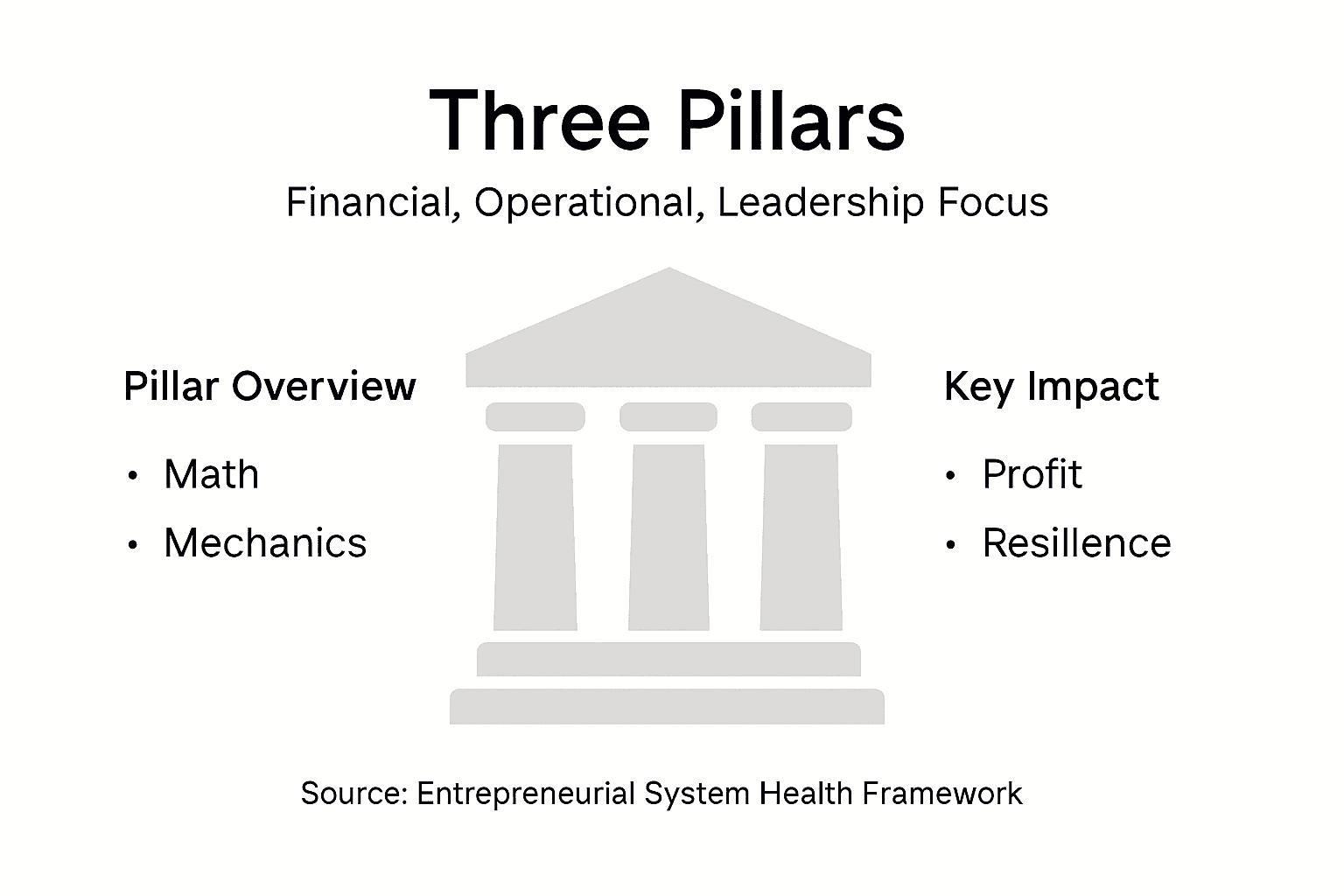
Finally, the Mind pillar encompasses leadership psychology, emotional intelligence, cognitive flexibility, and personal resilience. This dimension recognizes that entrepreneurial success depends not just on financial acumen or operational efficiency, but on the founder’s ability to navigate complexity, manage stress, and maintain strategic focus amid uncertainty. The Mind pillar develops cognitive tools for decision making, emotional regulation, and maintaining a growth oriented mindset.
Pro tip: Conduct a monthly self assessment across these three pillars, rating your performance in financial intelligence, operational efficiency, and leadership mindset to identify areas for targeted personal and organizational development.
This table summarizes the Three Pillars framework for entrepreneurial system design:
| Pillar | Core Focus | Typical Outcome |
|---|---|---|
| Math | Financial intelligence | Better investment decisions |
| Mechanics | Operational infrastructure | Streamlined, scalable processes |
| Mind | Leadership mindset | Improved adaptability and resilience |
How System Health Drives Sustainable Growth
Sustainable growth is not merely about financial metrics, but about creating robust, adaptive organizational ecosystems that can evolve and thrive in complex business environments. Systems change entrepreneurship represents a transformative approach that goes beyond traditional growth models by addressing fundamental structural challenges and creating long-term value.
At its core, system health drives sustainable growth by establishing interconnected mechanisms that enable continuous organizational learning, resilience, and strategic adaptability. This involves developing dynamic capabilities that allow businesses to anticipate market shifts, respond to emerging challenges, and proactively redesign internal processes. By integrating financial intelligence, operational efficiency, and leadership mindset, entrepreneurs can create self-sustaining systems that generate consistent value without exhausting human or financial resources.

The sustainable entrepreneurship framework emphasizes holistic value creation that balances economic performance with social and environmental considerations. Entrepreneurs who prioritize system health understand that true growth transcends quarterly profits and involves building organizational infrastructures that can generate sustained impact. This means developing ethical governance structures, fostering stakeholder engagement, and creating innovative solutions that address broader societal challenges while maintaining financial viability.
Pro tip: Develop a quarterly system health dashboard that tracks not just financial metrics, but also organizational adaptability, stakeholder relationships, and innovation potential to maintain a comprehensive view of your business ecosystem.
Common Pitfalls Undermining System Health
Entrepreneurs often encounter systemic challenges that can critically undermine their organization’s health and potential for sustainable growth. Public health entrepreneurship research reveals that many system failures stem from fundamental misalignments in organizational design, resource allocation, and strategic thinking.
One primary pitfall is the fragmentation of organizational processes, where different departments operate in silos, preventing effective communication and collaborative problem solving. This disconnection leads to inefficient resource utilization, missed opportunities, and strategic blind spots. Entrepreneurs frequently struggle with creating integrated systems that enable seamless information flow, adaptive decision making, and holistic performance management. Without a unified approach, organizations become vulnerable to internal friction, redundant efforts, and diminished operational responsiveness.
Another critical vulnerability is the short-term mindset that prioritizes immediate financial gains over long-term system resilience. Many entrepreneurs fall into the trap of pursuing quick wins at the expense of building sustainable infrastructure. This approach typically manifests through underinvestment in human capital development, minimal attention to organizational learning mechanisms, and reactive rather than proactive management strategies. Such myopic perspectives prevent businesses from developing the adaptive capabilities necessary to navigate complex, rapidly changing business environments.
Pro tip: Conduct a quarterly system health audit that maps interdepartmental interactions, identifies communication bottlenecks, and evaluates the alignment between short-term tactics and long-term strategic objectives.
Steps to Assess and Strengthen Your System
Assessing and strengthening organizational systems requires a strategic, comprehensive approach that goes beyond surface-level analysis. Health information system assessment frameworks provide critical insights into understanding the intricate dynamics of organizational infrastructure, emphasizing the need for holistic evaluation and targeted intervention strategies.
The first step involves conducting a comprehensive system diagnostic. This means mapping out all organizational processes, identifying interdependencies, and evaluating the efficiency of each component. Entrepreneurs should create detailed flow charts that illustrate how different departments interact, how information moves through the organization, and where potential bottlenecks or inefficiencies exist. This diagnostic phase requires an honest, critical assessment that looks beyond surface metrics to understand the underlying structural challenges that may be hampering organizational performance.
The second critical phase focuses on strategic capacity building. This involves developing targeted interventions based on the diagnostic findings. Entrepreneurs must invest in developing robust communication channels, implementing adaptive technology solutions, and creating learning mechanisms that enable continuous organizational improvement. The goal is not just to fix immediate problems, but to build a self-evolving system that can proactively identify and address emerging challenges. This requires developing human capital, creating flexible governance structures, and establishing metrics that measure both quantitative performance and qualitative organizational health.
Pro tip: Create a quarterly system health scorecard that tracks key performance indicators across financial, operational, and cultural dimensions, allowing for continuous monitoring and strategic recalibration.
Empower Your Entrepreneurial System Health with Freedom Sun
The article highlights the critical challenge entrepreneurial founders face: maintaining a balanced system health that integrates financial intelligence, operational mechanics, and leadership mindset to avoid fragmentation and burnout. If you are struggling with siloed departments, short-term thinking, or unclear resource flows, you are not alone. These pain points directly impact your ability to build a resilient, adaptive business that thrives sustainably.
At Freedom Sun, we specialize in transforming these challenges into opportunities for profitable peace. Our unique Operating System framework focuses on the three pillars outlined in the article: Math for financial clarity, Mechanics for systems infrastructure, and Mind for leadership resilience. Through interactive training, diagnostic assessments, and a supportive community, we equip entrepreneurs to reclaim control over their internal systems without sacrificing wellbeing or burning out.
Ready to break free from the cycle of short-term fixes and operational chaos? Visit Freedom Sun now and discover how to align your entrepreneurial system health with sustainable, scalable growth. Take the first step toward mastering your business ecosystem and achieving the profitable peace you deserve.
Frequently Asked Questions
What is system health for entrepreneurs?
System health for entrepreneurs refers to the comprehensive assessment of an organization’s operational capacity and internal dynamics, focusing on how effectively various components interact, adapt, and sustain performance beyond just financial outcomes.
How can I assess the system health of my organization?
You can assess system health by conducting a comprehensive system diagnostic, mapping out all processes, understanding interdependencies, and evaluating the efficiency of components. This involves creating flow charts that illustrate interactions and identifying potential bottlenecks.
What are the Three Pillars of entrepreneurial system design?
The Three Pillars framework consists of Math (financial intelligence), Mechanics (operational infrastructure), and Mind (leadership mindset). Each pillar focuses on crucial aspects needed for sustainable business growth and interconnected organizational ecosystems.
What common pitfalls should I avoid to maintain system health?
Common pitfalls include the fragmentation of organizational processes, resulting in silos that hinder communication, and a short-term mindset that prioritizes immediate financial gains over long-term resilience. Avoiding these can help maintain system health and encourage sustainable growth.
Recommended
- Welcome to Freedom Sun
- Financial Wellness: Equipping Leaders for Sustainable Growth
- Financial Resilience: Why It Matters for Entrepreneurs
- AI Business Blog
- The Symbiosis of Innovation and Investment: Navigating the Strategic Continuum of Product Development - Stratgetic IT Consultants for Accountants