CRM for Consulting Companies: Building Client Trust and Growth

Struggling to keep track of client conversations and project details can quickly overwhelm even the most passionate consultant or coach. Consistent, personalized client management is not just a goal, it is a necessity for anyone serious about building lasting trust and sustainable results. By adopting a modern CRM system, you can centralize your interactions, simplify your operations, and uncover insights that reveal exactly what your clients need next.
Table of Contents
- CRM For Consulting Firms Explained
- Types Of CRM Systems For Consultants
- Core Features Consultants Should Prioritize
- Integrating CRM With Consulting Workflows
- Common CRM Mistakes Consulting Firms Make
Key Takeaways
| Point | Details |
|---|---|
| CRM as a Strategic Tool | CRM systems for consulting firms go beyond contact management, centralizing client interactions and insights for better engagement. |
| Integration is Key | Successful CRM implementation requires aligning digital tools with existing workflows, emphasizing collaboration and data integration. |
| Customize for Success | Tailored CRM features, such as reporting and automation capabilities, enhance productivity and decision-making in consulting practices. |
| Avoid Common Pitfalls | Firms should address cultural and strategic challenges, ensuring user training and data management to maximize CRM effectiveness. |
CRM for Consulting Firms Explained
Customer relationship management (CRM) has become a strategic cornerstone for consulting firms seeking sustainable growth and client trust. Modern CRM systems represent far more than simple contact databases - they are intelligent platforms designed to transform client interactions and streamline business processes.
At its core, a CRM for consulting firms serves three critical functions:
- Centralize client communication and interaction history
- Track project progress and deliverables
- Generate actionable insights from client data
The integration of advanced digital technologies has fundamentally reshaped CRM capabilities. Transformative digital technologies now enable consulting firms to deliver personalized client experiences through sophisticated data analytics and machine learning algorithms.
Consulting firms benefit from CRM systems that offer robust features like:
- Real-time collaboration tools
- Automated reporting and forecasting
- Customizable dashboard views
- Seamless communication tracking
- Integrated project management functionality
Successful CRM implementation requires more than just technology - it demands a holistic approach integrating people, processes, and digital tools. Firms must invest in training, establish clear data management protocols, and create a culture of client-centric communication.

Pro tip: Start by mapping your current client interaction processes before selecting a CRM system to ensure maximum alignment with your firm’s unique workflow.
Types of CRM Systems for Consultants
Consulting firms have diverse CRM requirements that demand specialized technological solutions tailored to their unique business models. CRM systems for consultants range from comprehensive platforms to niche tools designed for specific operational needs.
The primary categories of CRM systems for consulting professionals include:
- All-in-One CRM Platforms: Integrated systems combining sales pipeline management, project tracking, and client communication
- Sales-Focused CRM Tools: Specialized solutions targeting complex or streamlined sales processes
- Work Management CRM: Platforms emphasizing project delivery and collaboration
- Industry-Specific CRM Systems: Tailored solutions for particular consulting verticals
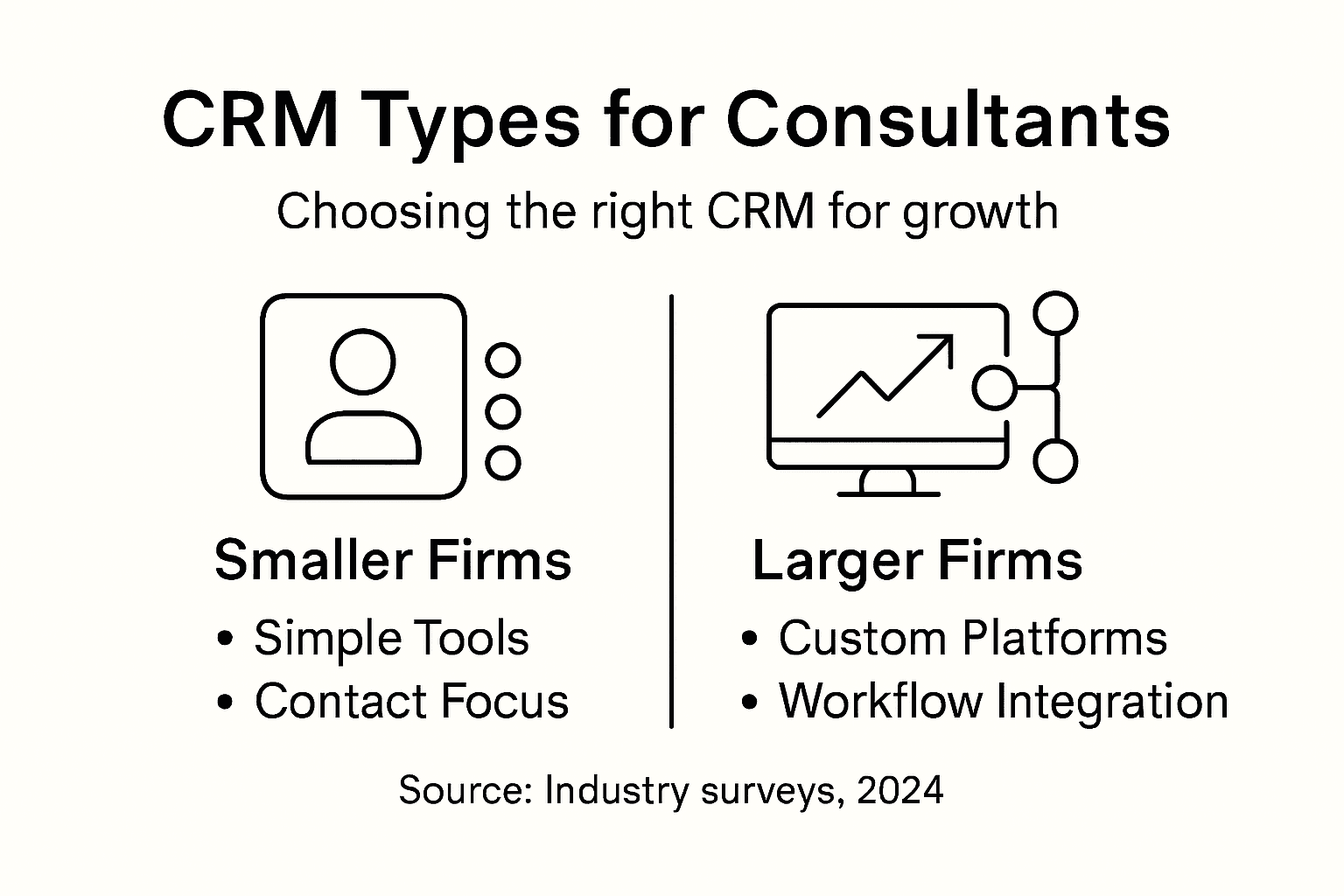
Small consulting practices and large enterprises have distinctly different CRM requirements. Solo practitioners might prioritize lightweight, cost-effective solutions, while multinational firms need scalable systems capable of managing complex client interactions across multiple teams and geographies.
Here’s a quick comparison of CRM types and their best-fit consulting scenarios:
| CRM Type | Best For | Example Focus |
|---|---|---|
| All-in-One Platform | Large, multi-team consultancies | End-to-end client management |
| Sales-Focused Tool | Firms prioritizing business development | Pipeline tracking |
| Work Management CRM | Project-delivery-centered teams | Task and milestone tracking |
| Industry-Specific CRM | Niche or highly regulated consultancies | Specialized compliance tools |
When evaluating CRM systems, consulting firms should consider critical features such as:
- Customizable dashboards
- Advanced reporting capabilities
- Seamless integration with existing tools
- Automated workflow management
- Client communication tracking
- Pipeline and opportunity management
Scalability remains a crucial factor in CRM selection. The ideal system should grow alongside the consulting firm, adapting to changing business dynamics and expanding client portfolios.
Successful CRM implementation is less about technology and more about aligning digital tools with your firm’s unique workflow and client engagement strategies.
Pro tip: Conduct a comprehensive workflow audit before selecting a CRM system to ensure it matches your specific consulting business processes and communication needs.
Core Features Consultants Should Prioritize
Choosing the right CRM demands a strategic approach to feature selection that aligns with a consulting firm’s unique operational needs. CRM features for consulting firms must go beyond basic contact management to support complex client relationship dynamics.
The most critical CRM features for consultants include:
- Centralized Client Data Management: Comprehensive client history and interaction tracking
- Advanced Pipeline Tracking: Visual representations of sales opportunities and project stages
- Automation Capabilities: Intelligent follow-up reminders and task management
- Customizable Reporting Tools: Detailed insights into client interactions and business performance
- Communication Integration: Seamless synchronization with email and messaging platforms
Consulting professionals require CRM systems that offer robust functionality across multiple dimensions. The ideal platform should reduce administrative overhead while providing deep insights into client behavior, project timelines, and potential revenue opportunities.
Key performance indicators consultants should evaluate in a CRM system include:
Key CRM features mapped to their business impact for consulting firms:
| Feature | What It Delivers | Impact on Consulting Firms |
|---|---|---|
| Centralized Client Data | Single client record access | Improved collaboration |
| Advanced Pipeline Tracking | Visual sales and project stages | More accurate forecasting |
| Automation Capabilities | Auto follow-ups and reminders | Higher productivity |
| Custom Reporting Tools | Tailored business insights | Informed business decisions |
| Communication Integration | Syncs with email/messaging | Consistent client engagement |
- Speed of data entry and retrieval
- Ease of cross-team collaboration
- Flexibility in customizing workflows
- Depth of analytical reporting
- Integration capabilities with existing tools
- Mobile accessibility for on-the-go professionals
Effective CRM implementation transforms data into strategic intelligence, turning client interactions into meaningful business opportunities.
Pro tip: Prioritize CRM systems that offer flexible customization and robust integration capabilities to ensure long-term adaptability for your consulting practice.
Integrating CRM With Consulting Workflows
Successful CRM integration demands more than technological implementation - it requires a strategic alignment between digital tools and unique consulting business processes. CRM integration in consulting workflows transforms disconnected systems into powerful, synchronized business intelligence platforms.
The integration process involves several critical components:
- Workflow Mapping: Identifying key touchpoints across sales and project delivery
- Data Synchronization: Ensuring seamless information flow between platforms
- Automation Triggers: Creating intelligent connections between different business functions
- Reporting Alignment: Configuring dashboards to reflect consulting firm’s specific metrics
- Stakeholder Communication Channels: Integrating communication tools with CRM platform
Consulting firms must approach CRM integration as a holistic transformation rather than a simple software implementation. This means carefully analyzing existing workflows, understanding team communication patterns, and designing an ecosystem that enhances rather than disrupts current operational rhythms.
Key strategies for effective CRM workflow integration include:
- Conducting comprehensive team workflow assessments
- Selecting flexible, customizable CRM platforms
- Implementing phased integration approaches
- Providing extensive user training and support
- Establishing clear data governance protocols
- Creating feedback mechanisms for continuous improvement
CRM integration is not about replacing human interaction, but amplifying a consulting team’s ability to deliver exceptional client experiences.
Pro tip: Involve team members from multiple departments during CRM integration planning to ensure the system meets diverse operational needs and gains widespread adoption.
Common CRM Mistakes Consulting Firms Make
Navigating CRM implementation requires strategic awareness and proactive planning. CRM adoption challenges for consultants often stem from fundamental misunderstandings about technology integration and organizational change management.
The most critical CRM mistakes consulting firms consistently make include:
- Inadequate Strategy Definition: Implementing CRM without clear business objectives
- Poor Data Management: Neglecting data quality and consistent input protocols
- Insufficient User Training: Failing to prepare team members for system adoption
- Overcomplicated System Selection: Choosing complex platforms misaligned with actual needs
- Lack of Cross-Team Integration: Creating siloed information repositories
Consulting firms frequently underestimate the cultural transformation required for successful CRM adoption. Technology alone cannot solve communication and workflow challenges - it requires a comprehensive approach that addresses people, processes, and systems simultaneously.
Specific pitfalls that derail CRM effectiveness include:
- Treating CRM as a standalone technological solution
- Ignoring user feedback and resistance
- Failing to customize system to specific consulting workflows
- Overlooking data privacy and security considerations
- Inconsistent maintenance and system updates
- Neglecting continuous performance monitoring
Successful CRM implementation is more about organizational adaptation than technological implementation.
Pro tip: Conduct a comprehensive internal audit of existing workflows and communication patterns before selecting and implementing any CRM system.
Unlock Sustainable Growth by Mastering CRM Strategies for Consulting Firms
Struggling with centralized client data and seamless workflow integration can hold your consulting business back from reaching its full potential. This article highlights the critical need for customizable CRM features like advanced pipeline tracking and automation capabilities to boost client trust and operational efficiency. If you want to avoid common CRM pitfalls such as poor data management and inadequate user training, adopting a strategic approach is essential.
At Freedom Sun, we empower coaches, consultants, and service-based entrepreneurs with comprehensive training that goes beyond technology. Our method focuses on strategic implementation and mental resilience to help you create profitable peace while scaling leadership success. Discover how to shift from hustle culture to automated, system-driven growth that enhances client relationships and streamlines your consulting workflows. Ready to take control of your business systems and build trust that leads to lasting growth Explore our interactive training programs and join a community committed to sustainable success.
Frequently Asked Questions
What are the key functions of a CRM for consulting firms?
A CRM for consulting firms centralizes client communication, tracks project progress, and generates actionable insights from client data.
What types of CRM systems are best suited for consulting companies?
Consulting companies can benefit from all-in-one CRM platforms, sales-focused tools, work management CRMs, and industry-specific systems, depending on their unique needs.
What core features should consulting firms prioritize in a CRM system?
Consulting firms should prioritize centralized client data management, advanced pipeline tracking, automation capabilities, customizable reporting tools, and communication integration.
What common mistakes do consulting firms make when implementing a CRM?
Common mistakes include inadequate strategy definition, poor data management, insufficient user training, overcomplicated system selection, and lack of cross-team integration.
Recommended
- Sustainable Business Scaling Guide for Lasting Success
- 7 Proven Wealth-Building Strategies for Founders
- Profitability Optimization Guide for Lasting Business Growth
- Operating System Setup for Founders: Achieve Scalable Success
- PSCG Earns Better Business Bureau Accreditation with A+ Rating | The Public Safety Consulting Group
- Employee Retention Solutions | Reduce Turnover | OpenElevator