Why Optimize Business Systems for Peaceful Growth

Most high-growth tech founders underestimate how quickly an outdated business system can drain profits and energy. With over 80 percent of american organizations reporting operational disruptions from inefficient processes, optimizing financial and sales systems is no longer optional. This article cuts through complexity to highlight core optimization principles that help leaders achieve real stability, sharper decision making, and sustainable growth without risking burnout.
Table of Contents
Key Takeaways
PointDetailsOptimize Business SystemsLeverage mathematical modeling to transform complex challenges into structured, solvable problems, enhancing performance across various domains.Prevent BurnoutImplement systematic work design strategies that create manageable workloads, psychological safety, and clear purpose to mitigate burnout risks.Address Systemic RisksRegular audits of technology and systems are essential to identify vulnerabilities, improve agility, and maintain compliance in an ever-evolving landscape.Shift to Strategic ManagementTransition from hustle culture to a focus on intelligent resource allocation and outcome-based metrics to promote sustainable growth and well-being.
Business Systems Optimization: Core Principles
Business systems optimization represents a strategic approach to enhancing organizational performance through mathematical modeling and decision-making techniques. At its core, this methodology transforms complex business challenges into structured, solvable problems by leveraging mathematical programming methods that identify optimal solutions across finance, operations, and marketing domains.
The fundamental principles of business systems optimization revolve around three critical components: objective definition, constraint identification, and mathematical modeling. Companies can systematically break down intricate business processes into quantifiable variables, allowing them to design computational models that reveal the most efficient pathways to achieve strategic goals. By utilizing techniques like linear programming, nonlinear optimization, and network analysis, organizations can make data-driven decisions that minimize resource expenditure and maximize operational effectiveness.
Practical implementation of business systems optimization requires a strategic framework that integrates computational tools with organizational insights. This involves developing mathematical models that accurately represent business constraints, selecting appropriate optimization algorithms, and interpreting results through sensitivity analysis. Advanced optimization techniques enable businesses to simulate multiple scenarios, test potential strategies, and uncover hidden opportunities for improvement across different functional areas.
Pro tip: Start by mapping your current business processes visually before attempting complex mathematical modeling, as this will help you identify potential optimization points more effectively.
Types of Optimization: MATH, MECHANICS, MIND
Optimization strategies within business systems can be comprehensively understood through three fundamental pillars: MATH (financial clarity), MECHANICS (sales infrastructure), and MIND (leadership resilience). These interconnected domains represent a holistic approach to systematic business enhancement, addressing different optimization models that transform organizational performance.
The MATH pillar focuses on quantitative optimization, leveraging mathematical modeling techniques to analyze financial systems. This approach involves continuous and discrete optimization methods, enabling businesses to develop precise financial models that identify resource allocation strategies, predict cash flow dynamics, and minimize operational expenses. By applying linear programming, integer optimization, and probabilistic forecasting, companies can create robust financial frameworks that support strategic decision making.
The MECHANICS pillar centers on sales infrastructure optimization, translating mathematical principles into practical sales ecosystem design. This involves creating systematic processes that streamline lead generation, conversion tracking, customer relationship management, and revenue predictability. By implementing data-driven sales mechanisms, businesses can develop repeatable, scalable models that transform sales from unpredictable art to systematic science. The goal is constructing sales systems that operate with mathematical precision, reducing human variability and increasing organizational reliability.
The MIND pillar addresses leadership optimization, recognizing that human capital represents the most complex and nuanced optimization challenge. This dimension focuses on developing mental resilience, strategic thinking frameworks, and leadership decision-making models that integrate emotional intelligence with analytical capabilities. By treating leadership development as an optimization problem, organizations can design training, communication, and personal development strategies that enhance individual and collective performance.
Pro tip: Create a visual optimization dashboard that tracks key performance indicators across MATH, MECHANICS, and MIND domains to maintain a comprehensive view of your business system’s health and potential improvement areas.
Here’s how the three pillars of business optimization compare in terms of focus and outcomes:
PillarPrimary FocusTechniques UsedBusiness OutcomesMATHFinancial system optimizationMathematical modeling, forecastingCost control, cash flow predictabilityMECHANICSSales process designData-driven sales mechanismsStreamlined lead conversion, reliable salesMINDLeadership resilienceStrategic thinking frameworksEnhanced decision making, improved well-being
How Optimized Systems Prevent Burnout
Burnout represents a critical challenge for modern organizations, emerging from systemic inefficiencies and unsustainable work practices. Systematic work design strategies offer a transformative approach to addressing this pervasive issue by fundamentally restructuring how work is conceived, managed, and executed.

The prevention of burnout requires a multifaceted approach that goes beyond traditional stress management techniques. Human-centred process management provides a sophisticated framework for understanding and mitigating workplace exhaustion. This approach recognizes that burnout is not an individual failure but a systemic problem rooted in organizational design. By implementing optimized systems that distribute workload intelligently, create meaningful task structures, and provide clear performance expectations, businesses can dramatically reduce the psychological and physiological strain on employees.
Optimized systems prevent burnout by addressing three critical dimensions: workload manageability, psychological safety, and purpose alignment. This means redesigning workflows to create predictable work rhythms, establishing clear communication channels that reduce uncertainty, and connecting individual tasks to broader organizational objectives. The goal is to transform work from a source of chronic stress into a platform for professional growth and personal fulfillment. By integrating technological solutions, adaptive management practices, and empathetic leadership models, organizations can create resilient work environments that naturally counteract burnout.
Pro tip: Conduct quarterly system audits that map employee energy levels against task complexity to proactively identify and redesign potential burnout trigger points.
Financial and Operational Impacts Explained
Business system optimization represents a strategic approach to transforming financial performance and operational efficiency. Cloud-based ERP systems significantly enhance organizational capabilities by providing comprehensive frameworks that integrate financial reporting, resource allocation, and decision-making processes into a unified, intelligent infrastructure.
The financial impacts of optimized systems extend beyond traditional accounting metrics. These advanced frameworks enable businesses to achieve granular cost control, predictive financial modeling, and real-time performance tracking. By automating complex financial processes, organizations can dramatically reduce administrative overhead, minimize human error, and generate more accurate financial insights. The result is a more agile financial management approach that supports strategic decision-making and enables proactive resource optimization.
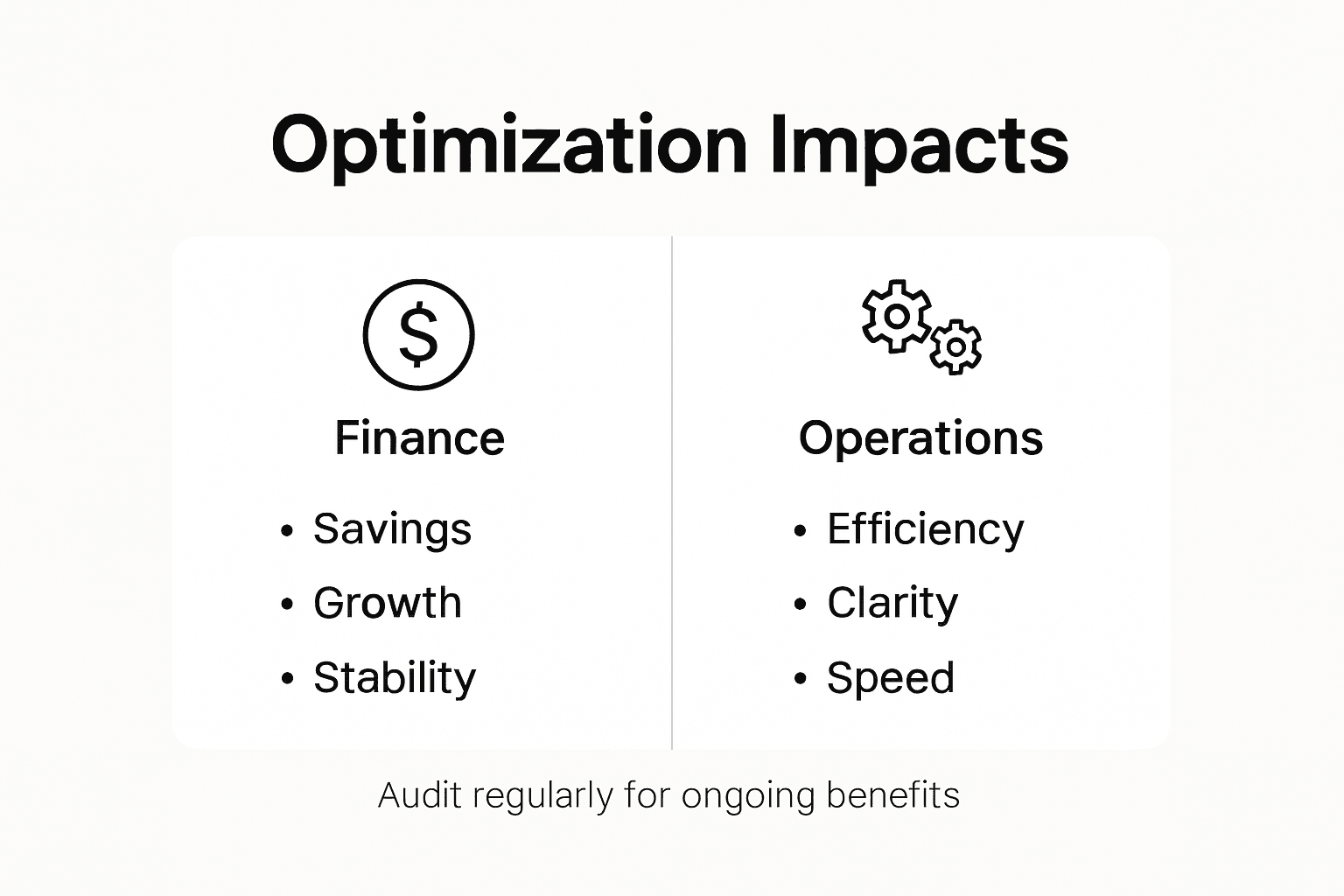
Operational transformation occurs through systematic redesign of workflow structures, communication protocols, and technology integration. Optimized systems create interconnected ecosystems where data flows seamlessly across departments, eliminating information silos and enabling more responsive organizational dynamics. This holistic approach ensures that financial strategies are not isolated functions but integrated components of broader business performance, allowing leadership to make more informed, data-driven decisions that align economic resources with strategic objectives.
Pro tip: Implement quarterly cross-departmental system audits to identify and eliminate inefficiencies in your current operational and financial workflows.
Risks of Outdated or Inefficient Systems
Business systems deteriorate silently, creating substantial organizational vulnerabilities that can compromise entire operational infrastructures. Outdated technological systems pose significant strategic risks that extend far beyond simple technological limitations, threatening fundamental business sustainability and competitive positioning.
The cybersecurity landscape represents one of the most critical risk dimensions for organizations maintaining legacy systems. Obsolete technological infrastructure creates multiple potential entry points for malicious actors, leaving businesses exposed to data breaches, intellectual property theft, and regulatory compliance violations. These vulnerabilities can emerge from unpatched software, deprecated security protocols, and disconnected communication channels that prevent comprehensive threat monitoring and rapid response mechanisms.
Operational inefficiencies compound the risks associated with outdated systems, creating cascading performance challenges across organizational domains. Slow workflows, manual data processing, and fragmented information systems generate significant productivity losses, increased administrative overhead, and reduced decision-making agility. When technological infrastructure cannot seamlessly integrate emerging market demands, businesses become increasingly rigid, losing their ability to adapt quickly to changing competitive landscapes and customer expectations.
Pro tip: Conduct a comprehensive annual technology audit that assesses system vulnerabilities, performance metrics, and alignment with current business strategy to proactively identify and mitigate potential systemic risks.
Below is a summary of risks associated with outdated systems compared to benefits delivered by optimized systems:
AspectOutdated Systems RisksOptimized Systems BenefitsCybersecurityVulnerabilities, data breach riskContinuous monitoring, secured dataOperational SpeedManual processing, slow workflowsAutomated tasks, faster responsesDecision QualityFragmented information, poor agilityUnified data, informed decisionsAdaptabilityRigid structure, slow changeFlexible, market-responsive
Transitioning From Hustle Culture to Strategic Management
Hustle culture represents an outdated paradigm of business performance that prioritizes constant activity over strategic effectiveness. Transitioning toward strategic management involves fundamentally redefining success metrics by moving beyond relentless busyness and embracing more sustainable, intentional work practices that generate meaningful organizational outcomes.
Proactive organizational transformation requires structured approaches that challenge traditional reactive management models. Strategic management frameworks emphasize context-sensitive decision making, stakeholder engagement, and adaptive governance. This approach shifts focus from glorifying constant motion to creating systematic processes that amplify organizational capabilities, reduce operational friction, and promote long-term sustainable growth.
The fundamental shift from hustle culture to strategic management demands a holistic reimagining of work infrastructure. This transformation involves developing robust systems that prioritize intelligent resource allocation, precise goal setting, and continuous performance optimization. By implementing strategic management principles, organizations can create environments that balance ambition with well-being, enabling team members to achieve higher productivity without experiencing chronic stress and potential burnout.
Pro tip: Implement a quarterly strategic review process that evaluates individual and organizational performance against predefined outcome-based metrics, not hours worked or tasks completed.
Achieve Peaceful Growth by Optimizing Your Business Systems
The challenge explored in “Why Optimize Business Systems for Peaceful Growth” highlights common pain points like inefficient workflows, leadership burnout, and financial unpredictability. These issues often stem from outdated or unstructured business systems that drain energy and stall sustainable progress. This article emphasizes the importance of strategic frameworks based on MATH, MECHANICS, and MIND—principles that align perfectly with the transformational approach offered by Freedom Sun.
At Freedom Sun, we understand how critical it is to move beyond hustle culture toward intentional, automated systems that foster clarity, operational reliability, and mental resilience. Our unique Operating System (OS) framework is designed to help entrepreneurial founders and leaders build robust financial models, streamline sales infrastructure, and strengthen leadership performance without risking burnout. By integrating these pillars into your business, you create space for profitable peace and scalable success.
Ready to stop fighting chaotic systems and start leading with confidence? Discover how to transform your business operations today with proven strategies that prevent burnout and drive real growth. Visit Freedom Sun to access interactive training, diagnostic assessments, and a supportive community tailored for strategic leaders. Take the first step toward sustainable wealth and empowered leadership now.
Frequently Asked Questions
What is business systems optimization?
Business systems optimization is a strategic approach that enhances organizational performance by leveraging mathematical modeling and decision-making techniques to transform complex business challenges into structured, solvable problems.
Why is optimizing business systems important for organizations?
Optimizing business systems is crucial as it minimizes resource expenditure, maximizes operational effectiveness, and enables data-driven decision-making that directly supports strategic goals.
How can businesses prevent burnout through optimized systems?
Businesses can prevent burnout by redesigning workflows to create manageable workloads, establishing clear communication channels, and aligning individual tasks with broader organizational objectives, ultimately reducing stress and enhancing employee well-being.
What are the benefits of transitioning from hustle culture to strategic management?
Transitioning to strategic management prioritizes sustainable work practices over constant activity, fostering a work environment that focuses on intelligent resource allocation, precise goal setting, and long-term growth without leading to chronic stress.