Pricing and receiving: build wealth without burnout

TL;DR:
- Most women entrepreneurs underprice due to social conditioning, fear, and industry bias.
- Pricing strategically and building systems for confident receiving is essential for wealth growth.
- Deep mindset work is crucial to overcoming internal blocks and valuing one’s worth confidently.
Most women entrepreneurs are leaving serious money on the table, and the worst part is they already know it. 88% of women-owned businesses earn under $100K a year, with average revenue sitting at just 40% of what men-owned businesses generate. That gap is not a talent gap. It is a pricing and receiving gap. If you are already generating revenue but still feel squeezed, overworked, or afraid to raise your rates, this article is for you. We are going to walk through why underpricing happens, how to set rates that actually reflect your value, and how to receive payment without the stress that burns you out.
Table of Contents
- Why women entrepreneurs underprice—and what it costs
- How to set premium pricing with confidence
- Receiving with ease: Systems for getting paid
- Mindset shifts for sustainable wealth and well-being
- A new lens: What most pricing advice misses for women entrepreneurs
- Your next step: Greater confidence and wealth
- Frequently asked questions
Key Takeaways
| Point | Details |
|---|---|
| Underpricing is widespread | Most women entrepreneurs set prices too low, which limits income and impact. |
| Raise prices strategically | Adopt premium pricing using tiers, payment plans, and boundaries for sustainability. |
| Systematize receiving payments | Use reliable systems and automation to receive money with ease and protect well-being. |
| Mindset matters most | Lasting wealth requires changing beliefs around value and receiving, not just new strategies. |
Why women entrepreneurs underprice—and what it costs
Underpricing is not a math problem. It is a pattern rooted in conditioning, fear, and a system that was never designed to reward women equitably. Understanding why it happens is the first step to changing it.
The most common reasons women entrepreneurs underprice their services:
- Fear of rejection: Charging more feels like risking the client relationship entirely.
- Imposter syndrome: A persistent internal voice that says you are not experienced or credentialed enough to charge premium rates.
- Industry bias: Sectors where women dominate, like coaching, wellness, and creative services, are often culturally undervalued.
- People-pleasing patterns: Keeping prices low feels like being generous, accessible, or likable.
- Comparison traps: Looking at what competitors charge and defaulting to the lower end to feel “safe.”
None of these are personal failures. They are predictable responses to real social and economic pressures. But they carry a steep price.
“Average women-owned business revenue is just 40% of men’s. That is not a coincidence. It is the compounded result of years of underpricing, undervaluing, and under-advocating.”
The cost of underpricing goes beyond your bank account. When you charge too little, you attract clients who do not value your work. You work more hours to compensate for low rates. You have less margin to invest in your business, your team, or your own growth. Over time, this creates the exact burnout cycle you were trying to avoid.
Women who are serious about sustainable wealth need to understand pricing strategies for startups and beyond. The goal is not just to survive, it is to build a business that generates real wealth and supports your life.
The income gap is not closing on its own. You have to close it deliberately, starting with what you charge.
How to set premium pricing with confidence
Knowing you should charge more and actually doing it are two different things. Here is a practical framework to help you set premium prices and hold them.
First, let go of the “some business is better than none” mentality. That thinking keeps you trapped in a cycle of accepting low-paying work that crowds out high-value opportunities. Every discount you offer signals to your market that your rates are negotiable, which attracts clients who will always push for less.

Avoid on-spot discounts and instead build structured tiers and payment plans into your offer from the start. This gives clients flexibility without eroding your pricing integrity.
Here is a comparison of the three most common pricing models:
| Pricing model | Best for | Risk level | Wealth-building potential |
|---|---|---|---|
| Flat rate | Simple, one-time services | Low | Limited |
| Value-based | Outcomes and transformation | Medium | High |
| Tiered pricing | Multiple client segments | Low | Very high |
Value-based pricing is the most powerful model for service-based businesses. Instead of pricing your time, you price the result you deliver. A client who gains $50,000 in revenue from your consulting work will pay far more than your hourly rate suggests.
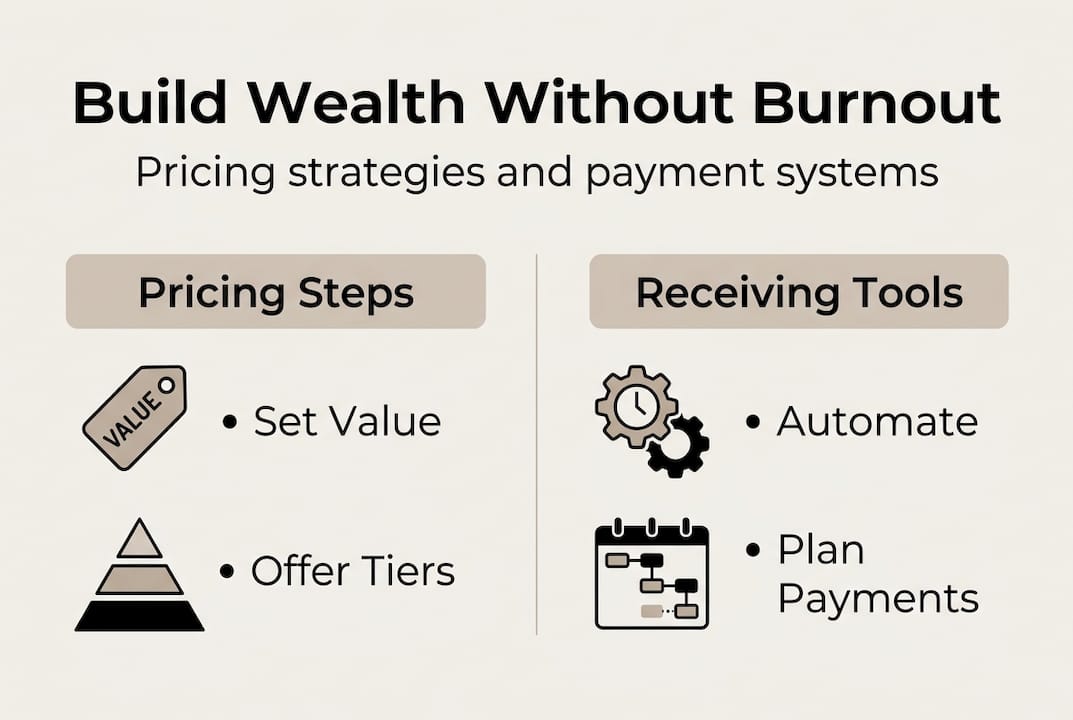
How to build your premium pricing in four steps:
- Identify your transformation: What specific, measurable result do clients get from working with you?
- Research market benchmarks: Know what top earners in your niche charge, not just the average.
- Build tiered offers: Create entry, core, and premium packages so clients self-select without you discounting.
- Test and hold: Raise your rate, hold it for 90 days, and track what changes.
Pro Tip: Scarcity and exclusivity are legitimate pricing tools. Limiting availability, like only taking four clients per quarter, signals high demand and justifies premium rates without you having to over-explain your value.
For a deeper look at how to structure your offers for maximum profitability, explore pricing for profit strategies that go beyond the basics.
Receiving with ease: Systems for getting paid
You can set the right prices and still struggle if your payment systems are chaotic or your boundaries around money are weak. Receiving with ease is a skill, and it requires both the right tools and the right mindset.
Start with your payment infrastructure. The platform you use matters more than most entrepreneurs realize. Here is a quick comparison:
| Payment method | Transaction fee | Reliability | Flexibility |
|---|---|---|---|
| Stripe | 2.9% + $0.30 | Very high | High |
| PayPal | 3.49% + fixed fee | High | Medium |
| Wave | 2.9% + $0.60 | Medium | Low |
| HoneyBook | Included in subscription | High | Very high |
For service-based businesses, platforms like HoneyBook or Dubsado are worth the investment because they combine contracts, invoicing, and payment collection in one place. This removes friction for your clients and for you.
Boundaries around payment are equally important. These are not optional policies. They are the structure that keeps your business financially healthy:
- Require deposits: A 25 to 50 percent deposit before work begins protects you from non-payment.
- Set clear net terms: Net 7 or Net 14 is standard for service businesses. Net 30 is too long for most solo operators.
- Automate reminders: Set up automated invoice reminders 3 days before and 1 day after the due date.
- Enforce late fees: State your late fee policy in your contract and apply it consistently.
Gradually test price increases and create payment plans to support client access without sacrificing your business health. A well-structured payment plan keeps cash flowing while making your premium offers accessible.
Pro Tip: Automate everything you can. Recurring payments, invoice reminders, and contract signatures should run without your manual involvement. Every hour you spend chasing payments is an hour not spent generating revenue.
Building sustainable sales systems means your business collects money consistently, not just when you remember to follow up.
Mindset shifts for sustainable wealth and well-being
Here is the part most pricing articles skip entirely. Your systems and strategies will only work as well as your mindset allows. If you believe deep down that you do not deserve to charge premium rates, you will find ways to sabotage even the best pricing structure.
Too many entrepreneurs accept less to avoid “making waves,” and in doing so, they reinforce the very income limits they want to break.
Common limiting beliefs and what to replace them with:
- “My clients can’t afford more” becomes “The right clients can and will pay my rates.”
- “I’m not experienced enough to charge that” becomes “My results speak louder than my years in business.”
- “Charging more feels greedy” becomes “Charging my worth is an act of integrity, not greed.”
“Your price is a statement about what you believe your work is worth. When you underprice, you are not being humble. You are being dishonest about your value.”
Five daily practices to strengthen confident receiving:
- Review your results: Keep a running list of client wins and outcomes. Read it before sales calls.
- Practice saying your price out loud: Rehearse quoting your rates without apologizing or over-explaining.
- Celebrate every payment received: Acknowledge income as evidence that your value is recognized.
- Set a weekly revenue intention: Name the number you want to receive each week and hold it without apology.
- Audit your language: Remove phrases like “just” and “only” from how you describe your offers.
The connection between mindset, boundaries, and income is not theoretical. Women who do this internal work consistently report that their income grows not because they worked harder, but because they stopped leaking value through discounts, over-delivery, and under-charging.
Sustainable wealth is built at the intersection of smart systems and a nervous system that can actually hold the growth you are creating.
A new lens: What most pricing advice misses for women entrepreneurs
Most pricing frameworks were built by and for men in product-based businesses. They assume a neutral playing field where the best price wins. That is not the reality for most women service providers.
The real issue is not that women do not know how to price. It is that the act of charging confidently requires a level of self-advocacy that runs directly against decades of social conditioning. Raising your rates is not just a business decision. It is a personal declaration that your work matters and that you will not shrink to make others comfortable.
At Freedom Sun, we see this pattern constantly. Women who have every strategic tool they need still freeze when it is time to send the invoice or hold the rate. That freeze is not a knowledge gap. It is a nervous system response.
True transformation happens when you combine the right beyond standard pricing tips with deep mindset work that rewires how you relate to money, value, and receiving. The women who break the “earn less” pattern are not the ones who found a better pricing calculator. They are the ones who decided their worth was non-negotiable and built systems that reflected that decision.
Your next step: Greater confidence and wealth
You now have a clear picture of why underpricing happens, how to set rates that honor your value, and how to build systems that make receiving feel natural. The next step is putting it all together with support that goes beyond a checklist.
At Freedom Sun, we work with women entrepreneurs who are already generating revenue and ready to build real, lasting wealth. Through the Women’s Wealth Collective academy, the Nervous System of Money podcast, and live events, we help you close the gap between what you know and what you can actually do when money is on the line. Explore Freedom Sun resources and find the support that fits where you are right now.
Frequently asked questions
How can I raise my prices without losing clients?
Test price raises gradually with existing clients, communicate the added value clearly, and offer flexible payment options to keep most clients engaged through the transition.
What’s the best way to handle late payments without feeling awkward?
Set clear payment terms in your contract before work begins, use automated reminders, and apply your late fee policy consistently so enforcement feels professional rather than personal.
Why do women entrepreneurs undercharge more often than men?
Women often face social conditioning and industry bias that reinforce price undercutting and imposter syndrome, which is reflected in average revenue at 40% of men-owned businesses.
Are payment plans a bad idea for service businesses?
Adopt payment plans when they are backed by contracts that protect your cash flow. Structured properly, they expand client access without compromising your financial stability.
Recommended
- Pricing for Profit: Unlocking Sustainable Business Growth
- Wealth Building Strategies for Entrepreneurs: 3x Growth
- 7 Proven Wealth-Building Strategies for Founders
- Master a Financial Mindset for Sustainable Business Growth
- Balancing Work and Family Life Without the Burnout | Laundry Tips
- Maximise your music income: a guide to smart monetisation | Music Video Marketplace Blog