Overcome limiting beliefs about money to grow your business

TL;DR:
- Women entrepreneurs feel less financially successful than men despite revenue growth. Limiting beliefs about money, shaped by cultural and systemic factors, hinder expansion and wealth building. Changing these beliefs requires awareness, reflection, and deliberate actions alongside strategic advocacy.
Only 23% of women entrepreneurs in the US feel financially successful, compared to 32% of men. That gap is not explained by effort, talent, or even revenue. Many women running profitable businesses still feel stuck, hesitant to expand, reluctant to raise prices, and quietly convinced that real wealth is for someone else. The culprit is rarely a missing strategy. More often, it is a set of invisible money beliefs running silently in the background, shaping every financial decision you make. This article breaks down what those beliefs are, how to spot them in your own business, and what it actually takes to rewrite them for lasting growth.
Table of Contents
- What are limiting beliefs about money?
- How limiting beliefs show up for women business owners
- The impact of money beliefs on business expansion and wealth building
- Rewiring your money mindset for sustainable growth
- A new perspective on money beliefs: What most advice misses
- Ready to break your money limits for good?
- Frequently asked questions
Key Takeaways
| Point | Details |
|---|---|
| Recognize limiting beliefs | Uncover hidden attitudes about money that may restrict your ability to grow and invest boldly. |
| Real impacts on business | Money beliefs influence major decisions like investing, hiring, and expansion—regardless of current revenue. |
| Evidence-based strategies | Use proven frameworks and practical steps to challenge and rewire limiting money thoughts for lasting results. |
| Mindset plus action | A holistic approach blending new beliefs with business strategy leads to the most sustainable wealth-building. |
What are limiting beliefs about money?
A limiting belief about money is any deeply held thought that quietly caps what you allow yourself to earn, charge, invest, or keep. These are not conscious decisions. They are automatic, background assumptions that feel like facts. For women entrepreneurs, they often sound like: “I should not charge that much,” “Wanting more money is greedy,” or “If I make too much, people will resent me.”
These beliefs are not random. They are shaped by years of cultural messaging, family dynamics, and systemic patterns. Social norms and access barriers create persistent gender gaps in entrepreneurship, and those external pressures get internalized over time. You absorb the message that women who want a lot are difficult, that money talk is unladylike, or that your value is measured in service rather than results.
Understanding your money mindset for entrepreneurs starts with recognizing that these beliefs were installed, not chosen. And what was installed can be updated.
Common limiting beliefs women entrepreneurs carry include:
- “I have to work harder to deserve more money.” This ties income to exhaustion rather than value.
- “Raising my prices will drive clients away.” This assumes scarcity rather than trusting your market.
- “Talking about money is uncomfortable or rude.” This makes negotiation and sales feel like violations.
- “I am not good with money.” This outsources financial authority and keeps you dependent.
- “Wealthy women are selfish or out of touch.” This makes success feel like a moral risk.
These are not just mindset quirks. They are decision filters. Every time you set a price, write a proposal, or consider an investment, these beliefs are in the room with you.
“The most dangerous financial belief is the one you have never questioned, because it looks exactly like common sense.”
Recognizing these patterns is not about blame or therapy. It is about seeing the operating system clearly so you can choose to run a different one.
How limiting beliefs show up for women business owners
Revenue growth can mask a lot. Women-owned businesses now average $520,000 in annual revenue, a 15% year-over-year increase. That is real progress. But revenue and wealth are not the same thing. You can have a growing top line and still be undercharging, underinvesting, and underbuilding because of beliefs that operate below the surface.
Here is what that actually looks like in practice:
- You land a major client but immediately wonder if you charged enough, then talk yourself out of revisiting the contract.
- You see a competitor raise their prices and feel relief that it was not you.
- You delay hiring because spending money on your business feels risky, even when the math supports it.
- You say yes to a discount request because saying no feels confrontational.
- You avoid looking at your financial reports because the numbers feel like a judgment.
These are not personality flaws. They are belief patterns in action.
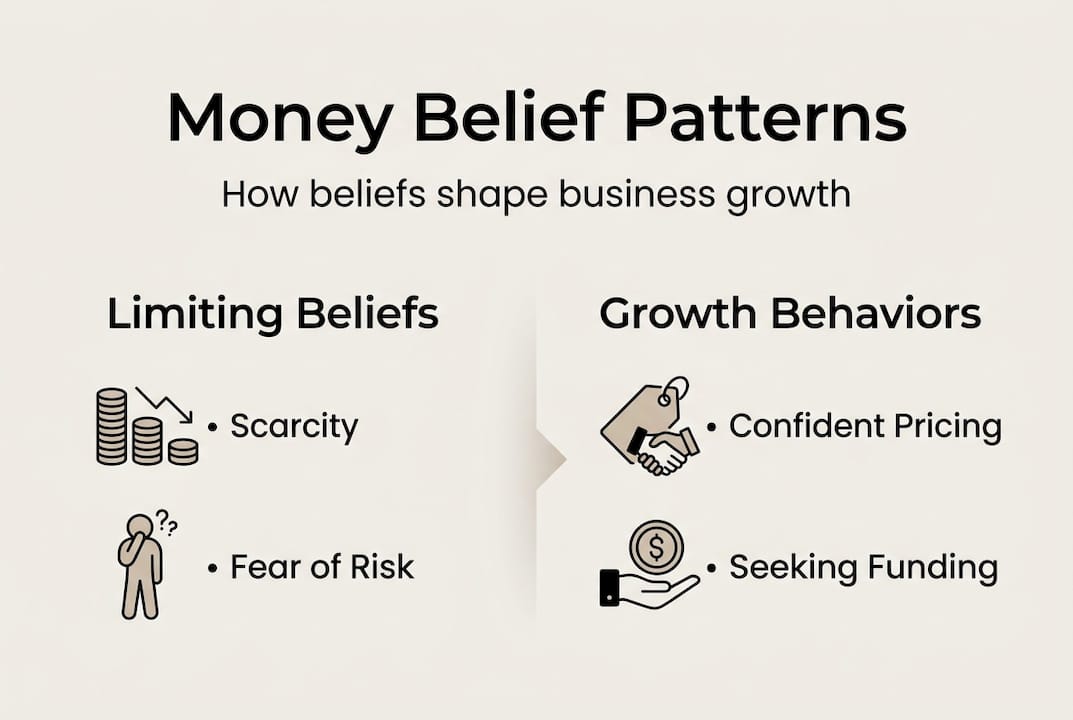
| Belief orientation | Pricing behavior | Funding behavior | Growth trajectory |
|---|---|---|---|
| Scarcity thinking | Undercharges, over-delivers | Avoids loans or investment | Slow, inconsistent |
| Abundance thinking | Prices for value | Seeks strategic capital | Intentional, scalable |
Building a sustainable business mindset means learning to recognize which column you are operating from on any given day. The goal is not perfection. It is awareness.
Pro Tip: Keep a “money reactions” journal for two weeks. Every time you feel a strong emotional response around pricing, a financial decision, or a money conversation, write it down. Patterns will emerge fast. That journal becomes your map for changing your money mindset in a targeted, personal way.
The subtlest version of this is the entrepreneur who is doing well by every external measure but privately feels like a fraud waiting to be found out. She keeps her prices just low enough to feel safe. She works more than she needs to because slowing down feels dangerous. She is successful and stuck at the same time.
The impact of money beliefs on business expansion and wealth building
Here is a number worth sitting with: only 13% of women-owned US businesses planned to expand in 2025. Not because the opportunity was not there. Because the internal permission was not there.

Expansion requires a specific kind of belief: that you are worth investing in, that growth is safe, and that more is not something to apologize for. When those beliefs are missing, even a thriving business stays small by design.
| Business area | Scarcity belief impact | Abundance belief impact |
|---|---|---|
| Pricing | Keeps rates below market value | Sets rates that reflect expertise |
| Funding | Avoids debt or outside capital | Leverages strategic investment |
| Team building | Delays hiring, does everything alone | Delegates to scale capacity |
| Networking | Minimizes visibility, fears judgment | Builds relationships as assets |
| Expansion | Waits for perfect conditions | Acts on calculated opportunity |
The ripple effects of money beliefs touch every corner of your business:
- Networking: Scarcity thinking makes you shrink in rooms where you should be leading. You understate your results. You avoid asking for referrals.
- Pricing: You leave money on the table repeatedly, not because clients push back, but because you preemptively discount before they even ask.
- Delegation: You hold onto tasks that drain you because spending money on support feels like a luxury rather than a business decision.
Women-owned firms have seen increased funding and revenue in recent years, which signals that the opportunity is real. The question is whether your beliefs are keeping pace with that opportunity or quietly holding you back from it.
You can transform your relationship with money in ways that directly shift these outcomes. But it starts with accepting that your beliefs are not neutral. They are active participants in your business results.
Rewiring your money mindset for sustainable growth
Changing a belief is not a one-time event. It is a practice. Here is a framework that actually works for women entrepreneurs who are already generating revenue and ready to grow further.
- Name the belief. Get specific. Not “I have money issues” but “I believe charging more than $X makes me greedy.” Precision matters because vague beliefs are hard to challenge.
- Find the origin. Ask yourself where that belief came from. A parent’s comment? A financial setback? A cultural message? You do not need to resolve the origin, just see it clearly.
- Test it against evidence. Look at your actual business data. Have clients left when you raised prices? Has investing in support hurt your bottom line? Often the evidence contradicts the belief entirely.
- Write a replacement belief. Make it true and stretchy. Not “I am a millionaire” if that feels false, but “My expertise creates real value and I am allowed to charge accordingly.”
- Anchor it with action. Take one small aligned action immediately. Raise one price. Send one proposal without discounting. Say yes to one opportunity you would normally shrink from.
Pro Tip: Accountability accelerates everything. A mastermind group, a business mentor, or even a peer you check in with weekly will help you stay honest about when old beliefs are running the show again.
Resources that support this work include mastering a financial mindset for strategic clarity, and changing your money mindset for the psychological layer underneath your decisions.
Supporting tools to keep the practice going:
- Daily journaling around money reactions and wins
- Regular financial reviews that you actually attend without dread
- Peer communities where wealth-building is normalized and celebrated
- Coaching or mentorship that holds both strategy and mindset together
Women-owned firms that combine increased funding access with intentional mindset work are the ones building real, lasting wealth. The mindset shift is not the soft part of the strategy. It is the foundation.
A new perspective on money beliefs: What most advice misses
Most money mindset content tells you to think positively and visualize abundance. That advice is incomplete at best and dismissive at worst.
Here is what we see at Freedom Sun after working with women entrepreneurs across 30 countries: the beliefs are real, but so are the structures that created them. Social norms and systemic barriers remain significant hurdles for women entrepreneurs worldwide. Telling a woman to just believe harder ignores the environment she is operating in.
The real work is not choosing between mindset and strategy. It is holding both at once. You do the inner work AND you advocate for better funding access, fairer networks, and pricing norms that reflect actual expertise. You transform your relationship with money while also changing the conversation in your industry.
The most powerful women entrepreneurs we know are not just recipients of mindset advice. They are rewriting the norms for the women coming after them. That is the bigger game worth playing.
Ready to break your money limits for good?
Freedom Sun Co was built specifically for women entrepreneurs who are already generating revenue and ready to stop leaving wealth on the table. The platform bridges financial strategy with the psychology underneath it, because knowing what to do and actually doing it are two very different things.
If the patterns in this article felt familiar, the next step is not more information. It is supported action. Start by exploring how changing your money mindset works in practice, with frameworks and community built for women who are serious about sustainable growth. Your business is already proof you can build something real. Now let’s make sure your beliefs are catching up to your results.
Frequently asked questions
What is a limiting belief about money?
A limiting belief about money is an unconscious idea that restricts your earning, saving, or investing potential. Common social norms and internalized messages can quietly convince women entrepreneurs they do not deserve wealth or that wanting more is selfish.
How can I identify my own limiting beliefs about money?
Track your emotional reactions around pricing, negotiations, and investing, and pay close attention to repeated feelings of guilt, fear, or hesitation. Those patterns are the clearest signal of where a limiting belief is active.
Why do limiting beliefs affect business growth?
They prevent you from seeking funding, setting appropriate prices, or pursuing expansion even when your revenue is steady. Only 13% of women-owned businesses planned to expand in 2025, reflecting how mindset barriers translate directly into inaction.
What is one first step to shifting limiting beliefs?
Begin by noticing and journaling any automatic negative thoughts around money, then deliberately challenge those assumptions against your actual business evidence.
Are money mindset shifts enough for success?
Mindset is essential, but it works best when combined with business strategy and advocacy. Structural barriers are real, and addressing them alongside inner work produces the most lasting results.