How to close a sale: Empathetic strategies for women entrepreneurs

TL;DR:
- Successful sales require multiple follow-ups built on trust, not just a single close.
- Consultative sales methods like Challenger and SPIN significantly increase win rates over high-pressure tactics.
- Tailoring your closing approach to buyer type and deal complexity ensures sustainable long-term revenue.
Most women entrepreneurs believe the close is a single, high-stakes moment. It isn’t. 80% of sales require five or more follow-ups before a deal is won, which means the pitch you deliver at the end of a discovery call is rarely what seals the relationship. What actually closes deals is a sequence of trust-building steps, smart follow-up rhythms, and techniques that match your buyer’s personality and needs. This article breaks down the modern science of closing, seven proven techniques, and how to build a sales process that works without grinding you into the ground.
Table of Contents
- The science of closing: Debunking traditional sales myths
- 7 proven closing techniques (and when to use each)
- Adapting your close: Aligning with your ideal buyer and deal type
- The sustainable close: Building rhythms and frameworks for long-term success
- Why closing a sale is a practice, not a single moment
- Take the next step: Level up your sales with expert support
- Frequently asked questions
Key Takeaways
| Point | Details |
|---|---|
| Empathy wins deals | Closing sales with empathy and understanding builds trust and boosts your win rates. |
| Consistent follow-up is vital | 80% of sales require 5 or more follow-ups, so persistence outperforms one-time pitches. |
| Tailor your approach | Adjust your closing strategy based on each buyer’s style and the deal type for the best results. |
| Sustainable rhythms prevent burnout | Build repeatable frameworks and sales rhythms to keep growing your business without overexertion. |
The science of closing: Debunking traditional sales myths
For years, sales training glorified the “hard close.” You know the type: create manufactured urgency, handle objections like a debate, and push until the client says yes or hangs up. That approach didn’t just feel wrong for most women entrepreneurs. Research confirms it actually backfires.
Consultative methods like Challenger and SPIN boost win rates by up to 40% compared to traditional high-pressure tactics. The difference is philosophy. Hard closes treat the sale as something you do to a prospect. Consultative closes treat it as something you build with them.
Three methodologies worth knowing:
- Challenger Sale: You teach, tailor, and take control of the conversation by reframing how prospects see their problem.
- SPIN Selling: You guide buyers through Situation, Problem, Implication, and Need-Payoff questions so they convince themselves.
- MEDDIC: A qualification framework focusing on Metrics, Economic Buyer, Decision Criteria, Decision Process, Identify Pain, and Champion. Especially useful for complex deals.
Here’s what the data shows about who’s actually winning:
| Seller type | Average win rate |
|---|---|
| Top performers | 72% |
| Average performers | 21% |
| Hard-close reliant | Below 15% |
The gap isn’t talent. It’s methodology.
“The best salespeople don’t close harder. They qualify better, listen longer, and make the buyer feel seen.”
A consultative sales approach also reduces the emotional toll of selling. When you’re solving a problem rather than pushing a product, every conversation feels more purposeful and less draining.

Pro Tip: Before your next sales call, write down the three most common problems your ideal client faces. Lead with questions about those problems, not with your offer. You’ll close more and feel better doing it.
For a deeper look at modern sales techniques, several frameworks are now built specifically around empathy and buyer psychology rather than pressure.
7 proven closing techniques (and when to use each)
Knowing that consultative selling works is one thing. Knowing which technique to deploy in a specific conversation is where the real skill lives. Here are seven closes that top-performing sales processes rely on, with context for when each one fits.
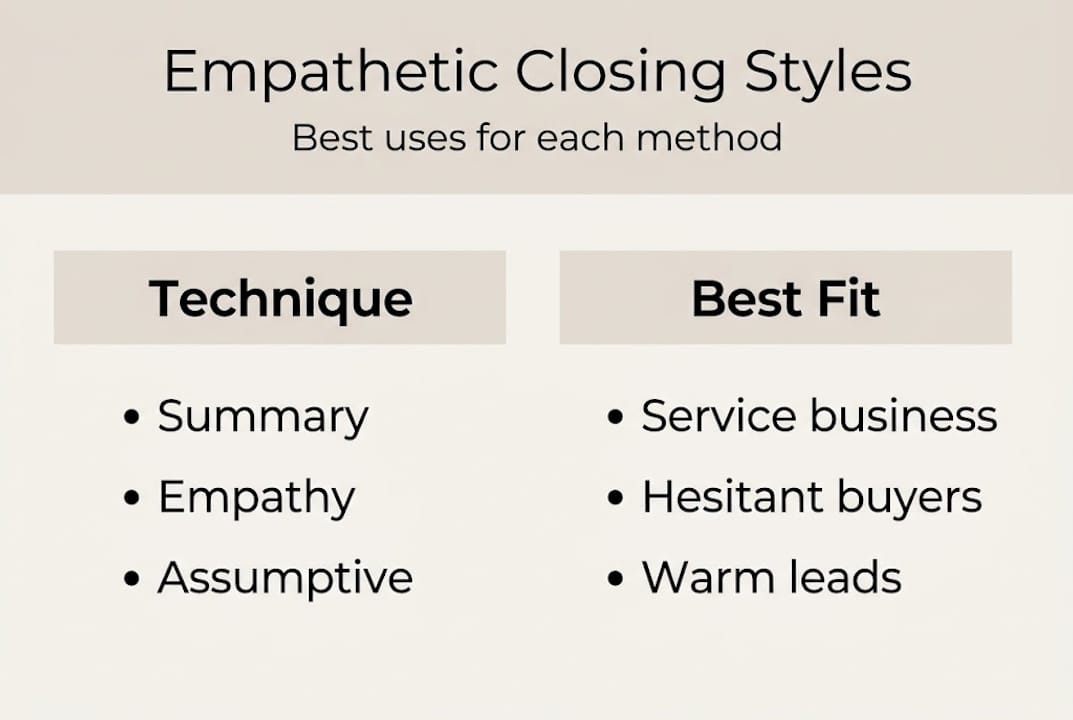
1. The assumptive close: You speak as if the decision has already been made. “When we start in March…” works well with warm prospects who are clearly aligned but haven’t verbally committed.
2. The summary close: You recap every value point before asking for the decision. Perfect for service-based businesses where the deliverables are detailed and complex.
3. The urgency close: You highlight a genuine constraint, a deadline, a price change, limited availability. Note: it must be real. Manufactured urgency destroys trust.
4. The question close: You ask a question that surfaces any remaining hesitation. “What would need to be true for this to feel like a clear yes?” is one of the most powerful sentences in sales.
5. The empathy close: You name what the client is feeling and hold space for it. Especially effective when a prospect is fearful or has been burned before.
6. The alternative close: You offer two options, both of which move forward. “Would you prefer to start with the three-month package or the six-month?” removes the yes/no dynamic.
7. The puppy dog close: You invite them to experience your work before fully committing, a trial, a pilot session, a small starter project. Low-risk entry points build trust fast.
| Technique | Best buyer type | Best deal type |
|---|---|---|
| Assumptive | Warm, aligned | Simple, transactional |
| Summary | Analytical | Complex, service-based |
| Urgency | Decision-fatigued | Time-sensitive |
| Question | Hesitant, thoughtful | Any |
| Empathy | Relationship-driven | High-trust services |
| Alternative | Overwhelmed | Mid-range packages |
| Puppy Dog | Risk-averse | Premium or retainer |
For techniques that specifically elevate client trust, the empathy and summary closes are worth practicing first. They feel natural and they match the relational strength most women entrepreneurs already have.
Pro Tip: Record yourself on your next three sales calls (with permission). You’ll notice patterns in where conversations stall. That stall point is usually where a specific close technique needs to be inserted.
For a broader look at 10 top techniques used across industries, the frameworks remain consistent even as deal sizes and contexts shift.
Adapting your close: Aligning with your ideal buyer and deal type
There is no single closing approach that works for every buyer. The most expensive mistake you can make is using the same script with a data-driven CFO that you use with a founder who buys on feeling. One size doesn’t fit all, and forcing the wrong technique can undo weeks of relationship building.
Here’s how to think about matching your close to your buyer:
- Analytical buyers want evidence, comparison, and time to process. Use the summary close with supporting data. Don’t rush them. A well-timed follow-up with a one-page value recap can close deals that a verbal pitch couldn’t.
- Relationship-driven buyers need to feel understood before they commit. Use the empathy and question closes. The warmth in your communication matters as much as the logic of your offer.
- Multi-stakeholder deals require a different strategy altogether. According to B2B sales benchmarks, multi-threaded deals enjoy 130% higher win rates when you have relationships with more than one decision-maker. Stop trying to win through a single champion.
“Adapting your close isn’t about being inauthentic. It’s about being fluent in how different people receive value.”
Two pitfalls that kill close rates regardless of buyer type:
- Premature closing: Asking for the decision before the buyer has enough context to say yes confidently. This creates pressure that pushes people away.
- Random discounting: Dropping your price to overcome hesitation without understanding the real objection. It signals low confidence and trains clients to negotiate against you every time.
If your growth sales strategy isn’t accounting for buyer type and deal complexity, you’re leaving significant revenue on the table. Similarly, revisiting your pricing strategies before you discount is one of the highest-leverage moves you can make.
The sustainable close: Building rhythms and frameworks for long-term success
Closing one great deal matters. But closing consistently, without burning yourself out, is what actually builds wealth. The women entrepreneurs who sustain high revenue over time aren’t the ones with the sharpest pitch. They’re the ones with the most consistent rhythms.
A sustainable sales framework isn’t just good for your mental health. It’s a competitive advantage. Here’s a practical sequence built on two proven frameworks:
The CREATE framework:
- Connect with your audience regularly, not just when you need sales.
- Relate by sharing stories that reflect your clients’ real challenges.
- Educate with content that moves people closer to a decision.
- Activate your existing audience before chasing new leads.
- Trust the process by following up consistently without apologizing for it.
- Expand by turning closed deals into referrals and repeat business.
The Educate-Invite-Remind rhythm: Every week, you educate your audience on a problem, invite them into a solution, and remind them it’s still available. This three-part loop keeps your pipeline warm without requiring daily hustle.
Weekly sales planning also changes everything. Forty-five minutes on Monday to review your pipeline, identify your three priority follow-ups, and plan one piece of content is often enough to maintain consistent flow.
Two areas women entrepreneurs consistently overlook:
- Underpricing: If you’re closing quickly and clients never push back, you’re probably undercharging. A well-positioned close should feel like a fair exchange, not a bargain.
- Dormant audiences: The clients who said “not yet” six months ago are often ready now. Activating that list with a well-timed offer is often faster than generating new leads.
Pro Tip: Use the Q4 framework at the start of each quarter to map your revenue targets back to specific closing activities. It removes the guesswork and the end-of-quarter panic.
If you want a business that closes more without costing you more energy, look at sales without burnout as a framework, not just a philosophy. Pair it with profitable operations and a clear vision for scaling your business and you have the architecture for sustainable revenue.
Why closing a sale is a practice, not a single moment
Here’s what most sales advice gets wrong: it treats the close as the destination. Build up to it, deliver the perfect line, win the deal. But for women entrepreneurs building businesses that last, that framing is the problem, not the solution.
The close isn’t a moment. It’s the result of every moment before it. The discovery call you led with curiosity. The follow-up email that actually addressed their concern. The proposal that was priced with confidence. When those pieces are consistent, the close almost happens by itself.
Sustainable wealth isn’t built by closing harder. It’s built by designing a sales system that reflects your values, respects your energy, and compounds over time. That means reviewing your business foundations and asking whether your sales process is something you can actually maintain for the next three years, not just the next three months.
If the answer is no, that’s not a discipline problem. It’s a design problem. And design problems are solvable.
Take the next step: Level up your sales with expert support
You now have the frameworks, the techniques, and the mindset to close with more ease and less pressure. But knowledge becomes revenue only when it’s put into practice with the right support behind it. At Freedom Sun, we help established women entrepreneurs translate sales strategy into real, repeatable results through workshops, templates, and expert coaching rooted in both financial strategy and psychology. If you’re ready to stop guessing and start closing with confidence, explore our consultative selling guidance and see how the right tools can change what’s possible for your business.
Frequently asked questions
What is the best closing technique for service-based businesses?
The summary and empathy closes work best for service-based businesses because they help you recap the value you’ve built and reinforce the trust that makes high-ticket decisions feel safe.
How many times should I follow up before giving up on a sale?
Most deals need at least five follow-ups, since 80% of successful sales are won after multiple contacts. Giving up after one or two follow-ups means leaving the majority of your potential revenue behind.
How can I close sales without feeling pushy?
Consultative methods that center on solving your client’s specific problem, rather than pitching features, consistently deliver higher close rates and leave both sides of the conversation feeling good.
Does adapting my close to buyer type really make a difference?
Significantly. Personalized approaches tailored to buyer style, especially in B2B and multi-stakeholder deals, more than double win rates compared to a one-size-fits-all script.