Design a signature offer to scale your service business

You built a business on your expertise, and now you’re booked out, burned out, and somehow still not making the money your work deserves. That’s the trap of custom, 1:1 service delivery. Every client engagement starts from scratch, your income is capped by your hours, and growth feels like it means working more. A signature offer changes that equation entirely. It’s a unique, flagship program that encapsulates your core expertise, delivers a specific transformation, and runs through a repeatable methodology you can scale far beyond trading time for money. This guide walks you through every step, from concept to pricing to launch.
Table of Contents
- Why create a signature offer?
- What makes an irresistible signature offer?
- Step-by-step: Designing your signature offer
- Smart pricing: Charge what your transformation is worth
- Avoiding pitfalls: Burnout, scope creep, and sustainable success
- Ready to build your signature offer?
- Frequently asked questions
Key Takeaways
| Point | Details |
|---|---|
| Signature offers scale impact | A unique, repeatable offer lets you impact more clients without burnout or overwork. |
| Value-based pricing wins | Charging based on the transformation you create enables higher, more sustainable income. |
| Framework and niche are key | A clear framework and narrow niche help your offer stand out and grow faster. |
| Test and iterate before scaling | Start small, refine with feedback, and adjust your offer for best results. |
Why create a signature offer?
The custom service model feels safe because it’s familiar. A client asks, you say yes, you deliver something tailored, and you invoice. But that model has a ceiling, and most revenue-generating women entrepreneurs hit it faster than they expect. Every new client means starting over. Every project is a negotiation. And the more you grow, the more exhausted you become.
“Prioritize repeatability and scalability to elevate pricing and avoid burnout, ideal for revenue-generating women ready to scale sustainably.”
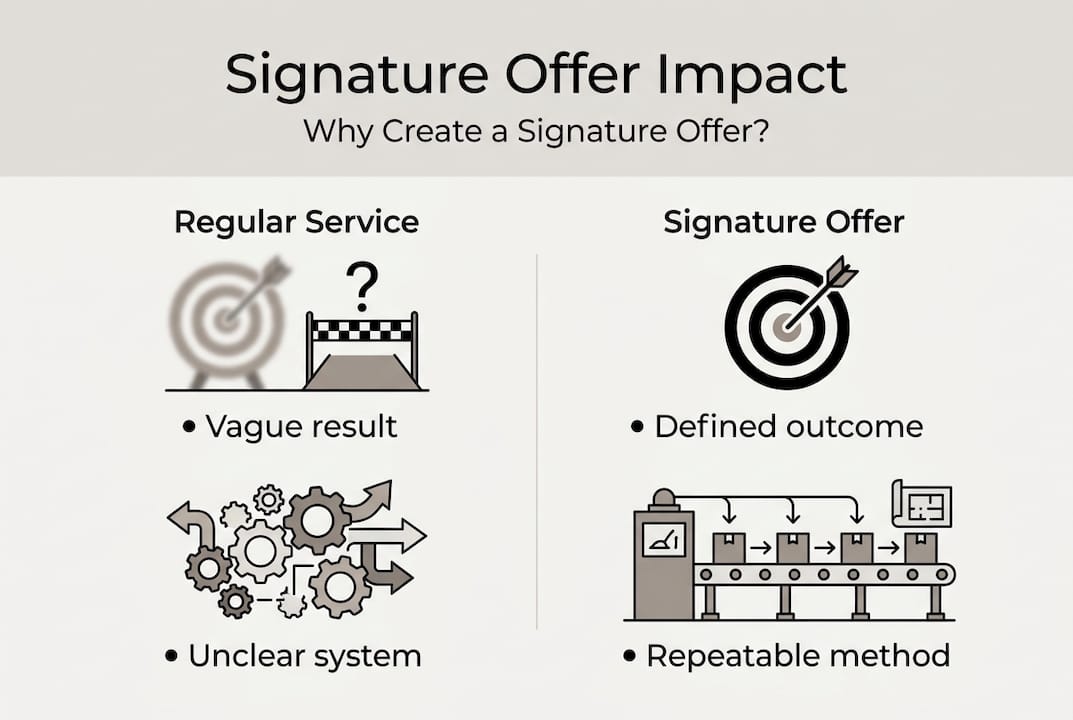
A signature offer breaks that cycle. Instead of selling your time, you sell a transformation. Instead of reinventing your process, you run a proven system. The benefits are real and compounding:
- Income scalability: Serve more clients without adding more hours
- Systemization: Repeatable delivery means less mental load and fewer errors
- Impact expansion: A clear methodology helps clients get better, more consistent results
- Well-being protection: Boundaries are built into the structure, not negotiated every time
- Premium pricing: Value-based fees replace hourly rates that undercut your worth
When you pair a signature offer with scaling with business systems, you stop being the bottleneck in your own business. That’s where real leverage begins.
What makes an irresistible signature offer?
Not every packaged service qualifies as a signature offer. The difference is in the design. A signature offer encapsulates your core expertise and delivers a specific transformation through a repeatable methodology. That’s a high bar, and it’s exactly why it commands premium pricing.

Here’s what separates a signature offer from a standard service:
| Feature | General service | Signature offer |
|---|---|---|
| Outcome | Varies by client | Specific and defined |
| Delivery | Custom each time | Repeatable framework |
| Pricing | Hourly or project | Value-based, premium |
| Marketability | Hard to explain | Clear, compelling story |
| Scalability | Limited by hours | Expandable beyond 1:1 |
The four non-negotiable ingredients are a clear outcome, a unique framework, niche alignment, and repeatability. Your framework is especially important. Naming it, visualizing it, and giving it a memorable structure makes your offer stick in a client’s mind long after the sales conversation ends. Think of it like a map: clients want to see the route before they buy the journey.
Niche-focused signature offers with proven ROI enable price increases of 60% or more and significant revenue jumps compared to generalist approaches. That’s not a small edge. That’s a business model shift.
Building systems and automation into your delivery from the start means your offer can grow without you manually managing every detail.
Pro Tip: Use a metaphor to name your framework. “The Profit Ladder,” “The Revenue Runway,” or “The Clarity Map” are all more memorable than “my six-step process.” Metaphors create mental images that clients remember and repeat to others.
Step-by-step: Designing your signature offer
The core steps to design a signature offer follow a clear sequence. Skip one and the whole structure gets shaky.
- Identify your target audience and their pain points. Get specific. “Women entrepreneurs” is not a niche. “Revenue-generating consultants who are overbooked and undercharging” is.
- Define the transformation. What does your client’s life or business look like after working with you? Name the before and the after with precision.
- Outline your proprietary framework. This is your unique methodology. It’s the steps, tools, and sequence that get clients from A to B.
- Package it. Decide on format: group program, intensive, hybrid, or self-paced. Match the container to the transformation.
- Validate and price. Before you build everything out, test the concept. Run a pilot, gather feedback, and adjust.
- Launch and iterate. Your first version won’t be perfect. That’s fine. Real client data is worth more than months of planning.
The coaching and consulting market hit $6.25 billion in 2024 and is projected to reach $7.3 billion in 2025. The demand for expert-led transformation is growing fast. Your offer has a market. The question is whether your packaging reflects your actual value.
Pro Tip: Launch a minimal viable offer first. Sell it before you build it. Run one client through the framework manually, document what works, and refine from there. This approach saves months of over-engineering and gives you real testimonials faster.
As you build out scaling service operations, pair your offer design with a consultative sales approach so you’re enrolling clients who are genuinely aligned with your methodology.
Smart pricing: Charge what your transformation is worth
Pricing is where most women entrepreneurs leave serious money on the table. Hourly rates anchor your value to time. Value-based pricing anchors it to results. That’s a completely different conversation.
Here’s a quick comparison of pricing models:
| Pricing model | Basis | Example outcome |
|---|---|---|
| Hourly | Time spent | $150/hr, income capped by hours |
| Project-based | Scope of work | $3K project, scope creep risk |
| Value-based | Client result | $10K offer, tied to ROI delivered |
| Retainer | Ongoing access | $2K/month, predictable revenue |
The benchmark for high-value signature offers sits between $5K and $25K, with a value-based approach capturing 15 to 25% of the client’s result. One documented case raised pricing from $8K to $13K, a 60% increase, and monthly revenue jumped from $125K to $178K.
When you’re setting your price, think about the ROI your client receives:
- Revenue generated from implementing your framework
- Time saved by avoiding costly mistakes
- Opportunities unlocked that weren’t accessible before
- Stress reduced by having a clear path forward
Pro Tip: Build a case study library. When a prospect hesitates at your price, a specific client story with real numbers does more than any discount ever could. Numbers make transformation tangible.
For a deeper look at how to structure your rates, explore pricing for profit and review pricing strategies that align with your growth goals.
Avoiding pitfalls: Burnout, scope creep, and sustainable success
Building a signature offer is exciting. It’s also where a lot of smart women entrepreneurs make avoidable mistakes. Knowing what to watch for protects both your profits and your energy.
Common pitfalls to avoid:
- Scope creep: Without clear deliverables, clients will keep asking for more and you’ll keep saying yes
- Over-customization: If every client gets a different version, you don’t have a signature offer, you have a custom service with a new name
- Misaligned pricing: Undercharging attracts clients who don’t value your work and drain your capacity
- No defined process: A framework that only lives in your head can’t scale and can’t be delegated
- Wrong client fit: Enrolling clients who aren’t ready for the transformation creates frustration on both sides
Niche-focused offers grow 30% faster than generalist services. Staying specific isn’t limiting. It’s a competitive advantage.
For women entrepreneurs specifically, building sustainable systems to support your offer is not optional. It’s the difference between a business that grows and one that grinds you down. Pilot your offer before you build it out fully. Test with real clients. Iterate with their feedback. And build sustainable scaling systems around your delivery from day one.
Guarantees and risk-reduction elements also matter. When clients feel protected, they say yes faster and with more confidence. A clear satisfaction policy or milestone-based structure signals that you stand behind your results.
Ready to build your signature offer?
You now have the framework, the pricing logic, and the pitfall map. The next step is putting it into motion with the right support around you. At Freedom Sun, we work with revenue-generating women entrepreneurs who are done leaving money on the table and ready to build offers that reflect their real expertise. Through the Women’s Wealth Collective academy, coaching, and live events, you get the strategy and the nervous system support to actually implement it. If you’re ready to scale your business with a signature offer that commands premium pricing, Freedom Sun is where that work happens.
Frequently asked questions
What is the difference between a signature offer and a regular service?
A signature offer delivers a specific, repeatable transformation through a unique methodology, while a regular service tends to be generalized and rebuilt from scratch for each client.
How much should I charge for my signature offer?
Use a value-based approach, typically capturing 15 to 25% of the result you create for your client, with benchmarks ranging from $5K to $25K or more depending on the ROI you can demonstrate.
How do I validate if my offer will sell?
Pilot and test a minimal version first, run one or two clients through it manually, and use their real feedback to refine before investing in a full build.
How do I avoid scope creep with a signature offer?
Define your deliverables clearly in writing, communicate boundaries before the engagement starts, and stay focused on your niche so client expectations stay aligned with what you actually deliver.