How a business coach for women empowers sustainable growth in 2026

Many women entrepreneurs dismiss business coaching as an expensive luxury or assume it’s only for those struggling to get started. You’re already generating revenue, meeting client needs, and managing complex operations. Yet something holds you back from the next level of growth and wealth. Business coaching for women addresses unique challenges like imposter syndrome, undercharging, and fear of visibility, leading to increased confidence and financial empowerment. The gap between what you’re capable of building and what you’re actually building isn’t a strategy problem. It’s about closing the distance between knowing what to do and making yourself do it when money and growth are on the line.
Table of Contents
- Understanding The Unique Challenges Women Entrepreneurs Face
- How Business Coaching Empowers Women Entrepreneurs
- Measuring The Impact And Return On Investment Of Coaching
- Applying Coaching Insights For Sustainable Wealth And Balanced Growth
- Empower Your Journey With Freedom Sun’s Coaching Solutions
- Frequently Asked Questions
Key takeaways
| Point | Details |
|---|---|
| Coaching addresses nervous system barriers | Business coaching helps women entrepreneurs overcome internal blocks like imposter syndrome and financial anxiety that prevent sustainable growth. |
| Strategic blend of support | Effective coaching combines financial strategy, emotional intelligence, and accountability tailored to women’s unique business challenges. |
| Measurable financial returns | Women entrepreneurs typically see 3 to 7 times return on their coaching investment through improved confidence and business performance. |
| Sustainable wealth building | Coaching helps align business decisions with personal values while maintaining work-life integration and long-term financial health. |
| Stage-specific solutions | Professional coaching adapts to your current business phase, whether you’re scaling operations or breaking through revenue plateaus. |
Understanding the unique challenges women entrepreneurs face
You’ve built something real. Revenue is coming in, clients are satisfied, and you’re managing operations that would overwhelm most people. Yet female entrepreneurs face challenges including imposter syndrome, work-life integration, gender bias, and access to funding that create invisible ceilings on growth. These aren’t beginner problems. They’re the barriers that show up precisely when you’re ready to scale.
Imposter syndrome doesn’t disappear with success. It evolves. You might charge less than male counterparts despite delivering superior results, or hesitate to pursue high-visibility opportunities that could transform your business. The fear isn’t about competence. It’s about being seen, judged, and potentially rejected at a larger scale. This psychological barrier costs you real money and opportunities every single day.
Balancing business growth with family responsibilities creates unique decision-making frameworks that traditional business advice ignores. Work-life balance and emotional intelligence are key concerns shaping women’s business strategies, influencing everything from hiring decisions to revenue models. You’re not just building a business. You’re integrating it into a life that includes caregiving, relationships, and personal well-being.
Gender bias in funding and networking creates systemic disadvantages that compound over time. Women receive a fraction of venture capital compared to male entrepreneurs, and informal networks that drive business opportunities remain predominantly male-dominated. You can’t network your way out of structural inequality, but you can build strategies that work within and around these realities.
Emotional intelligence becomes both an asset and a burden. Your ability to read clients, manage team dynamics, and navigate complex relationships drives business success. Yet this same sensitivity can make financial conversations, pricing negotiations, and boundary-setting extraordinarily difficult. You feel everything, which means every business decision carries emotional weight that others might not experience.
“The challenge isn’t that women entrepreneurs lack skills or drive. It’s that the internal operating system—the nervous system response to money, visibility, and growth—hasn’t been updated to match their capabilities.”
Networking opportunities remain underutilized not because you lack social skills, but because traditional networking spaces weren’t designed with your needs in mind. The golf course, late-night dinners, and male-dominated industry events create barriers that have nothing to do with your ability to build relationships. Starting a life coaching business or any service-based enterprise requires connections, yet accessing those connections demands navigating spaces where you’re often the only woman in the room.
How business coaching empowers women entrepreneurs
Coaching blends practical strategy, emotional support, and financial guidance, leading to sustained business growth aligned with values. This isn’t about learning new tactics or discovering secret strategies. It’s about addressing the nervous system barriers that prevent you from implementing what you already know works. The gap between knowledge and action is where coaching creates transformation.
Financial anxiety shifts to empowerment when you understand numbers as tools rather than judgments. Many women entrepreneurs avoid looking at their finances not because they lack intelligence, but because money triggers deep nervous system responses tied to safety, worth, and survival. A coach helps you build a new relationship with numbers that feels curious rather than threatening. This shift alone can unlock pricing decisions and investment choices that double or triple revenue.

Customized strategies integrate your personal values with business growth in ways that generic business advice never addresses. You don’t want to build someone else’s version of success. You want sustainable wealth that supports the life you’re actually trying to create. Financial coaching services help founders align profit goals with personal priorities, creating business models that generate wealth without requiring you to abandon everything else that matters.
A coach listens deeply, asks powerful questions, and empowers women with honest feedback and accountability. This isn’t cheerleading. It’s having someone who sees your blind spots, calls out self-sabotage, and refuses to let you play small when you’re capable of so much more. The accountability creates momentum that’s nearly impossible to generate alone.
Imposter syndrome and undercharging get addressed directly rather than ignored. Your coach helps you recognize the patterns: discounting before clients ask, over-delivering to prove your worth, avoiding sales conversations that feel uncomfortable. These aren’t personality flaws. They’re learned protective strategies that once kept you safe but now limit your growth. Coaching provides new strategies that feel aligned rather than forced.
Clarity emerges around vision and goals that might have felt fuzzy or conflicting. You’re juggling multiple priorities, and traditional goal-setting frameworks assume you have unlimited time and energy. A coach helps you identify what actually matters right now, what can wait, and what needs to stop entirely. This clarity transforms decision-making from overwhelming to straightforward.
Pro Tip: Schedule coaching sessions during your highest-energy time of day, not as an afterthought squeezed between other commitments. The quality of your engagement directly impacts the value you receive, and treating coaching as a priority rather than an obligation accelerates results significantly.
Financial empowerment insights show that leadership clarity and financial confidence are interconnected. When you trust yourself with money decisions, you lead differently. Your team feels it, clients sense it, and opportunities appear that weren’t visible before. This isn’t magical thinking. It’s the practical result of nervous system regulation meeting strategic business planning.
Measuring the impact and return on investment of coaching
Business coaching can yield a 35% higher return on investment, with median business owners earning 7 times their investment. These aren’t hypothetical numbers. They represent real outcomes from women who committed to the process, implemented recommendations, and tracked their progress. The ROI comes from multiple sources: increased revenue, better pricing, reduced overhead, and faster decision-making.
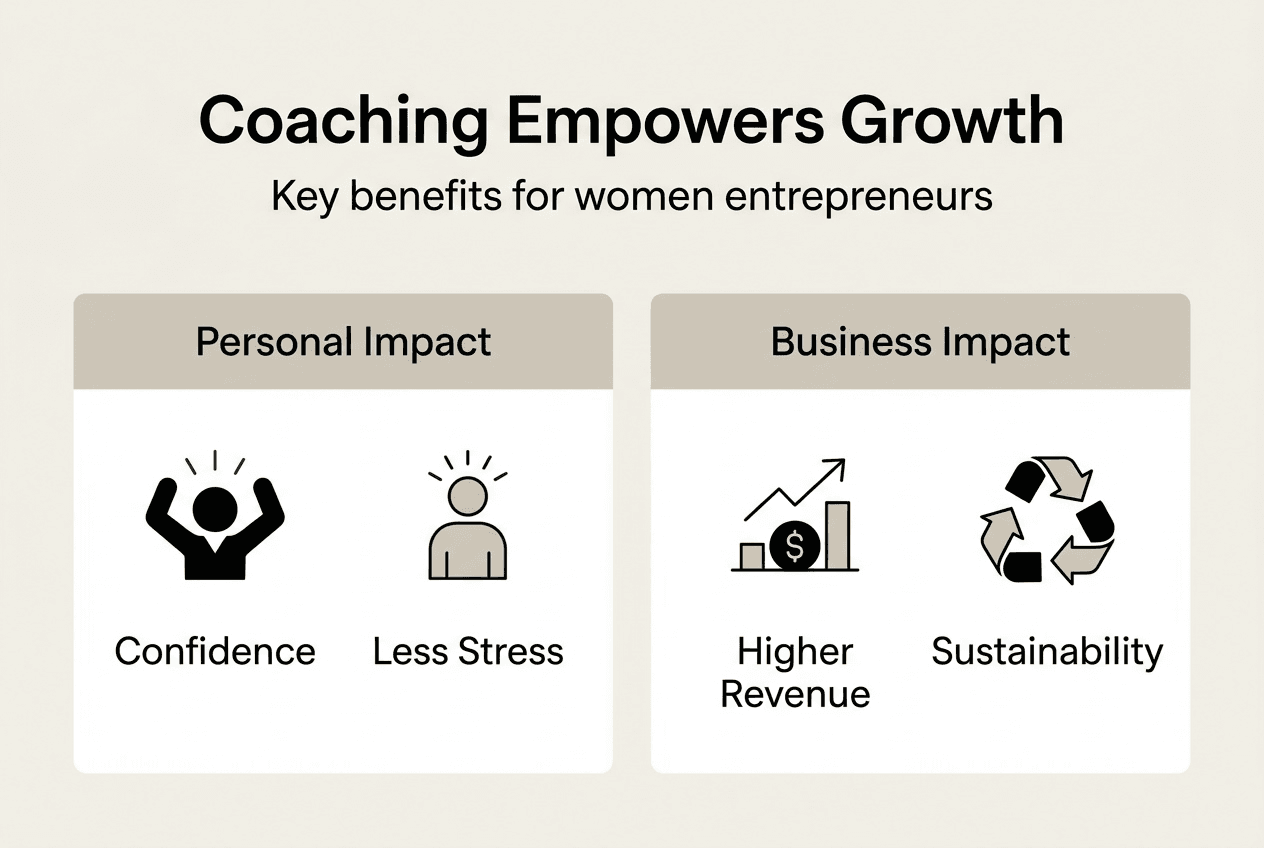
Most business owners report measurable improvements in confidence, productivity, and business sustainability within the first three months of coaching. Confidence translates to better sales conversations, stronger client boundaries, and willingness to pursue larger opportunities. Productivity increases when you stop second-guessing every decision and start trusting your judgment. Sustainability emerges when your business model supports your life rather than consuming it.
Executive coaching typically returns 3 to 7 times the initial investment, with 87% reporting improved confidence and 70% improved work performance. These statistics reflect outcomes across industries and business stages, but the impact for women entrepreneurs often exceeds these averages because the barriers being addressed are more fundamental. When you’re not just learning new skills but rewiring your nervous system response to money and growth, the transformation compounds.
ROI depends on three critical factors: clarity of goals, willingness to act on recommendations, and systematic tracking of progress. Vague intentions produce vague results. If you enter coaching hoping to “feel more confident” or “grow the business,” you’ll struggle to measure impact. Specific goals like “increase average project fee by 40%” or “reduce client acquisition time by half” create clear metrics for evaluation.
| Metric | Before Coaching | After 6 Months | Improvement |
|---|---|---|---|
| Average client value | $3,500 | $6,200 | 77% increase |
| Monthly revenue | $12,000 | $22,000 | 83% increase |
| Hours worked weekly | 55 | 42 | 24% decrease |
| Confidence in pricing | 4/10 | 8/10 | 100% increase |
The qualitative benefits often exceed quantitative returns. Women report sleeping better, feeling less anxious about money, and enjoying their businesses again. These outcomes don’t appear on profit and loss statements, yet they determine whether you can sustain growth long-term. Burnout destroys businesses faster than poor strategy, and coaching addresses both simultaneously.
Pro Tip: Before starting coaching, document your current metrics: revenue, profit margins, hours worked, client acquisition cost, and subjective measures like confidence and stress levels. Review these monthly to see patterns you might otherwise miss and adjust strategies based on what’s actually working rather than what you hope is working.
“The real ROI of coaching isn’t just the money you make. It’s the money you stop leaving on the table, the opportunities you finally pursue, and the business model you build that doesn’t require burning yourself out to maintain.”
Financial coaching business strategies emphasize tracking both leading and lagging indicators. Revenue is a lagging indicator. It tells you what already happened. Leading indicators like sales conversations initiated, proposals sent, and pricing confidence predict future revenue. Coaching helps you identify and improve the leading indicators that drive the lagging results you want.
Applying coaching insights for sustainable wealth and balanced growth
Female entrepreneurs prioritize economic stability and work-life balance, structuring operations around family responsibilities in ways that create competitive advantages rather than limitations. This isn’t about doing less or accepting lower ambitions. It’s about building business models that generate wealth sustainably rather than through unsustainable hustle.
-
Set clear priorities that balance business growth with personal and family needs by identifying non-negotiables in both areas. What must happen in your business this quarter? What must happen in your personal life? Where do these overlap, and where do they conflict? Coaching helps you navigate these tensions rather than pretending they don’t exist.
-
Use coaching tools to clarify vision and align daily actions with long-term values. The gap between vision and action is where most entrepreneurs get stuck. You know what you want to build, but daily decisions pull you in conflicting directions. Coaches provide frameworks that make alignment practical rather than aspirational.
-
Build supportive networks that overcome the underutilization of resources many women entrepreneurs experience. This means intentionally creating relationships with other women building similar businesses, mentors who’ve navigated your current challenges, and strategic partners who complement your strengths. Isolation kills more businesses than competition.
-
Review progress regularly to adjust strategies for sustainable wealth rather than reactive growth. Monthly reviews identify what’s working, what’s draining resources, and what needs to change. This practice prevents you from continuing strategies that stopped working months ago simply because you’re too busy to notice.
-
Implement pricing strategies that reflect your expertise and value rather than market averages or what feels comfortable. Undercharging is expensive. It attracts clients who don’t value your work, requires you to work more hours for less money, and prevents investment in business growth. Coaching helps you price based on transformation delivered rather than time invested.
Businesses with female leadership generate higher returns, and investors report better performance in female-founded companies. This isn’t about gender superiority. It’s about different leadership approaches that prioritize sustainability, relationship-building, and long-term thinking over short-term extraction. These qualities create business value that compounds over time.
| Aspect | Without Coaching | With Coaching |
|---|---|---|
| Pricing confidence | Charges market average or below, fears client rejection | Prices based on value delivered, comfortable with premium positioning |
| Decision speed | Overthinks decisions, seeks excessive validation | Makes clear decisions quickly, trusts judgment |
| Work-life integration | Business consumes personal time, constant overwhelm | Clear boundaries, sustainable schedule, present in both areas |
| Revenue growth | Incremental, reactive, plateaus frequently | Strategic, intentional, compounds over time |
| Stress levels | High anxiety around money and visibility | Regulated nervous system, handles challenges calmly |
Business coach leadership training develops skills that translate across all business areas. Leadership isn’t about managing people. It’s about managing yourself first. When you lead yourself effectively, everything else becomes easier. You make decisions faster, communicate boundaries clearly, and inspire rather than exhaust your team.
Self-sufficiency business coaching focuses on building internal capacity rather than external dependence. The goal isn’t to need coaching forever. It’s to develop the skills, mindset, and nervous system regulation that allow you to navigate future challenges independently. Great coaching makes itself obsolete by building your capability rather than your reliance.
Empower your journey with Freedom Sun’s coaching solutions
This is exactly the work we do inside the Women’s Wealth Collective, where women who are already successful come to build the next level of wealth, not just revenue. If you’re ready to stop circling the same ceiling and build something that actually reflects what you’re capable of, the Collective is where that happens. We bridge financial strategy with the nervous system work that makes implementation possible, addressing the gap between what you know you should do and what you can actually make yourself do when money and growth are on the line. Freedom Sun offers tailored coaching that transforms internal barriers into sustainable wealth through our four pillars: Profit, Sales, Communication, and Leadership.
Frequently asked questions
What does a business coach for women do differently than other coaches?
A business coach for women addresses gender-specific challenges like imposter syndrome, undercharging, and systemic barriers to funding and visibility that generic business coaching often ignores. The approach integrates emotional support with strategic planning, recognizing that women entrepreneurs face unique pressures around work-life integration and societal expectations. Coaches tailor strategies to align business growth with personal values rather than imposing one-size-fits-all frameworks. This creates sustainable success that doesn’t require abandoning everything else that matters in your life.
How can coaching help overcome imposter syndrome and undercharging?
Coaching provides tools to recognize and reframe limiting beliefs that drive imposter syndrome, helping you see patterns like over-delivering, discounting preemptively, and avoiding visibility. Regular feedback from your coach builds evidence of your capabilities that contradicts the internal narrative of inadequacy. Confidence-building exercises and pricing frameworks help you value your work appropriately based on transformation delivered rather than time invested. The accountability ensures you implement new pricing and positioning strategies even when they feel uncomfortable initially.
What measurable results can women expect from business coaching?
Women entrepreneurs typically see 3 to 7 times return on their coaching investment through increased revenue, improved profit margins, and better resource allocation. Clients report 87% improvement in confidence and 70% improvement in work performance within six months of starting coaching. Beyond financial metrics, women experience reduced anxiety around money, faster decision-making, and better work-life integration. The compound effect of these improvements creates sustainable wealth that continues growing long after coaching ends.
Is business coaching suitable for all stages of entrepreneurship?
Business coaching adapts to stage-specific challenges, whether you’re breaking through your first revenue plateau, scaling operations, or preparing for a major business transition. The focus shifts based on your current needs: early-stage entrepreneurs might prioritize pricing and positioning, while established businesses focus on delegation, systems, and sustainable growth models. Personalized coaching addresses your evolving goals and the work-life balance needs that change as your business and personal life develop. The key is that coaching serves entrepreneurs already generating revenue who are ready for the next level, not beginners still validating their business concept.