Operating System Framework: Powering Entrepreneurial Growth

Most high-growth startups fall short of their true potential because they lack a unified approach—an issue even top American companies face. Building an organization without a robust OS framework often leads to wasted time, missed revenue, and unpredictable growth. For founders determined to steer their companies away from chaos and towards strategic clarity, understanding and implementing such a system can redefine everything, creating an environment where financial visibility, sustainable growth, and operational resilience become the new standard.
Table of Contents
- Defining An Operating System Framework For Business
- Core Pillars: MATH, MECHANICS, And MIND Explained
- How The OS Framework Transforms Operations
- Implementing The OS Framework In Your Startup
- Common Mistakes When Adopting A System Framework
Key Takeaways
| Point | Details |
|---|---|
| Operating System Framework | This framework simplifies business processes, aligning finances, sales, and leadership for better performance. |
| Three Pillars: MATH, MECHANICS, MIND | Integration of financial strategy, operational processes, and leadership psychology drives sustainable growth. |
| Implementation Process | Adopt a phased approach, focusing on vision alignment, team assessment, and continuous improvement. |
| Common Mistakes | Avoid premature standardization and ensure stakeholder engagement to enhance framework adoption success. |
Defining an Operating System Framework for Business
An operating system framework transforms business infrastructure from chaotic complexity to strategic simplicity. Think of it like the central nervous system for your organization - connecting disparate functions, standardizing processes, and creating predictable performance pathways that drive sustainable growth.
At its core, an operating system framework represents a comprehensive blueprint that synchronizes three critical business domains: financial management, sales infrastructure, and leadership practices. These interconnected systems work together like precision gears in a sophisticated machine, enabling entrepreneurs to shift from reactive problem solving to proactive strategic management. By establishing clear protocols, measurement standards, and communication channels, businesses can eliminate inefficiencies and create scalable, repeatable success models.
The fundamental components of an effective operating system framework typically include:
- Financial Clarity Systems: Tracking revenue streams, expense management, and profit trajectory
- Sales Infrastructure: Standardized lead generation, conversion, and customer retention processes
- Leadership Protocols: Decision making frameworks, communication standards, and performance evaluation methods
Pro Tip: Strategic Implementation: Begin mapping your business operating system by documenting existing processes, identifying bottlenecks, and creating standardized workflows that can be easily replicated and optimized across your organization.
By implementing a robust operating system framework, entrepreneurs can transform their businesses from unpredictable ventures into well-oiled machines capable of sustained, strategic growth.
Core Pillars: MATH, MECHANICS, and MIND Explained
The MATH, MECHANICS, and MIND framework serves as a comprehensive operating system for entrepreneurial success, strategically integrating financial intelligence, operational infrastructure, and leadership psychology. These three interconnected pillars represent a holistic approach to building sustainable, high-performance business ecosystems that transcend traditional growth models.
MATH represents the quantitative foundation of business strategy. Entrepreneurial mathematical modeling provides critical insights into financial decision making, risk assessment, and strategic planning. This pillar focuses on developing robust financial literacy, enabling entrepreneurs to transform raw numerical data into actionable strategic intelligence. Key components include financial forecasting, performance metrics, revenue trajectory analysis, and predictive modeling that transforms complex financial landscapes into clear, navigable roadmaps.

MECHANICS addresses the operational infrastructure that powers business scalability. This pillar concentrates on designing systematic processes for sales, customer acquisition, workflow optimization, and technological integration. By establishing standardized protocols, entrepreneurs can create repeatable systems that function independently of individual personalities, ensuring consistent performance and sustainable growth.
MIND explores the psychological and leadership dimensions of entrepreneurial success. This pillar recognizes that strategic thinking, emotional resilience, and personal development are equally crucial as financial and operational competencies. It encompasses mental frameworks for decision making, stress management, cognitive flexibility, and cultivating a growth-oriented mindset that can navigate complex business challenges.
The interconnected nature of these pillars means that improvement in one area positively influences others. Financial clarity (MATH) enhances operational efficiency (MECHANICS), while psychological resilience (MIND) enables more strategic financial and operational decisions.
Here’s a concise overview comparing the three pillars of the MATH, MECHANICS, and MIND framework:
| Pillar | Primary Focus | Key Benefit | Typical Challenge |
|---|---|---|---|
| MATH | Financial strategy | Informed decision making | Data interpretation |
| MECHANICS | Operational infrastructure | Reliable business execution | Process consistency |
| MIND | Leadership psychology | Adaptive, resilient teams | Change resistance |
Pro Tip: Holistic Integration: Conduct a quarterly audit of your MATH, MECHANICS, and MIND systems, identifying strengths and potential improvement areas across all three pillars to ensure balanced and sustainable business growth.
How the OS Framework Transforms Operations
Operating system frameworks represent a revolutionary approach to business transformation, shifting organizations from fragmented, reactive models to integrated, proactive systems. This strategic methodology fundamentally reimagines how businesses structure, execute, and optimize their core operational processes.
Comprehensive case studies on operational efficiency demonstrate that implementing a robust operating system framework can dramatically reduce organizational complexity, minimize communication breakdowns, and create sustainable performance pathways. The transformation occurs through systematic deconstruction and strategic reconstruction of existing business processes, enabling entrepreneurs to design self-regulating systems that operate with minimal manual intervention.
The operational transformation typically manifests through several critical mechanisms:
- Process Standardization: Creating repeatable workflows that eliminate variability
- Automated Decision Protocols: Developing clear guidelines for routine decision making
- Performance Measurement: Establishing precise metrics that objectively track organizational health
- Communication Infrastructure: Designing transparent information flow channels
By treating the business as an interconnected ecosystem rather than a collection of disconnected departments, operating system frameworks enable unprecedented levels of operational coherence. Each process becomes intelligently linked, creating a dynamic environment where performance optimization happens organically and continuously.
The ultimate goal of this transformative approach is not just incremental improvement, but a fundamental redesign of organizational capabilities. Entrepreneurs move from managing individual tasks to architecting intelligent systems that can scale, adapt, and self-correct.
Pro Tip: System Mapping: Spend one day each quarter creating a visual map of your current operational processes, identifying bottlenecks, redundancies, and potential automation opportunities to continuously refine your business operating system.
Implementing the OS Framework in Your Startup
Implementing an Operating System (OS) framework is not a one-size-fits-all process, but a strategic journey of continuous refinement and organizational adaptation. Startup founders must approach this implementation as a deliberate, phased transformation that aligns systems, people, and processes toward a unified strategic vision.
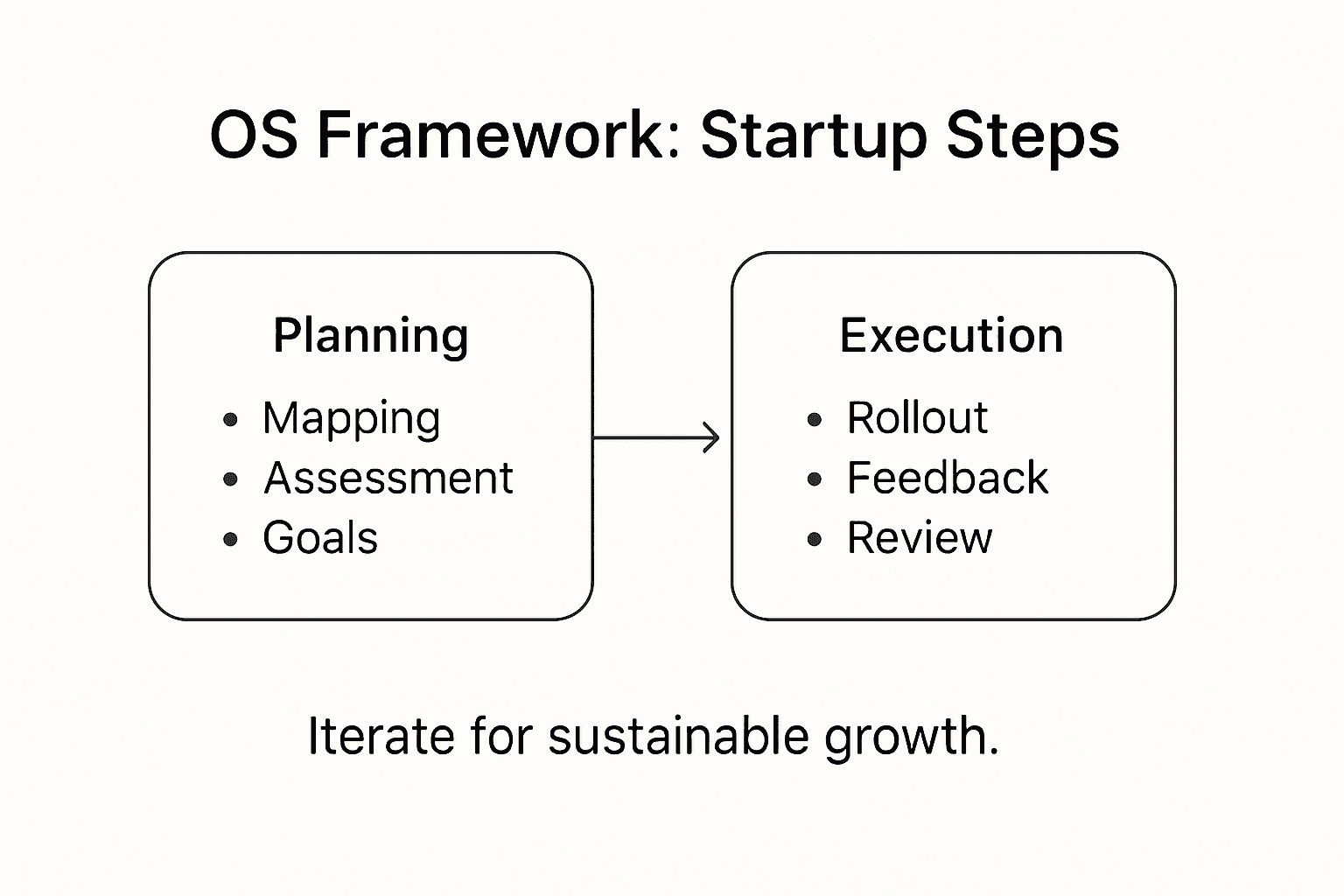
Systematic implementation strategies for entrepreneurial operating systems reveal a structured approach that breaks down complex organizational transformation into manageable stages. This methodical process involves five critical domains: vision alignment, talent optimization, data-driven decision making, process standardization, and adaptive problem solving. Each domain requires intentional design and consistent execution to create a resilient, self-sustaining business ecosystem.
The implementation roadmap typically encompasses several key phases:
- Vision Alignment: Clearly define organizational goals, core values, and long-term strategic objectives
- Team Assessment: Evaluate current team capabilities, identify skill gaps, and design recruitment strategies
- Data Infrastructure: Establish robust metrics, reporting mechanisms, and performance tracking systems
- Process Documentation: Create standardized workflows, communication protocols, and operational guidelines
- Continuous Improvement: Design feedback loops and adaptive mechanisms for ongoing system optimization
Successful OS framework implementation demands more than technical execution. It requires a cultural shift where every team member understands their role in maintaining and enhancing the organizational system. Entrepreneurs must cultivate a mindset of systemic thinking, moving beyond traditional management approaches toward creating intelligent, self-regulating business architectures.
Pro Tip: Incremental Implementation: Start by implementing the OS framework in one critical department, document the results, and progressively expand the system across your entire organization, allowing for real-world testing and refinement.
Common Mistakes when Adopting a System Framework
System framework adoption is a complex process fraught with potential pitfalls that can derail even the most well-intentioned organizational transformation efforts. Entrepreneurs must navigate these challenges with strategic awareness and proactive planning to ensure successful implementation.
Empirical research on organizational systems adoption reveals a series of critical mistakes that consistently undermine framework integration. The most prevalent errors stem from fundamental misunderstandings about systemic change, organizational readiness, and the nuanced requirements of comprehensive operational redesign.
The most common mistakes entrepreneurs encounter include:
- Premature Standardization: Implementing rigid processes before understanding unique organizational dynamics
- Insufficient Stakeholder Engagement: Failing to secure buy-in and commitment from key team members
- Overcomplication: Creating unnecessarily complex systems that overwhelm rather than streamline operations
- Neglecting Cultural Adaptation: Treating the framework as a technical solution rather than a holistic organizational transformation
- Inconsistent Implementation: Applying the framework sporadically instead of comprehensively
Most system framework failures occur when entrepreneurs treat the process as a one-time event rather than an ongoing journey of continuous improvement. The most successful implementations recognize that organizational systems are living ecosystems that require constant nurturing, adjustment, and strategic refinement.
For reference, here’s a summary of common mistakes and how to prevent them during system framework adoption:
| Mistake | Impact on Business | Prevention Strategy |
|---|---|---|
| Premature standardization | Processes do not fit needs | Analyze unique requirements |
| Insufficient engagement | Low morale and missed targets | Involve all stakeholders early |
| Overcomplication | System overwhelm and confusion | Design for simplicity |
| Neglect of culture | Resistance and poor adaptation | Prioritize cultural integration |
The root cause of most adoption failures lies in a fundamental misunderstanding of systems thinking. Entrepreneurs often approach framework implementation as a technical exercise, overlooking the critical human and cultural dimensions that determine true organizational effectiveness.
Pro Tip: Diagnostic Assessment: Before full implementation, conduct a comprehensive organizational readiness assessment to identify potential resistance points and design a tailored change management strategy that addresses your specific organizational context.
Unlock Predictable Growth with a Proven Operating System Framework
Entrepreneurs often struggle with chaotic processes, unclear financial direction, and leadership challenges that slow growth and increase burnout. This article highlights the core issue of missing a unified operating system framework that connects MATH, MECHANICS, and MIND to create predictable success. If you are seeking clarity in financial strategy, reliable sales infrastructure, and resilient leadership protocols, your business needs a strategic OS model designed to transform confusion into coordinated, scalable systems.
At Freedom Sun, we specialize in delivering this exact transformation. Our platform offers interactive training, comprehensive diagnostic assessments, and supportive community engagement tailored to entrepreneurial founders ready to reclaim control over their business operations without sacrificing wellbeing. By integrating the principles outlined in the article, you can move beyond reactive management to automated, strategic growth driven by clarity and resilience. Explore how our Operating System framework brings Fortune 500 CFO insights into your startup ecosystem. Take action today and start building your business’s future with confidence by visiting Freedom Sun and learn how to implement your own adaptive OS framework that powers sustained entrepreneurial success.
Frequently Asked Questions
What is an operating system framework in business?
An operating system framework is a comprehensive blueprint designed to streamline and integrate various business functions, including financial management, sales infrastructure, and leadership practices, ultimately facilitating strategic growth.
How can an operating system framework improve operational efficiency?
By standardizing processes, implementing automated decision protocols, and establishing clear communication channels, an operating system framework helps eliminate inefficiencies and minimizes organizational complexity, leading to improved operational efficiency.
What are the core pillars of the MATH, MECHANICS, and MIND framework?
The core pillars include MATH (financial strategy), MECHANICS (operational infrastructure), and MIND (leadership psychology). Together, they provide a holistic approach to enhancing business performance and fostering sustainable growth.
How can I implement an operating system framework in my startup?
Implementing an operating system framework involves a phased approach, focusing on vision alignment, team assessment, data infrastructure, process documentation, and continuous improvement to create a resilient and adaptive business ecosystem.
Recommended
- Welcome to Freedom Sun
- 7 Inspiring Examples of Growth Mindset for Entrepreneurs
- Financial Wellness: Equipping Leaders for Sustainable Growth
- Communication
- WordPress Digital Guide: Mastering Online Success in 2025 - WPCTO
- 7 Essential Types of E-Commerce Sites for Small Businesses - ResponsiveWebsiteDesign