Business Operating System: Unlocking Profitable Growth

Most american technology startups face a hidden challenge: over 80 percent of scaling failures stem from missing or poorly implemented business operating systems. Every founder chasing rapid growth knows how easily chaos disrupts financial stability, sales consistency, and team wellbeing. Understanding how world-class companies build adaptive systems can make the difference between burnout and sustainable success. This guide reveals the proven foundations and modern misconceptions behind operating systems, offering practical strategies for founders ready to grow with confidence.
Table of Contents
- Business Operating System Defined and Debunked
- Primary Types and Core Components Explained
- How Business Operating Systems Drive Scale
- Essential Pillars: Math, Mechanics, and Mind
- Common Pitfalls and Best Practices
Key Takeaways
| Point | Details |
|---|---|
| Business Operating Systems Enhance Performance | They provide a structured framework that aligns processes, communication, and decision-making across organizations, leading to consistent results. |
| Types of Business Operating Systems | Options like EOS, Scaling Up, Agile, and Holacracy cater to different organizational needs and growth stages, ensuring proper fit for companies. |
| Key Pillars: MATH, MECHANICS, and MIND | These pillars are essential for fostering financial clarity, operational efficiency, and a strong leadership culture, respectively, driving overall business success. |
| Importance of Change Management | Effective implementation of a business operating system requires careful planning, communication, and adaptation to counter common pitfalls and foster holistic transformation. |
Business Operating System Defined and Debunked
A business operating system represents a strategic framework that transforms how entrepreneurs organize, execute, and scale their ventures. Unlike traditional management approaches, this system provides a comprehensive blueprint for coordinating processes, communication, and decision making across an entire organization. Business systems fundamentally coordinate organizational performance by establishing clear protocols that drive consistent results.
At its core, a business operating system integrates multiple critical components: standardized workflows, communication channels, performance metrics, and strategic alignment mechanisms. High-performing companies like Toyota have long understood that systematic approaches create predictable outcomes. The goal isn’t merely to document processes but to create an adaptive framework that evolves with your business’s growth and changing market dynamics.
Most founders mistakenly believe operating systems are complex, rigid structures reserved for massive corporations. In reality, every company already has an operating system—whether intentionally designed or accidentally inherited. The difference lies in whether you proactively architect your system or allow it to emerge chaotically through default behaviors. Small businesses and startups can particularly benefit from deliberately establishing clear decision frameworks, communication protocols, and performance tracking mechanisms.
Pro Tip: Start documenting your existing business processes, even informally, to understand your current operating system and identify potential optimization opportunities.
Primary Types and Core Components Explained
Business operating systems are not monolithic structures but diverse frameworks designed to optimize organizational performance. Comprehensive operating systems integrate multiple critical components including processes, people, data management, and accountability structures. These systems can be categorized into several primary types, each with unique characteristics tailored to different organizational needs and growth stages.
The most prominent business operating system types include Entrepreneurial Operating System (EOS), Scaling Up, Agile, and Holacracy. EOS focuses on vision, traction, and healthy team dynamics, while Scaling Up emphasizes strategic planning and execution. Agile systems prioritize flexibility and iterative development, and Holacracy distributes decision making across self-organizing teams. Each system shares core components like performance tracking, communication protocols, and strategic alignment mechanisms, but differs in implementation approach and philosophical underpinnings.
Here’s a quick comparison of leading business operating system types and their core focus:
| System Type | Main Focus | Best For |
|---|---|---|
| EOS | Vision, team health, alignment | Established organizations |
| Scaling Up | Strategy and execution | Rapidly growing firms |
| Agile | Flexibility and adaptation | Innovative startups |
| Holacracy | Distributed decision making | Flat, dynamic teams |
Choosing the right business operating system depends on multiple factors: company size, industry complexity, growth stage, and cultural dynamics. Startups might benefit from more fluid, adaptable systems like Agile, while established enterprises might prefer structured frameworks like EOS or Scaling Up. The key is selecting a system that matches your organization’s unique rhythm, allowing for seamless integration of processes, transparent communication, and strategic flexibility.
Pro Tip: Conduct a thorough organizational assessment before selecting a business operating system to ensure alignment with your company’s specific cultural and operational requirements.
How Business Operating Systems Drive Scale
Business operating systems transform organizational potential by creating predictable, repeatable mechanisms for growth. These strategic frameworks serve as the architectural blueprint that enables companies to scale beyond their initial limitations, converting chaotic startup energy into structured, sustainable expansion. Systematic approaches to business infrastructure allow entrepreneurs to move from unpredictable performance to reliable, consistent results.

Scaling requires more than just adding resources—it demands intelligent system design. Predictable growth emerges when companies implement robust operating systems that standardize critical processes like sales, financial management, communication, and decision making. High-performing organizations create frameworks that continuously optimize performance, allowing teams to execute with precision while maintaining flexibility. This means developing clear accountability structures, performance metrics, and communication protocols that enable rapid adaptation without sacrificing operational integrity.
The most successful scaling strategies integrate three core dimensions: strategic alignment, operational efficiency, and cultural coherence. Companies that master these elements can transform from small, reactive entities into mature, proactive organizations. By documenting workflows, establishing key performance indicators, and creating transparent decision making processes, businesses can eliminate bottlenecks, reduce individual dependency, and build systems that can operate effectively with minimal founder intervention. The ultimate goal is creating an organizational machine that can grow independently of any single individual’s efforts.
Pro Tip: Document your current business processes and identify three key bottlenecks that prevent consistent, predictable performance.
Essential Pillars: MATH, MECHANICS, and MIND
MATH represents the foundational financial infrastructure that transforms entrepreneurial vision into measurable, predictable performance. Advanced business frameworks integrate mathematical precision with strategic design, creating systems that turn raw financial data into actionable insights. This pillar focuses on developing robust financial models, key performance indicators, cash flow projections, and profitability tracking that provide crystal-clear visibility into business health.
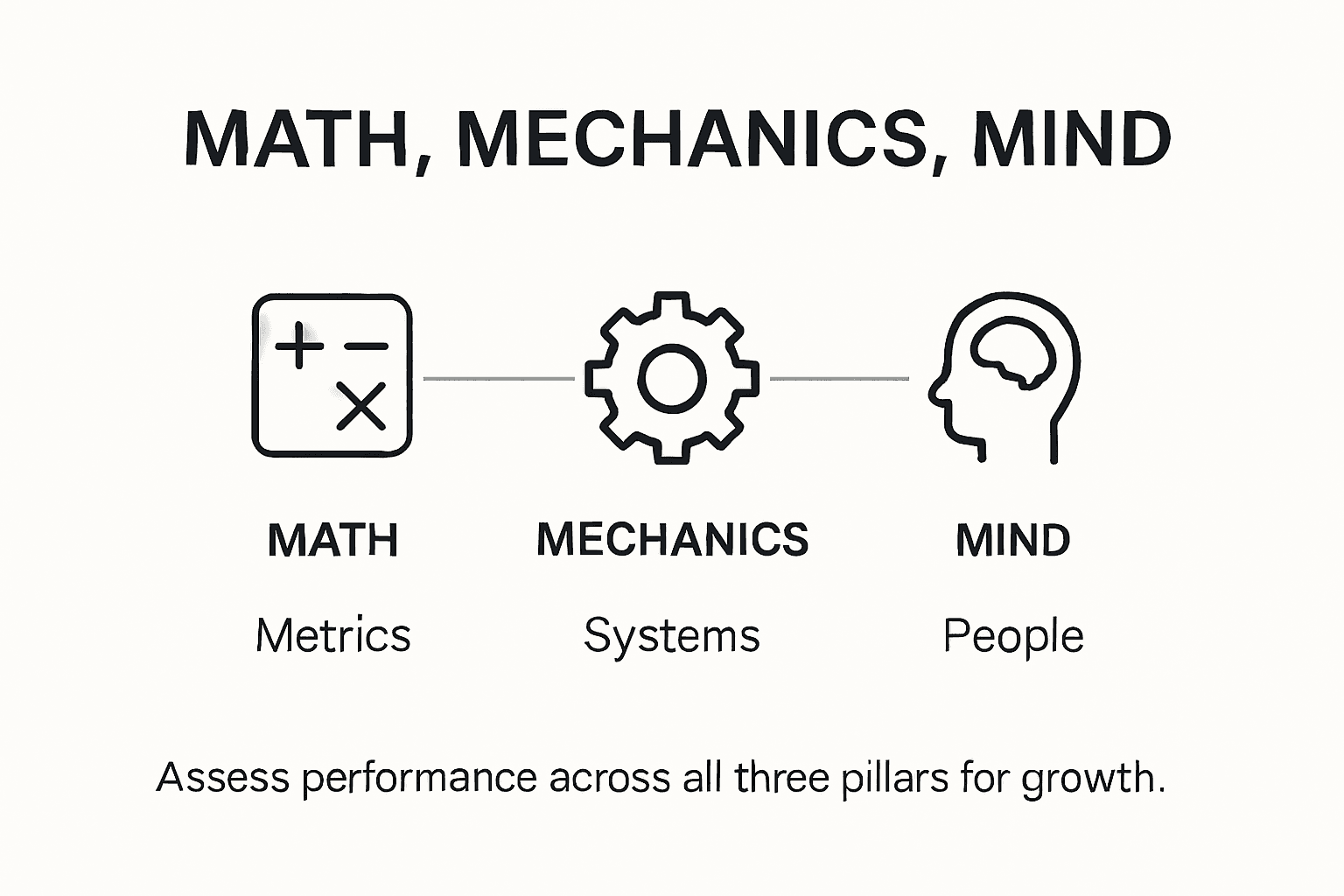
MECHANICS addresses the operational infrastructure that enables consistent, scalable execution. This pillar encompasses sales processes, communication protocols, workflow design, and systematic approaches to delivering value. High-performing organizations design repeatable mechanisms that transform individual brilliance into organizational capability. The goal is creating systems where performance becomes predictable, reducing dependency on specific team members and enabling sustainable growth.
The MIND pillar recognizes that technical systems are ultimately human systems. Leadership mindset, team psychology, communication dynamics, and personal resilience form the critical yet often overlooked dimension of business operating systems. Successful entrepreneurs understand that technical infrastructure must be balanced with emotional intelligence, clear vision, adaptive thinking, and a culture of continuous learning. This pillar focuses on developing leadership practices that create psychological safety, promote transparent communication, and build organizational adaptability.
The table below summarizes how the three pillars drive business performance:
| Pillar | Primary Emphasis | Business Impact |
|---|---|---|
| MATH | Financial modeling, KPIs | Enables data-driven decisions |
| MECHANICS | Processes, communication | Supports consistent execution |
| MIND | Leadership, culture | Builds resilience and adaptability |
Pro Tip: Conduct a quarterly assessment of your business systems across MATH, MECHANICS, and MIND to identify potential optimization opportunities and emerging performance bottlenecks.
Common Pitfalls and Best Practices
Implementing a business operating system is fraught with potential challenges that can derail even the most well-intentioned organizational transformation. Systematic approaches to risk management are critical in navigating complex system implementations, with the most common pitfalls emerging from inadequate planning, poor communication, and misalignment between technical capabilities and human behaviors. Founders often underestimate the complexity of integrating new systems, assuming technology alone can solve deeply rooted organizational inefficiencies.
The most significant barriers to successful business operating system implementation typically revolve around three core dimensions: leadership resistance, insufficient change management, and unrealistic expectations. Many organizations fail by treating system implementation as a technical exercise rather than a holistic organizational transformation. This means neglecting crucial elements like team training, cultural adaptation, and incremental implementation strategies. Successful organizations approach system design as a dynamic, iterative process that requires continuous feedback, flexibility, and a commitment to learning.
Best practices for implementing a robust business operating system demand a multifaceted approach. Critical strategies include conducting comprehensive organizational assessments before implementation, developing clear communication protocols, creating staged rollout plans, and establishing robust training and support mechanisms. Successful founders invest significant time in understanding their current organizational dynamics, identifying specific performance bottlenecks, and designing systems that address root cause challenges rather than applying superficial technical solutions. This requires a nuanced understanding of both technical infrastructure and human psychological factors that influence organizational behavior.
Pro Tip: Create a detailed change management plan that includes stakeholder mapping, communication strategies, and incremental implementation milestones before launching your business operating system.
Unlock Predictable Growth with a Proven Business Operating System
If you are struggling with chaotic processes and unclear leadership direction as described in the article “Business Operating System: Unlocking Profitable Growth,” you are not alone. Many entrepreneurial founders face the challenge of transforming scattered efforts into a cohesive, scalable system that balances financial clarity, operational consistency, and strong leadership. Key pain points include overcoming bottlenecks in communication, aligning strategic execution with culture, and escaping relentless hustle to build sustainable wealth.
At Freedom Sun, we specialize in helping high-growth entrepreneurs design and implement their tailored Operating System frameworks modeled around the powerful MATH, MECHANICS, and MIND pillars. Our professional development platform offers interactive training and diagnostic assessments that guide you through financial modeling, sales infrastructure, and cultivating resilient leadership. This approach transforms your business from unpredictable to predictable without sacrificing your peace of mind or risking burnout.
Are you ready to stop reacting to constant chaos and start architecting your profitable peace? Explore how to create a robust system that runs smoothly even when you step back by visiting our Operating System Framework. Take control of your business infrastructure today and unlock the freedom to lead with clarity and confidence.
Frequently Asked Questions
What is a business operating system?
A business operating system is a strategic framework that helps entrepreneurs organize, execute, and scale their ventures by coordinating processes, communication, and decision-making within an organization.
Why do I need a business operating system for my small business?
A business operating system provides a clear decision-making framework and communication protocols, which can help small businesses optimize their operations and achieve consistent, predictable growth.
What are the core components of a business operating system?
Core components of a business operating system include standardized workflows, communication channels, performance metrics, and mechanisms for strategic alignment, all working together to enhance efficiency and effectiveness.
What are some common pitfalls in implementing a business operating system?
Common pitfalls include inadequate planning, poor communication, leadership resistance, and unrealistic expectations. Successful implementation requires a thorough assessment, clear protocols, training, and a commitment to iterative learning.