Build self-trust for business success: Confidence tools

TL;DR:
- Self-trust is a crucial internal skill that enhances women entrepreneurs’ decision-making and resilience.
- Building self-trust involves daily practices, understanding psychological foundations, and aligning environment with internal authority.
- Focusing solely on confidence is limited; combining internal self-trust development with systemic environment change leads to lasting success.
You can have the credentials, the client wins, the track record, and still freeze before sending a proposal. That is not a skills gap. It is a self-trust gap, and it shows up for even the most accomplished women entrepreneurs every single day. The frustrating part? Most advice tells you to “just be more confident,” as if confidence is a switch you flip. It is not. Self-trust is a practice, a skill set, and a neurological habit you build deliberately. This article breaks down the real mechanics behind self-trust, exposes where common advice goes wrong, and gives you a practical framework to start building the kind of internal authority that shows up in your leadership and your sales.
Table of Contents
- Why self-trust matters more than generic confidence
- Understanding the roots: Psychological foundations of self-trust
- Beyond the ‘confidence gap’: What most advice gets wrong
- Building self-trust as a daily practice: Tools and frameworks
- Bringing it together: Self-trust for lasting leadership and sales impact
- The uncomfortable truth most experts miss about self-trust in business
- Start building unstoppable self-trust: Your next steps
- Frequently asked questions
Key Takeaways
| Point | Details |
|---|---|
| Self-trust is foundational | It underpins high-quality decisions, resilient leadership, and sustainable success in business. |
| Go beyond the confidence gap | Both mindset and system-level strategies are needed to unlock business potential for women. |
| Build self-trust daily | Practical routines like celebrating small wins and seeking honest feedback systematically strengthen self-trust. |
| Evaluate your environment | Surround yourself with feedback-rich, values-aligned networks that reinforce authentic self-trust. |
| Leverage expert guidance | Ongoing education and support accelerate the application and impact of self-trust in leadership and sales. |
Why self-trust matters more than generic confidence
Most conversations about women and confidence focus on the outward performance: speaking up more, taking up space, projecting certainty. But self-trust is something quieter and far more powerful. It is the internal conviction that your own judgment is reliable, that your interpretation of a situation is worth acting on, and that you can handle what comes next, even when you do not have every answer.
Outward confidence can be performed. Self-trust cannot be faked for long, and more importantly, it should not be. Research confirms that self-trust and self-efficacy map directly onto measurable entrepreneurial performance and resilience, not just emotional well-being. That means the way you relate to your own judgment literally shapes how your business performs.
“Self-trust is not arrogance. It is the willingness to act from your own knowledge while staying open to learning. That combination is what drives sustainable leadership.”
When women entrepreneurs build genuine self-trust, the business outcomes are concrete and compounding. You make faster decisions with less second-guessing. You negotiate without apologizing. You stay steady when clients push back on your pricing. You recover faster from setbacks because you trust your capacity to adapt.
Here are some of the most measurable business impacts self-trust produces:
- Better risk-taking. You evaluate opportunities from competence rather than fear, which means better bets.
- Persistence through rejection. Sales require resilience. Self-trust keeps you moving after a no without internalizing it as a verdict on your worth.
- Confident pricing. Women who trust their judgment are far less likely to discount reflexively or undercharge.
- Stronger leadership presence. Teams and clients sense internal authority. It creates safety and buy-in.
- Clearer communication. You stop over-explaining and over-hedging when you trust your own perspective.
You can also deepen your leadership foundation with mental resilience strategies and practical self-leadership habits that reinforce these outcomes daily.
Understanding the roots: Psychological foundations of self-trust
Self-trust is not a single trait. It is built from at least three well-researched psychological foundations, each of which influences how you operate in your business every single day.
Self-efficacy is your belief that you can execute specific tasks successfully. It is situational, meaning you might have high self-efficacy for client delivery but low self-efficacy for sales calls. Self-esteem is the broader sense that you are a person of worth and competence. Psychological capital is the combination of hope, resilience, optimism, and efficacy that research increasingly links to entrepreneurial performance.
These three foundations interact in powerful ways. Self-esteem mediates depression’s effect on self-efficacy, which is a key predictor of entrepreneurial action and confidence. In plain terms: when your sense of self-worth dips, your belief in your ability to take action dips with it, and that ripples into your revenue, your leadership, and your willingness to pursue growth.
Here is how each foundation maps to real business outcomes:
| Psychological foundation | What it looks like in business | When it breaks down |
|---|---|---|
| Self-efficacy | Taking on challenging clients, pitching at higher price points | Avoiding opportunities, excessive preparation before action |
| Self-esteem | Setting firm boundaries, negotiating clearly | Apologizing reflexively, undercharging, seeking constant approval |
| Psychological capital | Bouncing back after a loss, sustaining long-term vision | Quitting after one rejection, difficulty tolerating uncertainty |
Exploring growth mindset examples for entrepreneurs helps you see exactly how these foundations show up in real decisions. And if you are building a solo practice, understanding self-sufficiency in business directly connects to strengthening these pillars.
To assess where you stand right now, work through these steps:
- Name your high-efficacy zones. Where do you act with ease and certainty? Those are your anchors.
- Identify avoidance patterns. What tasks do you consistently delay or over-prepare for? Those point to efficacy gaps.
- Track self-esteem signals. Notice when you automatically apologize, discount, or seek reassurance that was not asked for.
- Test your resilience window. How long does it take you to recover after a setback? A week? An hour? That tells you a lot about your psychological capital.
- Map the patterns to revenue. Connect the avoidance behaviors and approval seeking directly to where your business growth has stalled.
This is not about diagnosing yourself. It is about building a clear, honest picture so you know exactly where to focus your development energy.
Beyond the ‘confidence gap’: What most advice gets wrong
Here is the problem with telling women to “just be more confident.” It treats a structural issue as a personal failing. Decades of research and workplace data show that women who demonstrate assertiveness and decisive leadership are often evaluated differently for potential than men showing the same behaviors. The confidence gap narrative can actively mislead capable women into performing a kind of confidence that either backfires socially or damages their self-concept when it does not produce results.
“Telling a woman to ‘be more confident’ without changing the systems that evaluate her is like handing someone a map to a destination they are already blocked from reaching.”
The distinction between authentic self-trust, performative confidence, and overconfidence matters enormously. Here is how they compare:
| Self-trust | Performative confidence | Overconfidence | |
|---|---|---|---|
| Source | Internal, evidence-based | External, approval-seeking | Inflated, unchecked |
| Decision quality | High, calibrated | Inconsistent | Poor, risk-blind |
| Response to failure | Learns and adjusts | Collapses or blames | Denies or deflects |
| Business risk | Low | Burnout, inauthenticity | Financial loss, damaged trust |
| Relationship effect | Builds deep trust | Erodes over time | Creates resistance |
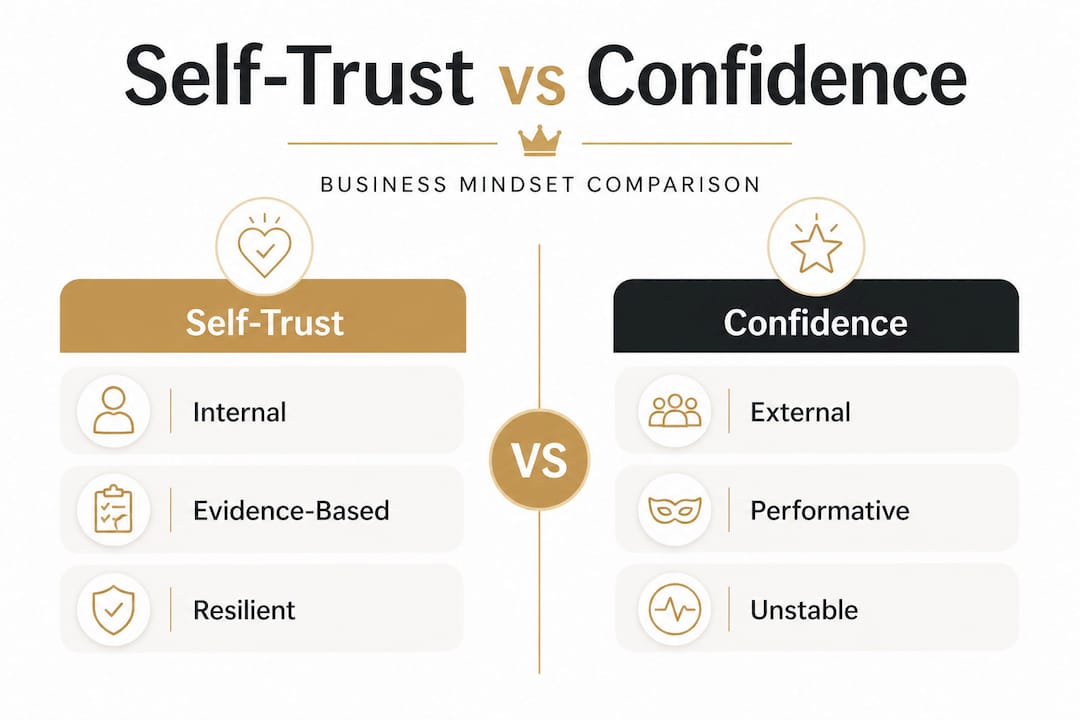
The goal is never to perform confidence for an audience. It is to develop the internal signals that allow you to make good decisions under pressure. That is what creates lasting leadership qualities for women in business: the ability to lead from a place of honest, calibrated authority rather than a mask.
Pro Tip: When you are in a business environment, pay attention to whether the culture rewards certainty over accuracy. If you notice that bold, quick answers are celebrated regardless of outcomes, and careful, nuanced thinking is overlooked, that environment is working against your self-trust, not with it. Recognize that pattern so you can navigate it strategically rather than internalize it as your own shortcoming.
Building self-trust as a daily practice: Tools and frameworks
Self-trust is not built in a weekend retreat. It is built in the small, repeated moments where you choose to act from your own judgment, reflect honestly on what happened, and adjust. Think of it as training, not transformation. And like any training, consistency beats intensity.

The framework that works is simple: small wins confirm competence, learning mindsets extend it, and honest feedback loops lock it in. These are not motivational concepts. They are evidence-backed mechanisms that systematically reinforce self-trust.
Authentic leadership research also points to values alignment, clear accountability, and firm personal boundaries as the architecture beneath real leadership authority. These are not soft skills. They are structural habits.
Here is a practical weekly practice to get started:
- Morning decision journaling. Each morning, make one micro-decision without researching it further. Practice trusting your first informed instinct.
- Evidence log. Keep a running document of decisions that went well. Not to boost ego, but to build an accurate data set of your judgment quality.
- Debrief one setback weekly. Ask what the situation required, what you did, what you would do differently. No self-blame, just data.
- Celebrate completion, not just outcomes. Finishing a sales call, sending a proposal, or holding a boundary deserves acknowledgment even if the result was not perfect.
- Weekly reflection prompt. Ask yourself: “Where did I trust myself this week, and what happened?” Then: “Where did I override my instinct, and what drove that?”
- Identify one learning edge. Choose one skill area where you need more competence, not more self-criticism, and take one concrete learning action.
Beyond the daily practices, these feedback and learning tools reinforce the whole system:
- Truth-telling peer groups. A small group of trusted peers who give you honest, specific feedback rather than cheerleading.
- Values audits. Quarterly check-ins where you assess whether your business decisions actually reflect your stated values.
- Leadership mindset frameworks that help you separate your identity from your results.
- Sales confidence strategies that train you to stay present and grounded in high-stakes conversations.
Pro Tip: When you experience a business setback, the instinct is often to either push through aggressively or retreat into over-analysis. A more powerful move is to name exactly what happened, separate facts from interpretations, and ask one clear question: “What does this tell me about what I need to learn, and what does it confirm I already know?” That is self-trust in action under pressure.
Bringing it together: Self-trust for lasting leadership and sales impact
Self-trust does not stay in one lane. Once you build it in one area of your business, it migrates. The woman who learns to trust her pricing instincts starts trusting her leadership instincts. The entrepreneur who stops seeking approval before every decision starts setting stronger client boundaries. The cascade is real, and self-esteem and self-efficacy link directly to improved entrepreneurial orientation and business growth for women.
The compounding benefits look like this:
- Leadership: Clearer vision communication, faster team trust, less second-guessing in strategic decisions
- Sales: More direct conversations about value, less over-explaining, higher close rates without discounting
- Client relationships: Firmer scope management, less over-delivering out of fear, stronger long-term retention
- Culture: Teams model your internal authority, creating organizations where honest feedback and clear accountability thrive
- Revenue: Pricing reflects actual value, fewer low-profit clients, higher average contract values
To maintain this momentum, build environmental supports into your business structure. Create routines that protect your reflection time. Choose mentors and peers who model calibrated decision-making. Review your leadership habits regularly to make sure they are reinforcing your self-trust rather than eroding it. And build your business finances on a foundation of financial resilience principles so that money stress does not become the primary driver of your decisions.
The uncomfortable truth most experts miss about self-trust in business
Here is what most confidence advice for women conveniently leaves out: even highly competent women are routinely underrated for leadership potential in evaluation systems designed around different behavioral norms. So when we tell women to build more self-trust as purely an inside job, we are solving half the problem and ignoring the other half.
Self-trust development is essential. It is non-negotiable. But if you do only the internal work and ignore the environments you operate in, you will keep running into invisible ceilings and attributing them to your own inadequacy. That is not accurate, and it is not fair.
The real power move is to do both things simultaneously. Build your internal authority through the practices and frameworks described here. And at the same time, design your business environment intentionally. Choose clients who value calibrated expertise over performative certainty. Build feedback systems that reward honest reflection rather than bravado. Create evaluation criteria in your own business that measure decision quality over time, not just confidence in the moment.
This is what advanced self-leadership actually looks like: not just managing your mindset, but architecting your environment to reinforce the behaviors and values that drive genuine growth. The women who accelerate fastest are not the ones who simply “believe in themselves” harder. They are the ones who build belief through evidence, and then redesign their business systems to keep generating that evidence.
The shift from mindset work as a solo project to mindset work as an integrated business strategy is where the real results live. That is the conversation that needs to happen more.
Start building unstoppable self-trust: Your next steps
Understanding the mechanics of self-trust is powerful. Putting it into practice every single day in the pressure of running a real business is a different kind of work, and you do not have to figure it out alone. At Freedom Sun, the training is built specifically for women entrepreneurs who are ready to close the gap between what they know and what they actually do in the room. Through live practice workshops, intensive seminars, and a six-month coaching cohort, you get the neuroscience-informed, body-based tools to lead and sell from a place of genuine internal authority. Start with the self-leadership resource to see how this work comes together in practice.
Frequently asked questions
What is the difference between self-trust and self-confidence in business?
Self-trust centers on reliably acting from your own judgment, while self-confidence is often outward assurance directed toward others. Research shows that self-trust and efficacy correlate more strongly with lasting business outcomes than surface-level confidence performance.
How can women entrepreneurs build self-trust if they struggle with imposter syndrome?
Start with small, verifiable wins that confirm your competence and build an honest evidence log of your decisions over time. Small wins and feedback loops are evidence-based tools that interrupt the imposter narrative at its root.
Why doesn’t “acting more confident” always lead to better business outcomes for women?
Because systems often penalize women for the same assertiveness they reward in others, meaning the problem is not just internal. Authentic self-trust combined with systemic awareness is what actually moves the needle, not performing a version of confidence designed for a different set of standards.
Can self-trust be measured or improved with specific tools?
Yes. Self-trust can be measured through constructs like self-efficacy and self-esteem, both of which are trackable and trainable. Self-efficacy and self-esteem are tied to real entrepreneurial action and improve with consistent daily practices and honest feedback.