Stop freezing on sales calls: 69% of women entrepreneurs do

TL;DR:
- Women entrepreneurs frequently freeze during sales calls due to fear, perfectionism, and imposter syndrome. The freeze response is a biological safety mechanism triggered by high-stakes situations. Building confidence involves preparation, regulation techniques, reflection, and consistent practice over time.
You’re mid-sentence on a sales call and your mind goes blank. The words stop coming, your confidence evaporates, and suddenly you’re over-explaining, apologizing, or rushing to end the conversation. If this sounds familiar, you’re not broken and you’re not alone. Freezing during sales calls is one of the most common, least talked-about challenges for women entrepreneurs who are already successful in their field. This article explains exactly why it happens, what your brain is doing in those moments, and how to interrupt the pattern so your next sales conversation feels different.
Table of Contents
- Understanding the freeze: What really happens in your brain
- Why women freeze more: The impact of imposter syndrome and gender expectations
- Breaking the cycle: Science-backed methods to unfreeze in real time
- Building lasting confidence: Everyday habits for sales resilience
- Our take: Moving from self-doubt to sales authority isn’t about perfection
- Ready for easier, more confident sales conversations?
- Frequently asked questions
Key Takeaways
| Point | Details |
|---|---|
| Freezing is normal | Many women entrepreneurs experience the freeze response in sales calls due to both biological and social factors. |
| Imposter syndrome’s impact | Imposter syndrome and gender norms increase anxiety but can be addressed with proven techniques. |
| Practical tools help | Using rituals, breathing, and scripts lets you recover in the moment and build ongoing sales confidence. |
| Confidence grows through action | Long-term resilience is developed by consistent practice, mentorship, and small wins—not perfection. |
Understanding the freeze: What really happens in your brain
The freeze response is not a character flaw. It is a protective mechanism your brain triggers when it perceives a threat. During a high-stakes sales call, your amygdala, the brain’s alarm system, can fire as if you’re facing physical danger. When that happens, it floods your body with stress hormones and temporarily reduces access to your prefrontal cortex, which is the part of your brain responsible for clear thinking, language, and decision-making.
The result? You go cognitively blank. Words disappear. You lose your train of thought. You might start over-qualifying your offer or drop your price before the client even pushes back. This is not weakness. It is biology.
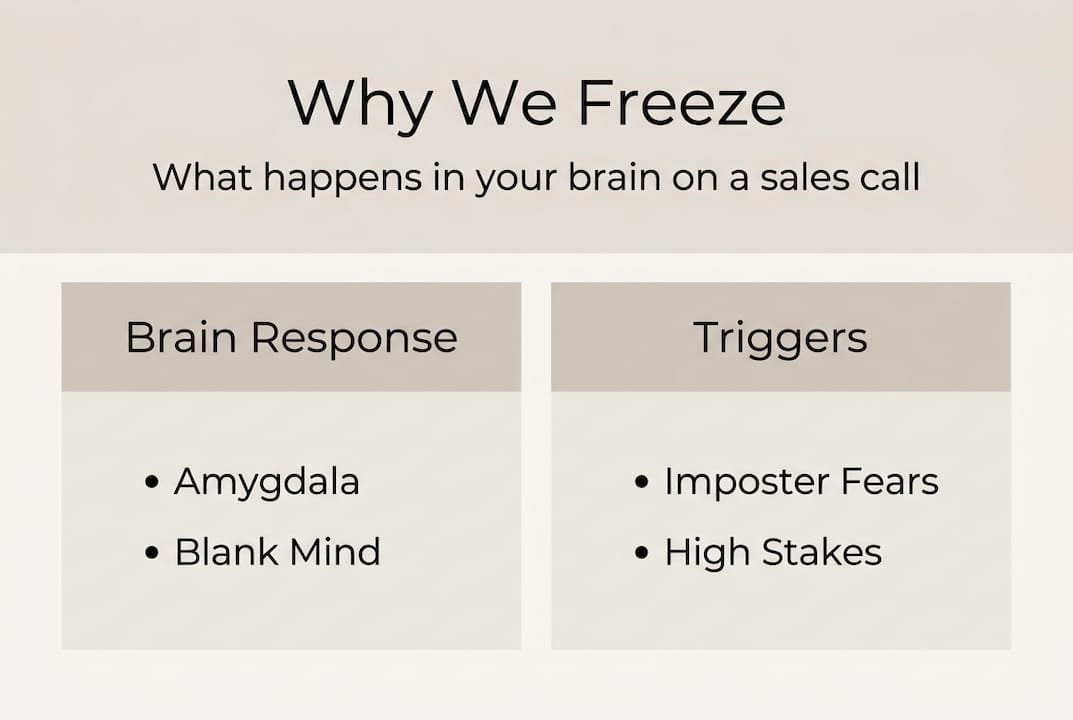
According to research on sales call anxiety, the amygdala triggers a cognitive shutdown that can be interrupted by structure and deliberate practice. That’s actually good news. It means the freeze is not permanent and it is not who you are.
For women entrepreneurs specifically, the stakes feel even higher because of how we’ve been socialized. You’ve likely been taught to be agreeable, likable, and not too pushy. Sales conversations can feel like they violate all of those rules at once. That creates a unique kind of internal conflict that makes the freeze more likely.
Common freeze triggers on sales calls include:
- Fear of rejection or being told no
- Perfectionism and pressure to say everything exactly right
- Imposter syndrome flaring up right when you need to sound authoritative
- The double bind: being assertive enough to close but not so assertive that you seem aggressive
- High-achiever pressure to perform flawlessly in every interaction
“The moment you understand that freezing is a nervous system response, not a personal failure, everything changes. You stop fighting yourself and start working with your biology.”
Developing stronger communication skills for business growth is one of the most effective long-term strategies for reducing how often the freeze shows up, because familiarity and structure calm the amygdala before it even fires.
Why women freeze more: The impact of imposter syndrome and gender expectations
With the brain science in place, let’s dig into why this pattern shows up more for women entrepreneurs.
The numbers are striking. Imposter syndrome affects 69% of female entrepreneurs, and 65% of women in Fortune 500 leadership roles report experiencing it regularly. That means the majority of high-achieving women are walking into sales conversations already carrying a quiet voice that says they’re not quite qualified enough, not quite ready, not quite worth the price they’re charging.

Here’s a comparison of how imposter syndrome and sales anxiety show up differently by gender:
| Factor | Women entrepreneurs | Men entrepreneurs |
|---|---|---|
| Imposter syndrome prevalence | 69% | ~49% |
| Use of qualifying language in sales | High | Low |
| Likelihood to negotiate assertively | 4x lower | Baseline |
| Tendency to underprice services | Common | Less common |
| Freeze response under sales pressure | More frequent | Less frequent |
Women outperform men in key sales metrics like listening, empathy, and relationship-building, yet remain four times less likely to negotiate assertively. That gap is not about skill. It is about conditioning.
The double bind is real. If you’re too direct, you risk being perceived as aggressive. If you’re too soft, you lose authority. Most women spend the first half of a sales call unconsciously trying to navigate that tension, which is exactly when the freeze sets in.
“Your sales anxiety is not evidence that you’re not good enough. It’s evidence that you care deeply and that you’ve been taught to shrink in the exact moments you need to expand.”
Pro Tip: Before your next call, write down three specific results you’ve delivered for past clients. Read them out loud. This activates the part of your brain that holds evidence of your competence, which is a direct counter to imposter syndrome.
Learning to get better at sales is not just a skill issue. It requires addressing the psychological layer underneath. And building self-sufficiency in business means developing the internal resources to show up confidently even when the old conditioning tries to pull you back.
Breaking the cycle: Science-backed methods to unfreeze in real time
Recognizing the problem is vital. Now, here’s how to reclaim confidence when it strikes.
The most effective approach combines preparation before the call, regulation during it, and reflection after. Here’s a step-by-step framework:
- Prepare with a ritual. Before every call, do something that grounds you physically. A short walk, three deep breaths, or even reviewing your wins list. Rituals signal safety to your nervous system.
- Use paced breathing. Breathe in for four counts, out for six. This activates your parasympathetic nervous system and reduces the amygdala’s alarm response within 60 to 90 seconds.
- Follow a call structure. A loose script or call framework keeps your prefrontal cortex engaged even when anxiety spikes. You don’t need to read it word for word. You just need it as an anchor.
- Reappraise in the moment. When you feel the freeze coming, silently remind yourself: “This is just my nervous system. I know what I’m doing.” Cognitive reappraisal is one of the most research-backed tools for interrupting anxiety in real time.
- Reframe sales as service. You’re not asking for something. You’re offering a solution to a real problem. That shift redirects anxiety toward purpose.
For the first two weeks, try a progressive exposure plan. Start with lower-stakes conversations, maybe a check-in call with an existing client or a casual discovery call. Gradually increase the challenge. Each successful call builds a new neural pathway that says: “I can do this.”
Pro Tip: If you freeze mid-call, use a bridging phrase like “Let me make sure I’m addressing what matters most to you” and then pause. It buys you five seconds to reset and sounds professional, not panicked.
A consultative sales approach naturally reduces freeze because it shifts the focus from performing to listening, which is a much more comfortable mode for most women entrepreneurs. Pairing that with solid sales growth tactics gives you both the mindset and the method.
Building lasting confidence: Everyday habits for sales resilience
Alongside in-the-moment fixes, building a foundation for future confidence is key.
There’s an important difference between short-term tricks and long-term confidence-building. Both matter, but they work differently.
| Approach | Short-term tricks | Long-term confidence building |
|---|---|---|
| Focus | Managing anxiety in the moment | Reducing baseline anxiety over time |
| Examples | Breathing, scripts, reappraisal | Weekly practice, mentoring, win tracking |
| Timeline | Immediate effect | Weeks to months |
| Sustainability | Situational | Foundational |
| Best used for | Crisis moments | Ongoing growth |
Sales anxiety is not a fixed personality trait. It is conditioned by experience, which means it can be reconditioned through deliberate, repeated practice. That’s one of the most freeing things to understand.
Here are the daily and weekly habits that build real resilience:
- Track your wins. After every successful call, write down what worked. Your brain needs evidence to override the imposter syndrome narrative.
- Ritualized review. Spend five minutes after each call noting one thing you’d keep and one thing you’d adjust. This builds skill without self-criticism.
- Progressive exposure. Keep raising the stakes slightly. Comfort zones expand only when you push their edges gently and consistently.
- Seek mentoring. Mentoring reduces imposter syndrome by 41% and accelerates the development of client trust. Having someone who has walked this path before you makes the process faster and less isolating.
- Find an accountability partner. A peer who is also working on sales confidence creates a safe space to practice, debrief, and celebrate progress.
Building consultative sales skills for entrepreneurs alongside strong communication skills for entrepreneurs creates a compounding effect. Each skill reinforces the other, and over time the freeze becomes the exception rather than the rule.
Our take: Moving from self-doubt to sales authority isn’t about perfection
Here’s what most advice on sales confidence gets wrong: it treats anxiety as the enemy. The goal becomes eliminating it entirely, and when you can’t, you assume you’re failing.
But freezing is actually a signal of growth. It shows up most when the stakes are real, when you care about the outcome, when you’re operating at the edge of your current capacity. That’s not a sign to retreat. That’s a sign you’re in the right room.
The women we see make the biggest leaps in sales confidence are not the ones who wait until the anxiety is gone. They’re the ones who learn to act alongside it. They feel the freeze coming and they use their structure, their breath, their script, and they keep going anyway.
Small, repeated wins compound faster than you’d expect. One call where you held your price. One conversation where you didn’t over-explain. One moment where you let silence do the work. Those moments stack up and they rewrite the story your nervous system tells about sales. Focusing on reducing burnout in sales while building this resilience means you grow sustainably, not through white-knuckling every call.
Perfect confidence is not the goal. Functional courage is.
Ready for easier, more confident sales conversations?
If this article gave you a clearer picture of why you freeze and what to do about it, the next step is putting these strategies into practice with real support behind you. Freedom Sun was built specifically for women entrepreneurs like you: successful, capable, and ready to close the gap between what you know and what you can actually make yourself do when money is on the line.
Through the Women’s Wealth Collective academy, live events, and the Nervous System of Money podcast, Freedom Sun helps you build sales confidence from the inside out, not just with tactics but with the nervous system work underneath them. Explore business training for women entrepreneurs and find the resource that fits where you are right now.
Frequently asked questions
Is freezing during sales calls common for women entrepreneurs?
Yes. Imposter syndrome affects 69% of female business owners, and many experience regular freezing on sales calls as a direct result of anxiety and gender-specific socialization pressures.
Can I stop freezing if I’m just naturally anxious about sales?
Absolutely. Sales anxiety is not a fixed trait. It is shaped by experience, and consistent practice with structured strategies helps most women reduce it significantly over time.
What do I do in the moment if I start to freeze on a call?
Use a paced breathing technique (four counts in, six counts out) or a scripted bridging phrase to reset. Paced breathing and scripts are among the most effective real-time tools for breaking the freeze.
Does confidence ever come naturally, or is it always a process?
Confidence in sales is built through repetition and small wins, not through a sudden transformation. High achievers still experience imposter syndrome, but resilience grows with consistent practice and evidence of past success.