Start a life coaching business: guide for women pivoting to wealth

TL;DR:
- Women entrepreneurs can succeed as life coaches by leveraging their existing business skills and lived experience.
- Building a niche, clear offering, and systems early leads to sustainable income and growth.
- Avoid common pitfalls like generalizing, underpricing, and lacking automation to maintain long-term success.
Most women entrepreneurs assume that pivoting to life coaching means trading revenue for purpose, or swapping one form of burnout for another. That assumption is wrong. The life coaching industry shows beginners earning $15,000 to $35,000 per year, averages climbing to $62,500 to $72,000, and the top 10% clearing $150,000 or more. The real question is not whether coaching can fund the life you want. It is whether you are building it the right way from the start. This guide gives you a step-by-step roadmap to pivot from entrepreneur to life coach without undercharging, burning out, or starting over from scratch.
Table of Contents
- Why women entrepreneurs excel as life coaches
- Core steps to launch your life coaching business
- Revenue goals and sustainable business models
- Pitfalls to avoid and proven strategies for sustainable wealth
- What most new life coaches get wrong (and how to avoid it)
- Ready to build your life coaching business?
- Frequently asked questions
Key Takeaways
| Point | Details |
|---|---|
| Credibility from lived experience | As a woman entrepreneur, your real-world experience and unique voice are your greatest assets—not just formal credentials. |
| Step-by-step launch roadmap | Success comes from clear steps: certification (optional), niching, legal setup, pricing, client attraction, and system building. |
| Diversify for sustainable wealth | Mixing 1:1, group, and digital coaching boosts revenue potential and keeps your work-life balance healthy. |
| Avoid burnout pitfalls early | Set boundaries, automate business management, and focus on ROI-driven client results to prevent overwhelm. |
| Start now, systemize quickly | Building systems before you scale lets you grow faster and more sustainably than hustling alone. |
Why women entrepreneurs excel as life coaches
Now that the industry’s potential is clear, let’s explore why women entrepreneurs are uniquely positioned to succeed in life coaching. The short answer is this: you already have what most coaches spend years trying to build.
Your corporate background, your revenue experience, and your hard-won lessons navigating sales, leadership, and growth are not just resume items. They are coaching assets. Clients in high-stakes situations, founders, executives, and business owners, pay premium rates for coaches who have actually lived the problems they are solving. That is a significant advantage you walk in with on day one.
Here is what transfers directly from your entrepreneurial experience:
- Business acumen: You understand P&L, pricing, and client dynamics, which makes you credible to founder and executive clients.
- Sales mindset: You have navigated the discomfort of selling, which means you can coach others through it with real empathy.
- Leadership experience: You have managed teams, made hard calls, and built systems, all of which are deeply coachable skills.
- Lived resilience: Your story of pivoting, failing forward, and building anyway is exactly what your future clients need to hear.
The leadership training for founders you have already done or sought out positions you to coach in high-value niches like burnout prevention, sales confidence, and business growth for women.
“Pivoting women entrepreneurs succeed by niching in high-value problems like burnout and sales for founders, using lived experience for credibility.”
The biggest mindset block at this stage is believing you need more credentials before you can charge well. You do not. Clients invest in transformation, not certificates. A self-employed coach roadmap built around your existing expertise will outperform a generic coaching practice built around a certification you pursued to feel ready.
Pro Tip: Write down three problems you have personally solved in business. Those are your first three coaching niches. Pick the one where you have the most evidence of results.
The pivot works best when it is additive, not subtractive. You are not leaving your expertise behind. You are packaging it differently.
Core steps to launch your life coaching business
With those strengths and opportunities established, here is a structured checklist for building your coaching business from the ground up. The core steps include certification, niche selection, legal setup, pricing, client acquisition, and marketing, and skipping any one of them creates gaps that cost you later.
- Choose your niche first. Before anything else, get specific. Burnout recovery for founders, sales mindset for women entrepreneurs, leadership development for executives. Specificity drives premium pricing.
- Decide on certification. ICF accreditation is not legally required, but it builds trust and can justify higher rates. If you have strong results and a clear niche, you can start without it.
- Set up your legal structure. Form an LLC, open a dedicated business bank account, and get liability insurance. This protects you and signals professionalism to clients.
- Build your offer and pricing. Start with a 90-day package rather than per-session pricing. Packages create commitment and better client outcomes.
- Acquire your first clients. Your network is your fastest path. Reach out directly, ask for referrals, and use LinkedIn to share your story and expertise.
- Build a simple content strategy. Consistency beats volume. One piece of content per week that speaks directly to your niche builds trust faster than daily posting on every platform.
| Step | Action | Timeline |
|---|---|---|
| Niche | Define your ideal client and core problem | Week 1 |
| Legal | LLC, bank account, insurance | Week 2 to 3 |
| Offer | Create a 90-day package with clear outcomes | Week 3 |
| Pricing | Set rates based on transformation, not time | Week 3 |
| First clients | Outreach to network and LinkedIn | Week 4 onward |
| Content | Weekly post or email to build trust | Ongoing |
Pro Tip: Before you launch publicly, run one beta client through your program at a reduced rate in exchange for a detailed testimonial. That testimonial becomes your most powerful marketing asset.
Building a sustainable coaching business means designing your systems before you are overwhelmed, not after. Also, explore lasting coaching impact by reviewing what separates coaches who scale from those who plateau. The life coaching business basics confirm that the coaches who grow fastest are the ones who niche early and price for transformation from day one.

Revenue goals and sustainable business models
Once you have built your foundation, it is crucial to map out revenue targets and a sustainable service mix. The numbers are more accessible than most people think, but only if you design your model intentionally.
The coaching business benchmarks show an average income of $72,000 per year, with session rates ranging from $100 to $200. Client acquisition costs run $150 to $450, and coaches who diversify their offers see 47% higher revenue than those running a solo 1:1 model.
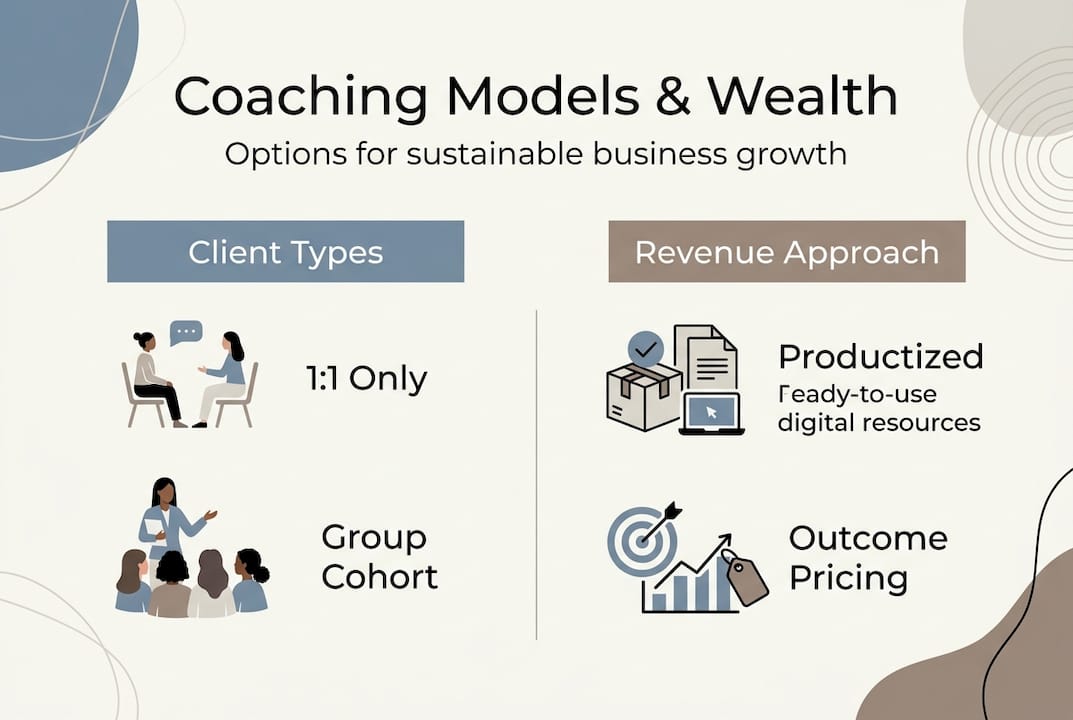
Here is what a diversified revenue model looks like in practice:
- 1:1 coaching packages (premium, high-touch, $3,000 to $8,000 per package)
- Group coaching programs (scalable, community-driven, $500 to $2,000 per participant)
- Digital products or courses (passive income layer, $97 to $997)
- Speaking or workshops (visibility and revenue combined)
| Model | Revenue potential | Time required | Burnout risk |
|---|---|---|---|
| Solo 1:1 only | $40k to $80k/yr | High | High |
| 1:1 plus group | $80k to $150k/yr | Medium | Medium |
| Diversified (1:1, group, digital) | $150k plus/yr | Medium | Low |
The solo 1:1 model is where most coaches start, and where many stay too long. It caps your income at the number of hours you can sell. Moving into group programs and digital offers is not about working less. It is about working smarter and protecting your energy while sustainable coaching strategies compound over time.
For coaching for profit, the shift happens when you stop pricing your time and start pricing your outcomes. A client who doubles her revenue after working with you did not pay for six sessions. She paid for the result. Price accordingly. The industry statistics back this up: coaches who charge for transformation, not time, consistently outperform their peers.
Pitfalls to avoid and proven strategies for sustainable wealth
Even the best strategies can get derailed. Here is what most new coaches miss and how to sidestep those traps.
The most common pitfalls are the generalist trap, underpricing, and lack of systems. Coaches who fall into all three rarely make it past year two without burning out or quitting.
- The generalist trap: Trying to coach everyone means you attract no one at a premium rate. Niche down to a specific problem for a specific person. Your marketing becomes sharper, your referrals improve, and your close rate goes up.
- Underpricing: Low prices do not attract grateful clients. They attract uncommitted ones. Clients who invest significantly show up differently. They do the work, get results, and refer others.
- No systems: Manually scheduling, invoicing, and onboarding clients is a fast path to resentment. Automate these before you think you need to.
“Client ROI of 5 to 7x drives retention and referrals, making it the single most powerful growth lever for coaching businesses.”
Here is how to protect your energy as you grow:
- Cap 1:1 clients at a number that feels sustainable, usually 8 to 12 per month.
- Batch your content creation and client calls on specific days.
- Add a group program once your 1:1 roster is full.
- Use your client wins as case studies to close new clients without cold outreach.
Pro Tip: Track your client results from week one. Documented outcomes become your sales page, your referral engine, and your confidence when imposter syndrome shows up.
For lasting impact, the goal is not to work harder. It is to build a business that works without you having to force it. Preventing coaching burnout starts with the decisions you make before you are overwhelmed, not after.
What most new life coaches get wrong (and how to avoid it)
Here is what most guides will not tell you, and it is the thing that separates coaches who build real wealth from those who stay stuck at survival income.
Chasing credentials is a delay tactic dressed up as preparation. The coaches who earn the most are not the most certified. They are the ones who got clear on a high-stakes problem, built a simple offer around it, and invested in systems early. Positioning beats hustle every single time.
The best time to design a sustainable business is at the very beginning, not after you have burned through your first year of 1:1 clients. Automate your scheduling, your onboarding, and your payments before you feel like you need to. Niche before you feel ready. Raise your prices before you feel worthy.
At Freedom Sun, we see this pattern constantly: talented women who know exactly what to do but cannot make themselves do it. That is not a strategy gap. It is a nervous system gap. One area you must master is learning how to sell and receive without shrinking. If you want to practice that in a safe, structured environment, the Practice Room is where that work happens. Explore sustainable success strategies to see how the internal and external work connect.
Ready to build your life coaching business?
If this article gave you clarity, the next step is building the systems and mindset that make it stick. At Freedom Sun, we work with women entrepreneurs who are already generating revenue and ready to pivot into coaching, scale their offers, and build wealth without burning out. The Women’s Wealth Collective academy, the Nervous System of Money podcast, and live events are all designed for exactly where you are right now. Get started with this guide to go deeper on the practical steps, or explore the full resource library to find the right entry point for your stage of business.
Frequently asked questions
Do I need to be certified to start a life coaching business?
Certification is not legally required since coaching is an unregulated industry, but ICF credentials build client trust and support higher pricing.
How much can a beginner life coach expect to earn?
New coaches typically earn $15,000 to $35,000 per year with 8 to 15 clients, and income rises significantly with a clear niche and consistent marketing.
What is the best way to get your first life coaching clients?
The fastest path is direct outreach to your existing network, followed by referral requests and building a visible presence on LinkedIn.
How do life coaches prevent burnout as they grow?
Automate scheduling and payments, cap your 1:1 client load, and add group or digital offers early to scale without trading all your time for revenue.
How important is choosing a niche for life coaches?
Niche selection is one of the most critical decisions you will make, since the generalist trap is cited as the top reason new coaches struggle to attract premium clients and grow.