What Is an Operating System for Entrepreneurs?

Most american founders face hidden challenges when scaling their tech companies, with over half reporting symptoms of burnout driven by weak internal systems. As business environments become more complex, the cost of poor frameworks escalates, eroding productivity and draining leadership energy. This article reveals how a strategic entrepreneurial operating system transforms chaos into clarity, empowering growth-focused leaders worldwide to achieve sustainable scaling and personal resilience.
Table of Contents
- Defining An Entrepreneurial Operating System
- Core Pillars: Math, Mechanics, And Mind
- How Entrepreneurial Os Transforms Growth
- Risks Of Weak Systems For Founders
- Avoiding Burnout Through Systemic Design
Key Takeaways
| Point | Details |
|---|---|
| Entrepreneurial Operating System (EOS) | EOS provides a strategic framework to align teams, clarify vision, and drive business growth through structured planning. |
| Core Components | The six critical components of EOS enhance organizational performance and drive sustainable scaling. |
| Risks of Weak Systems | Founders without robust systems face burnout, operational chaos, and loss of confidence, leading to diminished performance. |
| Preventing Burnout | Systemic design helps alleviate burnout by creating automated systems that reduce cognitive load and support proactive management. |
Defining an Entrepreneurial Operating System
An Entrepreneurial Operating System (EOS) represents a strategic framework designed to help business leaders transform complex organizational challenges into structured, executable plans. Unlike traditional management approaches, an entrepreneurial operating system provides a holistic methodology for aligning teams, clarifying vision, and systematically driving business growth.
At its core, an EOS consists of six critical components that work synergistically to enhance organizational performance. Entrepreneurial performance frameworks typically integrate vision alignment, people management, data-driven decision making, strategic issue resolution, process optimization, and execution momentum. These components create a comprehensive blueprint for businesses seeking sustainable scaling and operational excellence.
The primary goal of an entrepreneurial operating system is to simplify organizational complexity by establishing clear accountability, transparent communication channels, and measurable objectives. For high-growth companies navigating rapidly changing markets, an EOS provides a structured approach to maintaining strategic focus while adapting to emerging challenges. Business growth methodologies demonstrate that systematically implementing such frameworks can dramatically improve team performance and organizational resilience.
Pro tip: Implement a quarterly review process to assess how well your current operating system aligns with your strategic objectives and make necessary adjustments to maintain organizational agility.
Core Pillars: MATH, MECHANICS, and MIND
The Freedom Sun Operating System is built on three fundamental pillars that transform entrepreneurial complexity into strategic clarity: MATH, MECHANICS, and MIND. These interconnected domains provide a comprehensive framework for sustainable business growth and leadership resilience.

MATH focuses on financial clarity and quantitative decision-making. Entrepreneurial decision-making principles demonstrate how mathematical thinking enables entrepreneurs to interpret events systematically, balancing risks and opportunities through logical frameworks. This pillar emphasizes objective metrics, financial modeling, and data-driven strategic planning that moves beyond intuition into measurable, reproducible outcomes.
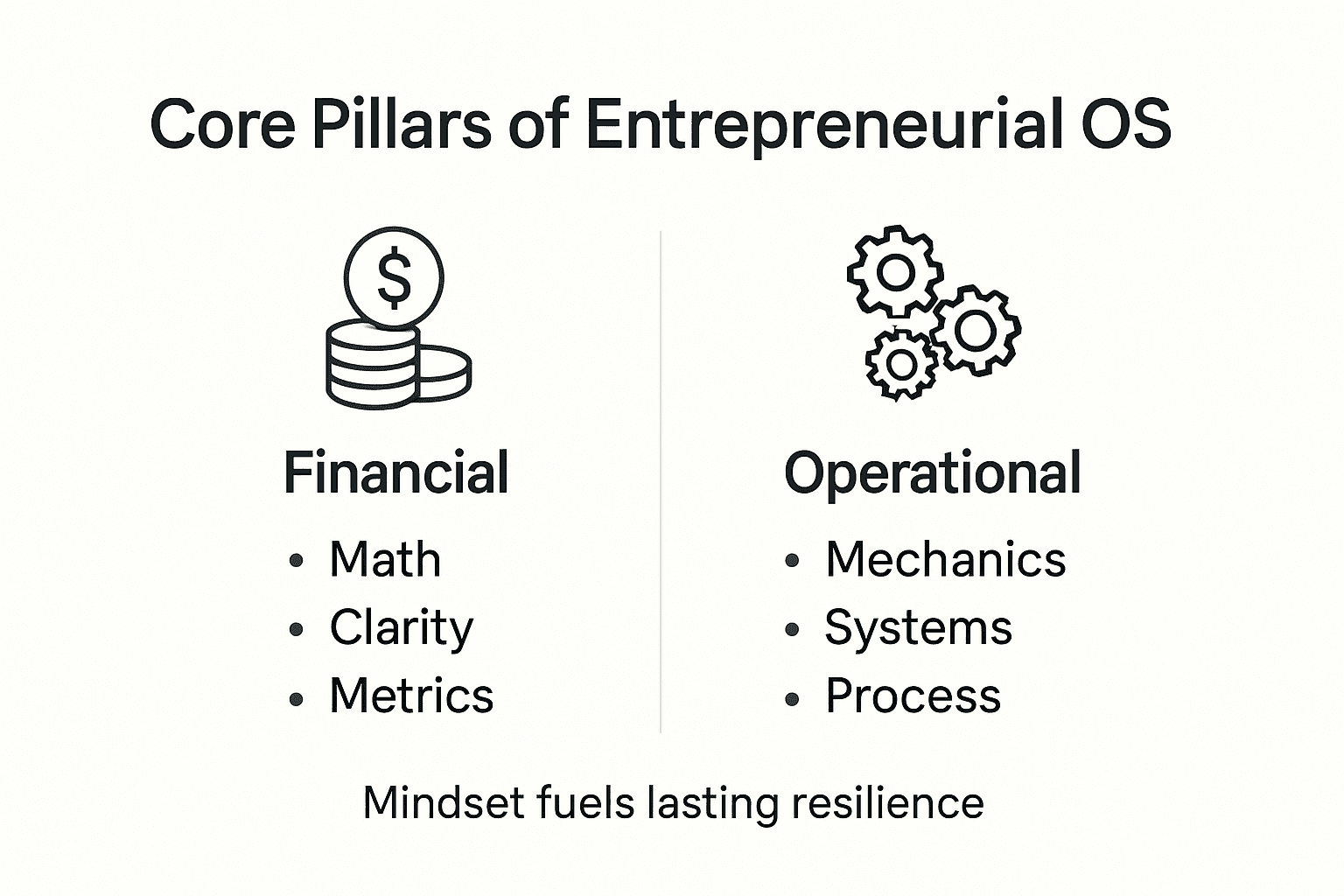
MECHANICS represents the operational infrastructure of a business. This pillar addresses sales systems, process optimization, and scalable organizational design. Psychological principles of organizational behavior reveal that systematic mechanical processes create consistency, allowing businesses to standardize excellence and reduce individual dependency. By establishing clear workflows, communication protocols, and performance expectations, entrepreneurs can build resilient enterprises that function smoothly regardless of individual team member variations.
MIND encompasses leadership psychology, mental resilience, and personal development. This pillar recognizes that sustainable success requires more than technical skills—it demands emotional intelligence, strategic thinking, and the ability to navigate complex personal and professional challenges. By integrating psychological insights with strategic frameworks, entrepreneurs can develop the mental fortitude necessary to lead effectively through uncertainty and change.
Pro tip: Create a quarterly dashboard that tracks key performance indicators across MATH, MECHANICS, and MIND to ensure holistic business development and personal growth.
Here’s how the three pillars of the Freedom Sun Operating System contribute to business success:
| Pillar | Key Focus | Business Benefit |
|---|---|---|
| MATH | Financial clarity, metrics | Informed, risk-balanced growth |
| MECHANICS | Operations, workflows | Consistent, scalable delivery |
| MIND | Leadership resilience | Strong, adaptive leadership |
How Entrepreneurial OS Transforms Growth
An Entrepreneurial Operating System fundamentally transforms business growth by replacing chaotic, reactive management with a strategic, intentional approach to organizational development. Where traditional businesses struggle with inconsistent performance and unclear direction, an OS provides a structured methodology for continuous improvement and systematic scaling.
Organizational performance strategies reveal that implementing a comprehensive framework enables leadership teams to achieve unprecedented clarity, focus, and discipline. By establishing clear roles, tracking critical metrics, and developing systematic issue resolution processes, entrepreneurs can create businesses that are not just reactive, but proactively designed for sustainable growth.
The transformative power of an Entrepreneurial OS lies in its ability to align human potential with strategic objectives. Growth mindset principles demonstrate that systematic frameworks do more than optimize operations—they fundamentally reshape how entrepreneurs think about challenges, opportunities, and organizational potential. This holistic approach moves beyond traditional management techniques by integrating psychological insights with pragmatic business strategies.
At its core, an Entrepreneurial OS acts as a comprehensive blueprint for translating vision into tangible results. It bridges the gap between strategic imagination and practical execution, providing entrepreneurs with a repeatable system for navigating complexity, managing uncertainty, and driving consistent performance across all business domains.
Pro tip: Conduct a quarterly system audit to identify friction points in your operating system and implement targeted improvements that enhance overall organizational efficiency.
Risks of Weak Systems for Founders
Founders without robust operating systems face catastrophic risks that extend far beyond simple business inefficiency. Organizational chaos becomes the default state, creating a dangerous environment where unpredictability and reactive management consume valuable energy and resources that should be directed toward strategic growth.
Startup survival challenges reveal a stark reality: over half of startup founders experience burnout directly resulting from weak systemic foundations. Without structured processes, entrepreneurs become trapped in continuous crisis management, making decisions based on immediate pressures rather than long-term strategic objectives. This perpetual state of reactivity leads to exhaustion, diminished cognitive performance, and increased probability of critical business mistakes.
Operational vulnerability manifests through multiple dangerous symptoms. Founders frequently encounter unclear role definitions, communication breakdowns, and misaligned team expectations. These systemic weaknesses create friction that erodes team cohesion, reduces productivity, and dramatically increases the risk of talent loss. Complex business environments demand sophisticated, adaptive frameworks that can scale alongside entrepreneurial ambitions.
The most insidious risk of weak systems is the gradual erosion of founder confidence and organizational momentum. What begins as minor operational inefficiencies can rapidly transform into existential threats, undermining the very foundation of entrepreneurial potential. Sustainable success requires intentional, proactive system design that anticipates challenges and creates resilient, self-correcting organizational architectures.
Pro tip: Conduct a monthly system diagnostic to identify and address emerging operational weaknesses before they become critical failure points.
The following table highlights major risks faced by founders without robust operating systems:
| Risk Area | Impact on Founder | Impact on Organization |
|---|---|---|
| Burnout | Exhaustion, poor focus | Higher error rate, lost talent |
| Communication Gaps | Decision bottlenecks | Misalignment, unclear priorities |
| Operational Chaos | Crisis-driven actions | Lost productivity, stalled growth |
| Eroding Confidence | Loss of motivation | Momentum loss, missed targets |
Avoiding Burnout Through Systemic Design
Entrepreneurial burnout represents a silent epidemic that systematically erodes founders’ mental resilience, creative potential, and long-term business sustainability. Systemic design emerges as a strategic shield, transforming chaotic operational landscapes into intentionally structured environments that protect both personal energy and organizational momentum.
The core philosophy of burnout prevention lies in creating automated, self-regulating systems that reduce cognitive load and eliminate repetitive decision-making processes. By designing frameworks that naturally distribute workload, anticipate challenges, and create built-in redundancies, entrepreneurs can shift from reactive survival modes to proactive growth strategies. Financial wellness strategies become critical in this approach, enabling founders to develop resilient infrastructures that support sustainable performance without constant personal intervention.
Successful systemic design requires a holistic approach that integrates psychological, operational, and financial considerations. Entrepreneurs must view their businesses as living ecosystems with interconnected components, where each system supports and reinforces others. This means developing clear communication protocols, establishing predictable workflow mechanisms, creating robust feedback loops, and implementing automated monitoring tools that provide real-time insights without requiring constant manual oversight.
Ultimately, avoiding burnout is not about working less, but working more intelligently. By investing time and resources into developing comprehensive operating systems that streamline complexity, entrepreneurs can create businesses that generate results with minimal personal friction. The goal is to build organizations that can function smoothly, even when the founder is not directly managing every detail.
Pro tip: Implement a weekly system review that takes 30 minutes to assess operational efficiency and identify potential areas of systemic improvement.
Master Your Entrepreneurial Operating System for Lasting Success
The article highlights the challenges entrepreneurs face without a strong operating system such as burnout, operational chaos, and unclear decision-making pathways. If you struggle with aligning your financial clarity (MATH), optimizing your sales processes (MECHANICS), or building leadership resilience (MIND), these pain points can stall your growth and threaten your peace of mind. The key is to replace reactive management with a strategic, automated system that supports sustainable business growth and prevents burnout.
At Freedom Sun, we specialize in exactly that transformation. Our professional development platform guides founders and leaders through creating a robust entrepreneurial operating system modeled after Fortune 500 CFOs. Using our interactive training, diagnostic assessments, and supportive community, you can build clear financial systems, seamless sales infrastructure, and powerful leadership practices. Why wait to break free from hustle culture and achieve profitable peace? Explore how our Operating System framework empowers you to take sovereignty over your business and personal wellbeing today.
Ready to design your tailored OS for lasting success and resilience? Discover more on the Freedom Sun landing page and begin turning complexity into clarity.
Frequently Asked Questions
What is an Entrepreneurial Operating System (EOS)?
An Entrepreneurial Operating System (EOS) is a strategic framework designed to help business leaders simplify complex organizational challenges into actionable plans, aligning teams and driving sustainable growth.
What are the core components of an Entrepreneurial Operating System?
The core components of an EOS include vision alignment, people management, data-driven decision making, strategic issue resolution, process optimization, and execution momentum, all aimed at enhancing organizational performance.
How can an EOS help prevent founder burnout?
An EOS helps prevent founder burnout by creating automated, self-regulating systems that reduce cognitive load and decision fatigue, allowing entrepreneurs to focus on strategic growth without being overwhelmed by daily operational challenges.
What are the three pillars of the Freedom Sun Operating System?
The three pillars of the Freedom Sun Operating System are MATH (financial clarity and metrics), MECHANICS (operational infrastructure), and MIND (leadership psychology), which collectively support sustainable business growth and resilience.