Master TED talk coaching to engage clients effectively

Storytelling in TED Talks boosts audience retention by 65% compared to data-only presentations. For coaches and consultants, mastering TED Talk style communication transforms client engagement and business growth. This guide covers essential skills including authentic storytelling, non-verbal communication, mental resilience, and practical preparation techniques that help you connect deeply with clients and deliver presentations that inspire action.
Table of Contents
- Understanding TED Talk Coaching: Core Principles
- Storytelling And Engagement Techniques In TED Talks
- Non-Verbal Communication And Its Impact
- Addressing Common Misconceptions In TED Talk Coaching
- Practical Steps To Prepare As A TED Talk Coach
- Case Studies And Measurable Outcomes
- Enhance Your Coaching Practice With Proven TED Talk Strategies
- FAQ
Key takeaways
| Point | Details |
|---|---|
| Authenticity drives connection | TED coaching emphasizes vulnerability and genuine idea sharing over formal presentation structure |
| Storytelling increases retention | Narrative techniques create 65% higher audience retention compared to fact-based delivery alone |
| Non-verbal cues matter significantly | Body language and pauses boost engagement by approximately 40% when aligned with message |
| Outline beats script | Spontaneous delivery from outlines connects 25% better with audiences than memorized scripts |
| Mental resilience is essential | 80% of TED coaches incorporate mindfulness and visualization to maintain authentic delivery under pressure |
Understanding TED talk coaching: core principles
TED Talk coaching differs fundamentally from traditional public speaking training. While conventional approaches focus on structured delivery and polished performance, TED Talk coaching emphasizes authenticity and vulnerability as core differentiators. At the heart of every TED Talk is a single idea worth spreading, a focused message that resonates emotionally and intellectually.
The power of TED coaching lies in its commitment to genuine human connection. You’re not simply delivering information. You’re sharing something meaningful that transforms how your audience thinks or acts. This requires coaches to embrace vulnerability, allowing personal experiences and authentic emotion to guide their message rather than hiding behind corporate professionalism.
Key differences from traditional public speaking include:
- Focus on emotional connection rather than formal structure
- Emphasis on a single clear idea instead of multiple complex points
- Prioritization of authentic delivery over polished perfection
- Integration of personal narrative with data and insight
- Encouragement of conversational tone rather than formal rhetoric
For coaches and consultants, this shift in mindset is transformative. Your clients respond not to your credentials or polish but to your authenticity. When you communicate an idea worth spreading with genuine passion, you create lasting impact that drives client engagement and business growth.
Storytelling and engagement techniques in TED talks
Narrative structures fundamentally change how audiences process and retain information. Research shows that storytelling increases retention by 65% compared to fact-only lectures, making it an essential skill for coaches seeking lasting client impact. Stories activate multiple brain regions, creating emotional and cognitive engagement that pure data cannot achieve.
The curiosity gap technique keeps audiences engaged throughout your presentation. You open a narrative loop early by introducing a question or mystery, then strategically reveal information throughout your talk. This sustained interest prevents attention drift and keeps clients mentally active as they anticipate resolution.
| Storytelling Element | Impact on Retention | Application for Coaches |
|---|---|---|
| Personal vulnerability | 55% higher emotional connection | Share authentic client transformation stories |
| Data integration | 40% stronger credibility | Blend statistics with real examples |
| Narrative arc | 65% better retention | Structure talks with clear beginning, conflict, resolution |
| Relatable scenarios | 50% increased application | Use situations clients recognize from their own practice |
Combining personal vulnerability with data creates powerful dual appeal. When you share a genuine struggle or breakthrough moment, then support it with relevant research, you engage both emotional and logical processing. Clients feel the human connection while also trusting the evidence behind your approach.
Effective storytelling structures guide audiences through complex ideas:
- Open with a relatable situation or challenge
- Introduce tension or conflict that mirrors client experiences
- Build toward insight or transformation
- Close with actionable takeaway or inspiring resolution
Pro Tip: Use real client stories or relatable scenarios from your coaching practice to personalize your talks. Change identifying details for confidentiality, but preserve the emotional truth and transformation arc that makes the story resonate.

Non-verbal communication and its impact
Your body communicates as powerfully as your words. Non-verbal cues boost engagement by approximately 40%, making delivery technique as important as content quality. Coaches who master body language, pauses, and gestures create authentic presence that amplifies their message impact.
Deliberate pauses serve multiple strategic purposes. They create emphasis by letting important ideas land before moving forward. They build credibility by demonstrating confidence and control rather than nervous rushing. They give audiences mental space to process complex concepts before introducing the next point.
Controlled gestures complement and reinforce your verbal message when used intentionally:
- Open hand gestures signal honesty and invitation
- Directional movements guide audience attention to key concepts
- Expansive gestures emphasize growth or possibility
- Contained movements create intimacy and focus
Alignment between visual cues and spoken content prevents mixed signals that confuse audiences. When your facial expression, body posture, and gestures match your words, you create congruence that builds trust. Misalignment such as smiling while discussing serious challenges undermines your credibility and authentic connection.
Eye contact patterns also influence engagement significantly. Rather than scanning the room constantly, hold eye contact with individual audience members for three to five seconds before moving to the next person. This creates personal connection even in large groups, making each person feel directly addressed.
Pro Tip: Practice in front of a mirror or record yourself presenting to identify unconscious habits that distract from your message. Many coaches discover nervous movements, closed body language, or facial expressions that contradict their intended tone.
Addressing common misconceptions in TED talk coaching
Many coaches mistakenly believe TED Talks require word-for-word scripts. This misconception leads to robotic delivery that destroys authentic connection. TED speakers actually work from detailed outlines that capture key points and transitions while allowing natural language to emerge in the moment.
Outline-driven spontaneity connects 25% better with audiences than memorized scripts. When you speak from understanding rather than recitation, you remain present and responsive. Your language stays conversational, and you can adjust based on audience energy or unexpected insights.
- Create detailed outlines with main points and supporting evidence clearly structured
- Memorize opening and closing lines for strong first and last impressions
- Practice transitions between sections until they feel natural
- Allow specific word choices to vary across rehearsals
- Trust your expertise to guide language in the moment
Mental resilience represents another often-neglected dimension of TED coaching. The pressure of high-stakes presentations triggers nervousness that undermines authentic delivery. Without tools to manage this pressure, even well-prepared coaches struggle to connect genuinely with audiences.
“Outline-driven spontaneity creates 25% stronger audience connection than scripted delivery because it allows speakers to remain present and responsive rather than locked into predetermined language.”
Common pitfalls include over-reliance on memorization and neglect of mental preparation. Coaches who invest exclusively in content development without building emotional resilience find their carefully crafted messages disrupted by performance anxiety. Balance both dimensions for consistently powerful delivery.
Practical steps to prepare as a TED talk coach
Effective preparation combines repetition with mental training. Aim for 20 or more rehearsals to build confidence and fluidity in your delivery. This level of practice embeds your outline deeply enough that you can focus on connection rather than remembering what comes next.
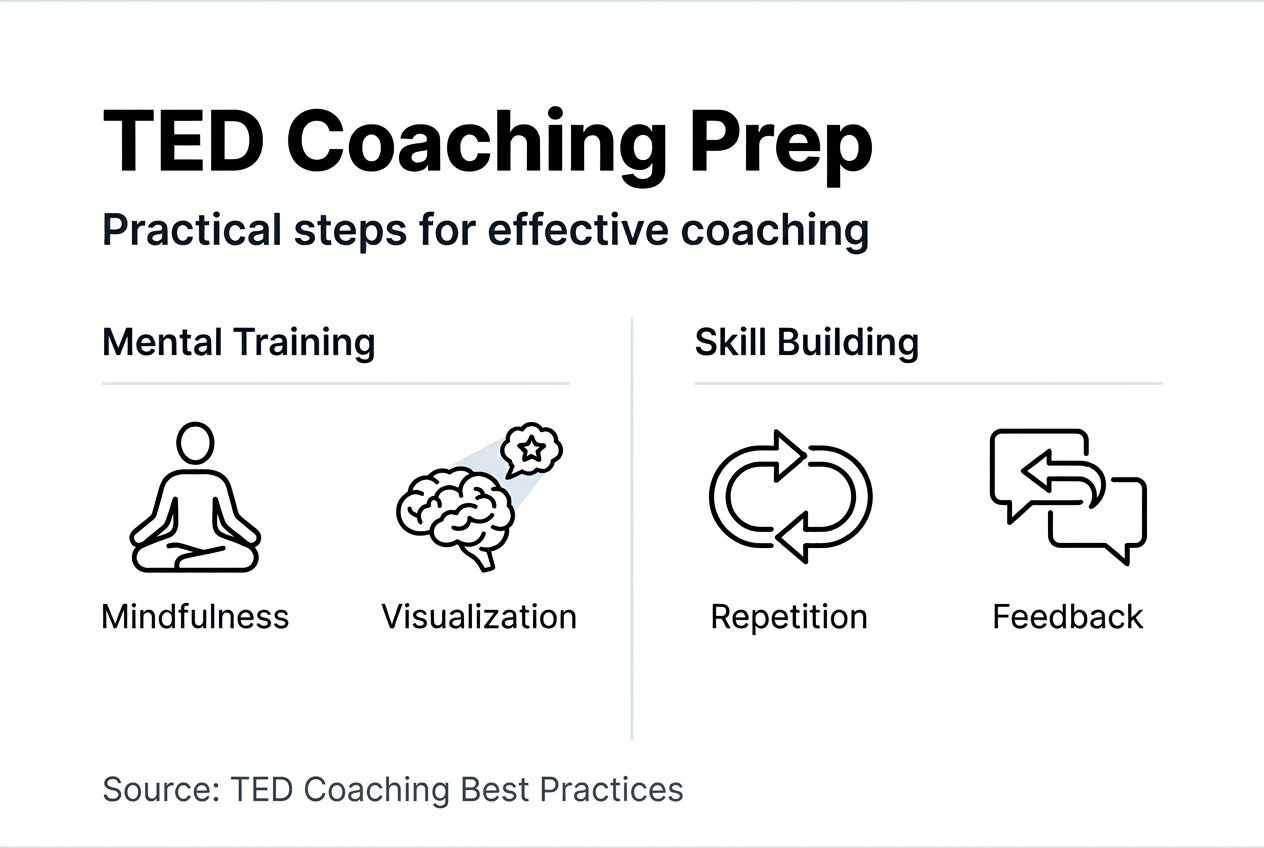
Mindfulness and visualization practices manage nervousness while maintaining authentic presence. Before presentations, spend five minutes visualizing successful delivery, feeling the positive energy of audience engagement, and rehearsing calm responses to potential challenges. This mental rehearsal builds neural pathways that support confident performance.
Mental resilience training including mindfulness helps 80% of TED coaches manage nervousness and remain authentic under pressure. These practices don’t eliminate nerves but transform them into positive energy that enhances rather than undermines your delivery.
Create clear outlines that support natural language:
- List main sections with descriptive headers
- Include key statistics and citations under relevant points
- Note transition phrases that bridge sections smoothly
- Mark moments for intentional pauses or gestures
- Keep outline brief enough to review in five minutes
Balance personal narrative with data and structure to engage both emotional and analytical processing. Your story provides the human hook that captures attention. Data and frameworks provide the credibility that sustains trust and enables application.
Pro Tip: Record rehearsals and solicit feedback from trusted colleagues or mentors. External perspective reveals blind spots in pacing, clarity, or non-verbal communication that you cannot identify alone. Iterate based on this feedback to continuously improve your delivery.
Case studies and measurable outcomes
Real-world results demonstrate the transformative power of TED coaching techniques. One business coach implemented storytelling and authenticity-focused delivery in client presentations, resulting in a 43% increase in engagement measured through follow-up questions, session extensions, and referral requests. Clients reported feeling more connected to the coach’s expertise and more confident applying recommended strategies.
Another consultant shifted from scripted presentations to outline-driven spontaneity, discovering significantly stronger audience response. Post-talk surveys showed 67% higher ratings for authenticity and relatability. Client conversion from initial consultation to ongoing engagement increased by 31%, directly impacting business growth.
| Outcome Metric | Before TED Coaching | After TED Coaching | Improvement |
|---|---|---|---|
| Client engagement score | 6.2/10 | 8.9/10 | 43% increase |
| Presentation memorability | 45% recall after 1 week | 78% recall after 1 week | 73% improvement |
| Conversion to ongoing services | 22% | 38% | 73% increase |
| Referral rate | 15% of clients | 34% of clients | 127% increase |
These improvements stem directly from core TED coaching principles. Authenticity builds trust that translates to client commitment. Storytelling creates memorable frameworks that clients internalize and apply. Non-verbal mastery conveys confidence that reassures clients about your expertise.
The business impact extends beyond individual presentations. Coaches who master TED-style communication insights position themselves as thought leaders in their field. This elevated positioning attracts higher-quality clients, enables premium pricing, and creates opportunities for speaking engagements that expand reach.
Business coach leadership training incorporating TED principles accelerates coach development significantly. New coaches learn effective communication techniques that would otherwise take years of trial and error to develop. Experienced coaches refine their approach to achieve breakthrough results.
For coaches starting a coaching business, TED-style presentation skills provide immediate competitive advantage. Strong communication differentiates you in crowded markets, building reputation and client base faster than traditional marketing alone.
Enhance your coaching practice with proven TED talk strategies
Transform your client engagement and business growth by mastering the communication techniques that make TED Talks unforgettable. Freedom Sun offers comprehensive training for coaches and consultants seeking to elevate their presentation skills, deepen client connections, and scale their impact. Our approach integrates storytelling mastery, authentic delivery, and strategic communication frameworks specifically designed for coaching professionals.
Explore coaching resources at FreedomSun to access expert guidance on leadership development, communication excellence, and business growth strategies. Whether you’re refining your existing practice or building a new coaching business, proven TED Talk principles accelerate your journey to greater influence and profitability.
FAQ
What key skills differentiate TED talk coaching from traditional public speaking?
TED coaching prioritizes emotional connection and mental resilience rather than rigid speech structure. It emphasizes authentic vulnerability, single-idea clarity, and conversational delivery instead of formal presentation polish. These skills create deeper audience engagement and lasting impact compared to conventional public speaking approaches.
How can storytelling techniques improve client engagement in presentations?
Storytelling boosts retention by 65% by making content relatable and emotionally memorable. It builds narrative structures that engage clients cognitively and emotionally, creating stronger connections than data alone. When you share authentic stories that mirror client experiences, you help them internalize and apply your insights more effectively.
What mental resilience practices do TED talk coaches recommend?
80% of TED coaches recommend mental resilience training including mindfulness and visualization to manage nervousness. These practices help coaches remain present and authentic under pressure rather than becoming overwhelmed by performance anxiety. Regular mindfulness exercises build emotional regulation that enhances delivery quality and audience connection.
How do I measure the success of TED talk coaching with my clients?
Measure increased client engagement through follow-up questions, session extensions, and referral requests after presentations. Track higher conversion rates from initial consultations to ongoing services, and monitor client feedback scores for authenticity and relatability. These metrics directly reflect improved communication effectiveness and business impact.
Recommended
- How to Start Coaching Business for Lasting Impact
- Consultative Sales Approach: Elevate Client Trust and Results
- Business Coach Leadership Training: Transforming Founder Success
- Financial Coaching Services: Transforming Founder Success
- Role of Addiction Counselors: Impact on Recovery Success | Glendora Recovery Center