How to Start a Consulting Business for Lasting Freedom

Building a consulting business is more than sharing expertise—it demands clear strategy, dependable systems, and a commitment to both client results and your own well-being. Aspiring coaches and consultants often grapple with balancing strong operational foundations and personal fulfillment. By mastering the basics and essential skills, you can create a practice that offers stability, confidence, and the freedom to focus on what truly matters. This guide highlights core consulting concepts and practical steps to help you lay the groundwork for sustainable success.
Table of Contents
- Consulting Business Basics And Core Concepts
- Common Consulting Models And Niches Explained
- Essential Skills And Systems For Success
- Legal Requirements And Structural Choices
- Financial Planning, Pricing, And Pitfalls
Key Takeaways
| Point | Details |
|---|---|
| Consulting Specializations | Differentiate your consulting practice by focusing on specific areas such as Management, Technology, Financial, Human Resources, or Marketing Consulting. |
| Successful Consultant Traits | Key competencies for success include deep expertise, problem-solving, communication skills, adaptability, and strategic thinking. |
| Choosing a Consulting Model | Evaluate various consulting models, including time-based, project-based, retainer, and performance-based, to find the best fit for your skills and client needs. |
| Legal Structure Importance | Selecting the right legal structure is crucial for liability protection, tax implications, and overall growth potential of your consulting business. |
Consulting Business Basics and Core Concepts
Starting a consulting business demands more than just expertise - it requires strategic planning and understanding fundamental industry dynamics. Consulting involves providing professional advice to organizations seeking solutions to complex business challenges. Unlike traditional employment, consultants leverage specialized knowledge to help clients improve performance, solve problems, and achieve strategic objectives.
The consulting landscape encompasses various specializations, each with unique characteristics:
- Management Consulting: Strategic guidance for organizational effectiveness
- Technology Consulting: Technology implementation and digital transformation strategies
- Financial Consulting: Financial analysis, planning, and optimization
- Human Resources Consulting: Talent management and organizational development
- Marketing Consulting: Brand strategy and market positioning
Successful consultants typically possess a combination of technical expertise, analytical skills, and strong interpersonal capabilities. Professional consulting fundamentals require understanding client needs, developing targeted solutions, and communicating recommendations effectively.
Key competencies for consulting success include:
- Deep domain expertise
- Problem-solving capabilities
- Communication skills
- Adaptability
- Strategic thinking
Building a consulting practice involves creating a clear value proposition that differentiates you from competitors. This means identifying your unique strengths, understanding target markets, and developing a systematic approach to delivering consistent, high-quality services.
Consulting is not about having all the answers, but about asking the right questions and guiding clients toward optimal solutions.
Business models in consulting vary widely, from hourly rate structures to project-based fees and retainer arrangements. Choosing the right model depends on your expertise, client expectations, and market dynamics.

Pro Tip: Invest significant time developing a comprehensive portfolio showcasing your past successes and demonstrating concrete value delivery to potential clients.
Common Consulting Models and Niches Explained
Consulting businesses thrive by developing specialized models that address unique client challenges and market needs. Consulting models represent structured approaches for delivering professional services, each with distinct characteristics, pricing strategies, and client engagement methods.
Key consulting engagement models include:
- Time-Based Model: Charging hourly or daily rates for professional services
- Project-Based Model: Fixed pricing for specific, defined project deliverables
- Retainer Model: Monthly recurring fee for ongoing strategic support
- Performance-Based Model: Compensation tied to measurable client outcomes
- Hybrid Model: Combination of multiple pricing and engagement approaches
Each model offers distinct advantages and potential drawbacks depending on the consultant’s expertise and client requirements. Business scaling strategies play a critical role in determining the most appropriate consulting approach.
Here’s how major consulting engagement models differ across key factors:
| Model Type | Pricing Structure | Best For | Key Risk |
|---|---|---|---|
| Time-Based Model | Hourly or daily billing | Short-term advice, audits | Unpredictable earnings |
| Project-Based Model | Fixed fee per deliverable | Defined projects, clarity | Scope creep risk |
| Retainer Model | Monthly recurring payment | Long-term, ongoing support | Overcommitment possible |
| Performance-Based | Tied to outcomes achieved | Result-oriented consulting | Complex results tracking |
| Hybrid Model | Mix of structures, flexible | Adaptive client needs | Management complexity |
Niche consulting specializations have emerged as powerful differentiation strategies:
- Technology Transformation Consulting
- Digital Marketing Strategy Consulting
- Organizational Change Management
- Sustainability and ESG Consulting
- Artificial Intelligence Implementation Consulting
Successful consultants often develop deep expertise within specific industry verticals, allowing them to command premium rates and build strong reputation networks. Industry expertise becomes a significant competitive advantage, enabling consultants to provide nuanced, contextually rich solutions.
The most valuable consultants do not just solve problems - they anticipate and prevent them before they emerge.
Choosing the right consulting model requires careful assessment of your skills, market demand, and long-term business objectives. Factors like personal strengths, target client base, and desired income level will significantly influence your selected approach.
Pro Tip: Develop a flexible consulting model that allows you to adapt pricing and service delivery based on evolving client needs and market dynamics.
Essential Skills and Systems for Success
Successful consulting requires a robust set of professional capabilities that extend far beyond technical expertise. Core consulting skills form the foundation of a sustainable and impactful consulting practice, enabling professionals to deliver exceptional value to clients and build long-term business relationships.
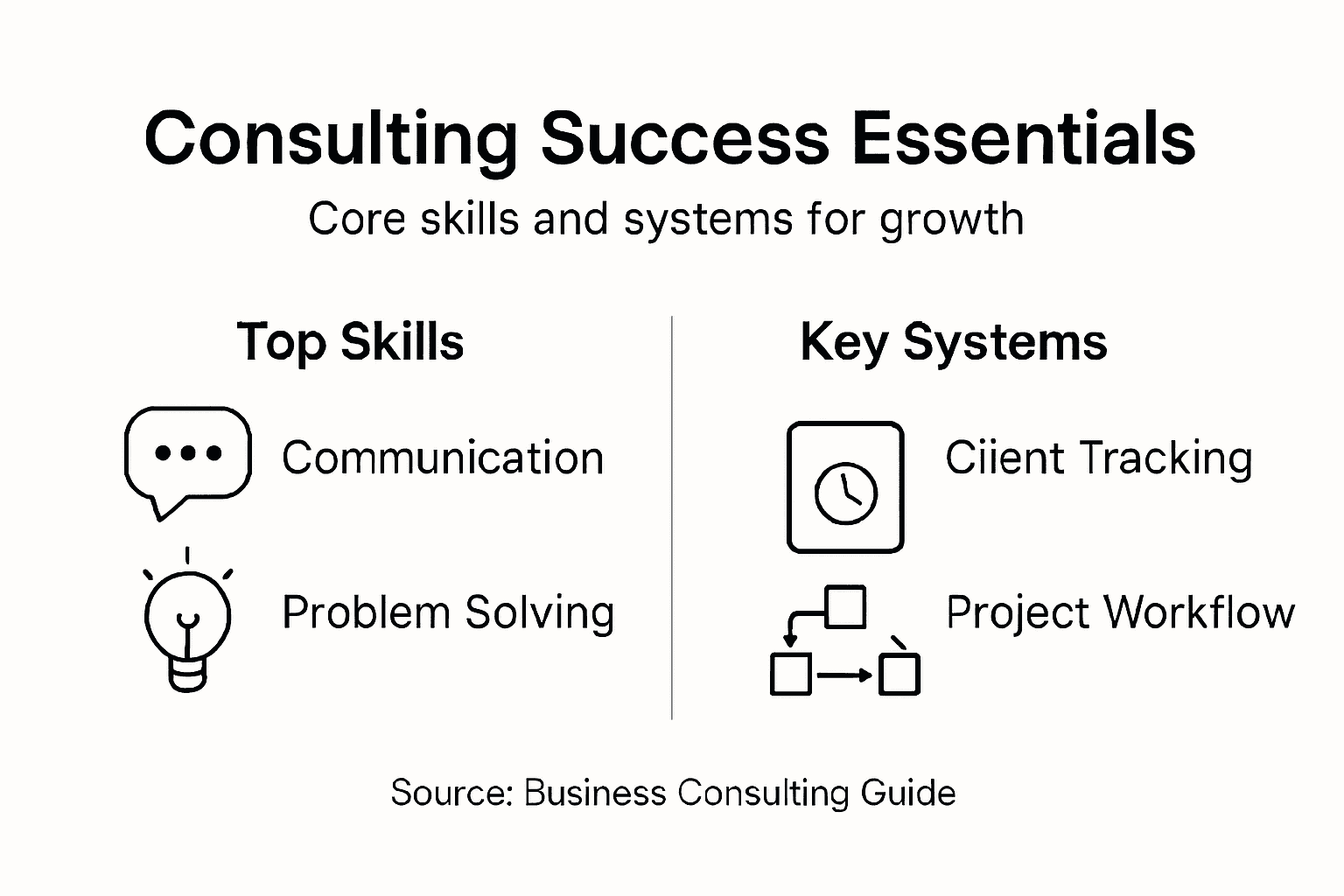
Critical skills for consulting excellence include:
- Communication: Articulating complex ideas clearly and persuasively
- Problem-Solving: Analyzing challenges from multiple perspectives
- Strategic Thinking: Developing holistic, forward-looking solutions
- Emotional Intelligence: Understanding and navigating client dynamics
- Data Analysis: Transforming raw information into actionable insights
Consulting skills development demands continuous learning and deliberate practice across multiple competency domains. Professional consultants must cultivate a mindset of adaptability and intellectual curiosity, constantly refining their approach to meet evolving client needs.
Key system requirements for consulting success involve creating robust operational infrastructure:
- Client Relationship Management (CRM) System
- Project Management Platform
- Financial Tracking and Invoicing Tools
- Professional Network and Referral Mechanism
- Continuous Learning and Skill Development Framework
Technical competence represents only one dimension of consulting effectiveness. Equally important are interpersonal skills, strategic thinking, and the ability to build trust with clients through consistent, high-quality deliverables.
True consulting excellence lies not in knowing all the answers, but in asking the right questions and guiding clients toward transformative solutions.
Implementing structured systems allows consultants to scale their practice, manage complex projects efficiently, and create predictable revenue streams. This systematic approach transforms consulting from a transactional service to a strategic partnership.
Pro Tip: Develop a personal development plan that allocates specific time for skill enhancement, industry research, and professional networking.
Legal Requirements and Structural Choices
Launching a consulting business requires carefully navigating complex legal landscapes and selecting an appropriate business structure that protects your interests and supports long-term growth. Business structures represent critical foundational decisions that impact liability, taxation, and operational flexibility.
Primary legal structure options for consultants include:
-
Sole Proprietorship: Simplest structure with minimal administrative requirements
-
Limited Liability Company (LLC): Personal asset protection and flexible taxation
-
S Corporation: Tax advantages for higher-earning consultants
-
C Corporation: Most complex structure with comprehensive legal protections
-
Partnership: Collaborative business model with shared responsibilities
Legal business structure selection involves evaluating multiple factors including personal risk tolerance, income potential, and long-term business objectives. Each structure carries unique legal and financial implications that require thorough understanding.
Key considerations for selecting your business structure:
- Personal liability exposure
- Tax efficiency
- Administrative complexity
- Scalability potential
- Regulatory compliance requirements
Professional registration plays a crucial role in establishing legal credibility. Most jurisdictions require consultants to register with local chambers of commerce, obtain necessary business licenses, and maintain appropriate professional certifications.
Choosing the right legal structure is not just a bureaucratic step - it’s a strategic decision that shapes your entire business trajectory.
Beyond initial structure selection, consultants must remain vigilant about ongoing compliance, including tax reporting, insurance requirements, and potential regulatory changes that might impact their business model.
The following table summarizes key factors when choosing a legal structure for your consulting business:
| Structure | Liability Protection | Tax Treatment | Administrative Complexity |
|---|---|---|---|
| Sole Proprietorship | None, full personal risk | Pass-through, self-employed | Lowest |
| LLC | Personal asset protection | Flexible: pass-through/EIN | Moderate |
| S Corporation | Asset protection, limited | Salary + dividends system | Higher, strict legalities |
| C Corporation | Strongest protection | Double-taxed, dividend tax | Highest, complex filings |
| Partnership | Shared between partners | Pass-through, form K-1 | Moderate, joint decisions |
Pro Tip: Consult with a business attorney and tax professional to thoroughly evaluate which legal structure best aligns with your specific consulting goals and risk profile.
Financial Planning, Pricing, and Pitfalls
Building a sustainable consulting business requires strategic financial planning that goes beyond traditional revenue models. Financial foundations represent the critical infrastructure that determines long-term business viability and personal economic freedom.
Consultants have multiple pricing strategies to consider:
- Hourly Rates: Straightforward billing based on time invested
- Project-Based Pricing: Fixed fees for defined deliverables
- Value-Based Pricing: Compensation tied to measurable client outcomes
- Retainer Models: Consistent monthly recurring revenue
- Performance Contingency: Percentage of achieved results
Financial systems checklist helps consultants create robust monetary frameworks that protect against common economic pitfalls. Successful pricing requires understanding market rates, personal value proposition, and client perceived worth.
Key financial planning considerations include:
- Establishing emergency business funds
- Tracking precise income and expense metrics
- Implementing tax-efficient strategies
- Creating multiple revenue streams
- Developing scalable pricing mechanisms
Pricing psychology plays a significant role in client perception and engagement. Setting rates too low suggests limited expertise, while pricing too high might discourage potential clients.
Your pricing communicates your professional value - it’s not just about numbers, but about positioning yourself as a strategic partner.
Common financial pitfalls for new consultants include undervaluing services, inconsistent income tracking, and failing to separate personal and business finances. Developing disciplined financial habits becomes crucial for sustainable growth.
Pro Tip: Develop a dynamic pricing model that allows flexibility while maintaining clear value boundaries and professional integrity.
Unlock Your Consulting Business Potential with Freedom Sun
Starting a consulting business involves navigating critical decisions about your business model, pricing strategy, and legal structure. You may feel overwhelmed by challenges like choosing the right pricing model, building scalable systems, or establishing your unique value proposition as described in the article. These obstacles often cause uncertainty and hesitation when taking those crucial first steps toward lasting freedom and business sovereignty.
At Freedom Sun you gain more than training - you get a strategic partner focused on helping coaches and consultants build automated, resilient businesses that break free from hustle culture. Our interactive training and proven frameworks cover essential skills like financial management, leadership, and sales tailored to consulting professionals. We help you design robust systems that ensure consistent revenue and scalable growth fueled by strategic implementation and mental resilience.
Stop spinning your wheels with guesswork. Visit Freedom Sun now to transform your consulting practice with expert guidance that matches the insights from the article. Discover how to build profitable peace through holistic business architecture and join a community committed to sustainable success. Take control of your consulting journey today by exploring our programs designed specifically for driven coaches, consultants, and service-based entrepreneurs like you.
Frequently Asked Questions
What are the essential skills needed to succeed in consulting?
Successful consultants should possess strong communication, problem-solving, strategic thinking, emotional intelligence, and data analysis skills to deliver exceptional value to clients.
How do I choose the right consulting model for my business?
Selecting the appropriate consulting model depends on your expertise, the nature of client projects, and revenue goals. Consider time-based, project-based, retainer, performance-based, or hybrid models based on client needs and market dynamics.
What legal structures can I choose for my consulting business?
Common legal structures include Sole Proprietorship, Limited Liability Company (LLC), S Corporation, C Corporation, and Partnership. Each has its advantages and implications regarding liability, taxes, and administrative requirements.
How should I price my consulting services effectively?
To price your consulting services effectively, consider using hourly rates, project-based pricing, value-based pricing tied to client outcomes, retainers for ongoing support, or performance-based fees. Balance market rates with the perceived value of your services.