How to practice public speaking as a woman entrepreneur

TL;DR:
- Women entrepreneurs face unique public speaking challenges due to gender bias and higher anxiety levels. Effective strategies include reframing nerves as excitement, authentic presentation, and mastering core mechanics. Consistent practice and storytelling are key to building confidence and creating lasting impact.
You already have a business, a message, and results that matter. What often holds revenue-generating women entrepreneurs back is not the quality of their ideas but their ability to command a room when it counts. The belief that great speakers are simply born that way is one of the most expensive myths in business. The data tells a different story: 95% of Toastmasters members show measurable improvement after structured training. Public speaking is a learnable, practicable skill, and the strategies that build it fastest are not the same for everyone. This guide is specifically designed for women who are already running businesses and are ready to show up with the authority their work has earned.
Table of Contents
- Why women entrepreneurs face unique public speaking challenges
- Essential mechanics: Techniques every woman leader should master
- Harnessing storytelling and audience connection
- Proven practice methods for lasting confidence
- A new perspective: Rethinking what confidence really means
- Get started: Resources to accelerate your speaking journey
- Frequently asked questions
Key Takeaways
| Point | Details |
|---|---|
| Practice drives results | Confidence and effectiveness rise with structured public speaking practice, regardless of starting skill. |
| Unique challenges for women | Women entrepreneurs face higher anxiety and bias, so gender-aware strategies are crucial. |
| Mechanics matter | Mastering voice, eye contact, and body language can dramatically increase audience connection. |
| Storytelling sticks | Using stories boosts retention and positive audience perception far more than statistics alone. |
| Authenticity over perfection | Owning your unique voice and focusing on realness is more impactful than striving for flawless delivery. |
Why women entrepreneurs face unique public speaking challenges
With the myth of natural-born speakers addressed, let’s explore the unique pressures women entrepreneurs face when taking the stage.
Public speaking anxiety is not equally distributed. Research on gender and professional communication confirms that women experience speaking anxiety at approximately 1.5 times the rate of men, and they also face authority gaps that require them to present more evidence before audiences grant them credibility. On top of that, gender bias shapes how the same delivery is received: an assertive tone that reads as confident in a man can be perceived as aggressive or abrasive in a woman. These are not imaginary obstacles. They are documented, structural, and worth naming plainly.
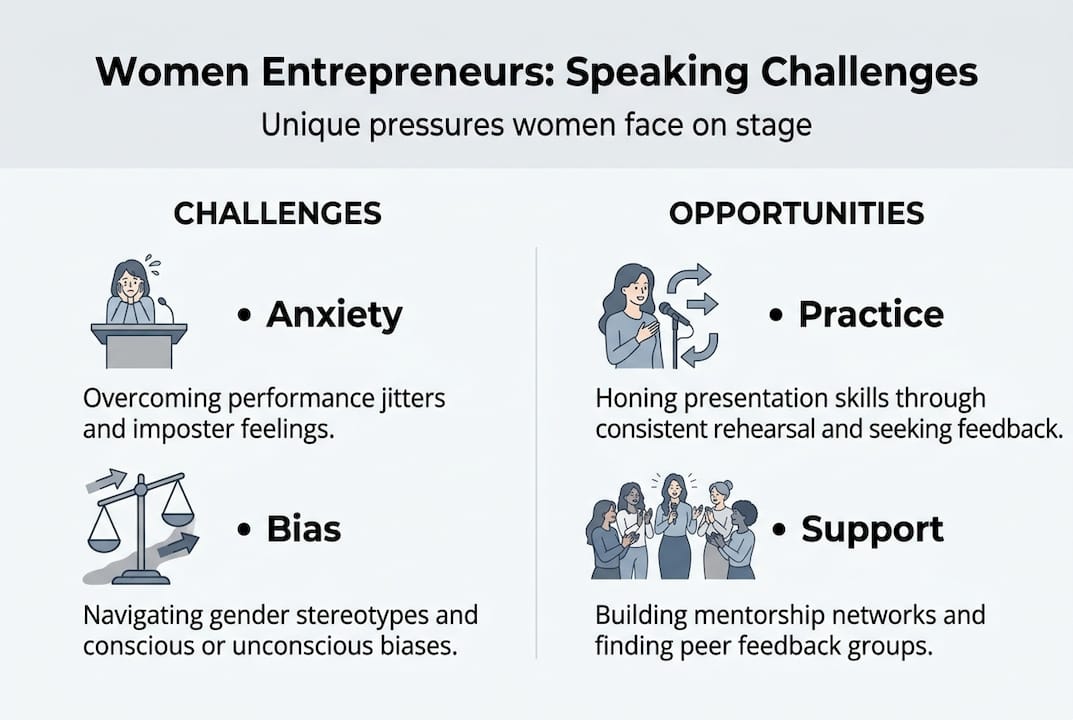
What this means practically is that a woman entrepreneur walking into a keynote, a sales presentation, or a pitch meeting is navigating more than content. She is managing an audience’s preloaded expectations about who is supposed to sound authoritative. That is an extra cognitive load that most public speaking advice completely ignores.
Here is what actually helps:
- Reinterpret the nerves. Research consistently shows that reframing anxiety as excitement rather than fear improves both performance and perceived confidence. Your nervous system is giving you energy, not a warning.
- Lead with authenticity, not perfection. Audiences forgive imperfection but rarely forgive feeling manipulated. When you show up as yourself, you lower the threat response in the room.
- Use body language strategically. Expansive posture before a talk, what researchers call “power poses,” actually shifts cortisol and testosterone ratios in ways that reduce anxiety and increase a sense of personal authority.
- Name your authority early. Without bragging, grounding your talk in specific experience signals competence and helps neutralize the authority gap from the start.
- Build your communication skills for business growth as a system, not a one-off effort. Confidence compounds over time only when the practice is consistent.
“The goal is not to eliminate nerves. The goal is to stop letting nerves make decisions for you.”
One of the most powerful reframes available to women entrepreneurs is this: the bias you face in rooms where you speak is real, but it does not mean the room is against you. Most audiences want to be moved, taught, and inspired. When you walk in prepared and grounded, you give them what they came for.
Essential mechanics: Techniques every woman leader should master
Understanding the challenges is step one; mastering core skills is next. Here is what every woman leader should focus on technically.
The mechanics of effective speaking are not glamorous, but they are the infrastructure everything else rests on. Without them, even a powerful story falls flat. With them, even a simple message can hold a room.
According to foundational principles of public speaking, the core mechanics include: vocal variety (shifting your tone, pitch, volume, and pace intentionally), strategic pauses, diaphragm breathing, the Rule of One for eye contact (hold eye contact with a single person for roughly three seconds before moving to another), purposeful gestures that reinforce rather than distract, and non-verbal cues that signal openness and confidence.
Here is a sequential approach to rehearsing these mechanics effectively:
- Record yourself. Video is uncomfortable and irreplaceable. Watch without sound first to catch body language issues, then watch without looking at yourself to catch vocal problems.
- Isolate one mechanic per practice session. Trying to fix everything at once trains nothing. Work on eye contact one day, pacing the next.
- Practice your opening sixty seconds until it is completely automatic. Nerves peak at the start. When the opening is rehearsed, your nervous system settles faster.
- Build in deliberate pauses. Silence feels eternal to a speaker and completely natural to an audience. Pauses signal confidence and give listeners time to absorb what matters.
- Practice presenting with confidence in front of a mirror or a small trusted audience before taking mechanics into high-stakes settings.
| Authenticity-first approach | Perfection-first approach | |
|---|---|---|
| Focus | Connection with the audience | Flawless delivery |
| Effect when things go wrong | Trust increases | Trust collapses |
| Energy in the room | Open, engaged | Tense, evaluative |
| Long-term confidence | Builds steadily | Erodes with pressure |
| Audience recall | High (emotion drives memory) | Low (performance creates distance) |
The table above reveals something counterintuitive: chasing perfection actively undermines the result you want. Audiences do not remember speakers who were flawless. They remember speakers who made them feel something.
“The most technically perfect delivery in the world cannot replace the moment a speaker makes someone in the audience feel genuinely seen.”
Pro Tip: Two minutes of expansive posture, standing tall with arms slightly out, before a talk measurably reduces cortisol. Do this backstage, in a bathroom, or in your car before you walk into a room. You can also learn to engage with TED talk techniques to add strategic structure to your delivery.

Harnessing storytelling and audience connection
With the mechanics in place, let’s uncover how connecting with your audience transforms both their attention and your impact.
Data does not move people. Stories do. This is not a soft insight; it is neurologically documented. When an audience hears a well-told personal story, their brains synchronize with the speaker’s, a phenomenon called neural coupling. This is why a speaker who shares a real, specific, emotionally honest moment holds a room in ways that slides full of statistics never will.
The numbers are stark: stories are retained at 70% by audiences, compared to just 5% retention for statistics alone. And eye contact during storytelling boosts engagement by an additional 30%. For women entrepreneurs, this is a structural advantage. Your lived experience as a business builder, a problem solver, a person who has navigated real uncertainty, is a rich source of story material that no competitor can replicate.
| Delivery approach | Audience retention | Emotional engagement | Call to action response |
|---|---|---|---|
| Data and statistics only | ~5% | Low | Minimal |
| Story without data | ~70% | High | Moderate |
| Story with supporting data | ~65-70% | High | Strongest |
The data and story combination wins every time, with the story carrying the emotional weight and the data providing the rational anchor that helps audiences justify acting on what they feel.
Here are quick connection boosters you can implement immediately:
- Open with a specific scene. Not “I struggled early in my business” but “It was 11 p.m., my invoice had just been declined, and I was sitting on my kitchen floor wondering what I had missed.”
- Use inclusive language. “We” and “you” pull audiences in. “I” used exclusively creates distance.
- Name the emotion before you name the lesson. Let the audience feel what you felt before you explain what you learned.
- Ask a rhetorical question early. It activates the audience’s own thinking and signals that this talk is for them, not at them.
- Mirror the audience’s reality back to them. When people hear their own experience described accurately, they lean in.
For TED Talks for inspiration on how master communicators use story structure, studying real examples is one of the fastest ways to internalize what emotional connection actually looks and sounds like in practice.
The single biggest storytelling mistake women entrepreneurs make is undervaluing their own stories. There is a tendency to sanitize the difficult parts, to skip to the lesson before the audience has felt the weight of the struggle. Resist that impulse. The mess is where the meaning lives.
Proven practice methods for lasting confidence
Knowing the “what” and “why” paves the way for “how.” Here is how to turn insight into habit and results.
Confidence in public speaking is not a personality trait. It is a measurable outcome of deliberate practice. Research shows that 10 hours of targeted practice produces approximately a 20% boost in self-reported confidence, and structured training programs like Toastmasters show improvement rates of 95% among participants. Importantly, annual retention in those programs runs around 50%, which means consistency is the variable that separates women who sustain their speaking growth from those who plateau.
Here is a structured practice routine built specifically for women entrepreneurs who already have a business to run:
- Week one: baseline. Record a three-minute talk on your core business message. Watch it once. Note two things to improve. Nothing more.
- Week two: mechanics focus. Redo the same talk, isolating one specific mechanic, such as eye contact or pacing. Record again and compare.
- Week three: story integration. Add a personal story to support your core message. Practice the story separately before embedding it in the full talk.
- Week four: live practice. Deliver the talk to a real person or small group. Collect one piece of specific feedback.
- Ongoing: speak publicly at least once per month. This can be a networking event, a workshop, a social media video, or a panel. Volume matters.
Structured training environments are especially effective for women, not just for feedback, but because they provide safe, repetitive conditions where you can practice without the stakes of a live business pitch. Peer groups and mentorship circles serve the same function when formal organizations are not accessible.
Pro Tip: Before a high-stakes talk, write the single most important thing you want your audience to feel when they leave. Not think. Feel. Anchor your preparation in that emotional outcome and every decision about content, story, and delivery becomes clearer.
Additional methods that compound confidence over time:
- Join or form a peer speaking group with other women entrepreneurs. Mutual accountability and shared context make feedback land better.
- Watch your recorded talks quarterly, not just immediately after. Progress over time is motivating in ways that in-the-moment feedback often is not.
- Seek out progressively larger audiences. Confidence that only works in small rooms is fragile. Build incrementally.
- Study becoming a TEDx speaker as a long-term goal that structures your growth across all speaking skills simultaneously.
- Integrate speaking into your sales process. The ability to communicate your value clearly under pressure is at the heart of every negotiation through public speaking opportunity in your business.
One thing that does not get said enough: the women who become exceptional speakers are almost never the ones who were “naturals.” They are the ones who practiced when it was uncomfortable and stayed in the room when they wanted to leave.
A new perspective: Rethinking what confidence really means
The conventional advice on public speaking confidence is backwards in one critical way. Most of it focuses on how you appear to others, your posture, your vocal projection, your facial expressions, as if confidence is a performance you deliver to an audience. But the women entrepreneurs we have seen transform their presence most dramatically did not get there by mastering performance. They got there by stopping the performance entirely.
Confidence, as we see it at Freedom Sun, is not about looking like you know what you are doing. It is about caring more about the person in front of you than about how you are being perceived. When the focus shifts from “how am I coming across” to “am I actually reaching this person,” something changes. The nerves quiet. The voice steadies. The message lands.
Women are often coached to mimic a style of authority that was designed by and for men. That is not just unnecessary; it actively works against you. Your natural communication instincts, the empathy, the specificity, the willingness to be honest about difficulty, are assets, not liabilities.
The real goal of cultivating business communication is not to become a different speaker. It is to become a more fully yourself speaker. That is where lasting authority lives.
Get started: Resources to accelerate your speaking journey
Ready to move from insight to applied mastery? Here is where you can take the next step.
If this article has clarified anything, it is that public speaking growth is not about talent, it is about structure, support, and consistent practice in environments designed for your success. Freedom Sun exists to provide exactly that for women entrepreneurs who are already building real businesses and are ready to communicate their vision with the authority it deserves. From the Women’s Wealth Collective academy to live events across Europe and the United States, the Freedom Sun resources available to you go well beyond speaking mechanics. They address the nervous system patterns, financial mindset blocks, and communication frameworks that help you show up fully, in every room that matters.
Frequently asked questions
What is the best first step to practice public speaking as a woman entrepreneur?
Start by recording a short practice session and reviewing it for one specific area to improve, then seek out a structured practice group like Toastmasters or a peer circle where supportive, consistent feedback is built into the environment.
How quickly can I improve my confidence in public speaking?
Most women see a measurable 20% confidence boost after approximately 10 hours of targeted, intentional practice, which means meaningful improvement is achievable within weeks, not years.
Do women face more challenges in public speaking compared to men?
Yes. Women experience speaking anxiety at roughly 1.5 times the rate of men and routinely navigate authority gaps and gender bias in audience evaluations that men rarely encounter in the same way.
Why is storytelling important in public speaking?
Stories are retained at 70% by audiences compared to just 5% for statistics, which means a well-told personal story is the single highest-leverage tool available to any speaker.
What if I still get nervous after practicing?
Reinterpreting physical nervous system signals as excitement rather than fear is an evidence-based strategy that reduces the negative impact of anxiety while keeping the energy that makes a talk feel alive.