Business Finance Training: Mastering Systems for Wealth

Scaling a business often exposes just how complex finance leadership can become for growth-minded founders and executives. Financial chaos is rarely caused by lack of ambition but usually by missing the right systems, accountability, and training that speak directly to your unique challenges. When your finance team struggles with accuracy or your leadership lacks confidence in interpreting financial data, progress stalls. This guide reveals how business finance training excellence creates clarity, enables strategic decision-making, and sets the foundation for wealth and calm at every stage of growth.
Table of Contents
- Defining Business Finance Training Excellence
- Core Elements of Financial Systems Mastery
- Types of Business Finance Training Programs
- Integrating Systems, Automation, and Mental Resilience
- Common Pitfalls and Strategic Solutions
Key Takeaways
| Point | Details |
|---|---|
| Focus on Practical Skills | Business finance training should develop the ability to read financial statements and understand cash flow dynamics, fostering confidence in decision-making. |
| Tailored Training Programs | Choose finance training that specifically addresses your business’s unique challenges rather than generic courses that do not apply to your situation. |
| Integration of Systems and Automation | Successful financial management requires integrating systems, automation, and mental resilience to build operational efficiency and reduce stress. |
| Continuous Accountability | Implement ongoing support and accountability measures to ensure that financial training leads to tangible, lasting changes in your business practices. |
Defining Business Finance Training Excellence
Business finance training excellence isn’t about memorizing accounting rules or mastering spreadsheet formulas. It’s a systematic approach to building financial competency that directly impacts your ability to make strategic decisions, scale operations, and create sustainable wealth. When we talk about training excellence in this context, we’re talking about a purposeful system that transforms how you and your leadership team understand and manage money within your business.
At its core, business finance training excellence combines three critical elements. First, it develops practical skills and knowledge that enable you to understand financial statements, cash flow dynamics, and the true health of your business. Second, it establishes the systems and processes that keep financial operations running smoothly without constant firefighting. Third, and perhaps most importantly, it builds the mental framework and confidence you need to lead with financial clarity. Research on training effectiveness and measurable business outcomes shows that training excellence requires clear educational goals aligned with specific business results. You can’t just attend a seminar and expect transformation. The training must be intentionally designed with your specific goals in mind, then systematically implemented and monitored for real impact.
What separates excellent business finance training from mediocre training programs is relevance and accountability. Generic financial literacy courses rarely address your actual situation. Your business faces unique cash flow challenges, specific scaling pressures, and particular industry dynamics. Excellence means training that speaks directly to your reality. A founder running a SaaS company needs different financial insights than someone building a product-based business. The training must address how organizations systematically develop competencies that actually change behavior and performance, not just transfer information. This means it should cover not just what to know, but how to implement that knowledge into your actual financial systems and decision-making processes. You need training that teaches you to build reliable financial dashboards, understand your unit economics, optimize cash flow timing, and ultimately use data to guide where you allocate resources. The best training also builds accountability into the learning process so you actually apply what you learn rather than letting it sit unused.
For entrepreneurs and business leaders, excellence in finance training comes down to this: Can you confidently read and interpret your financial statements? Do you understand what levers drive profitability in your business? Can you forecast with reasonable accuracy what your cash position will look like in three months? Can you make capital allocation decisions based on data rather than gut feeling? If the answer to these questions is yes, you’ve experienced excellent training. If not, your training program is missing something. The most valuable finance training transforms how you think about money in your business, gives you concrete tools to measure performance, and creates systems that keep financial operations running smoothly without exhausting you or your team. That’s the gold standard.
Pro tip: Start your finance training by identifying one critical financial metric your leadership team debates about most frequently, then dedicate focused learning time to understanding it deeply—this creates immediate relevance and shows the ROI of training within weeks.
Core Elements of Financial Systems Mastery
Mastering financial systems means understanding the building blocks that make money flow predictably through your business. You need to know what components matter, how they interact, and where friction typically occurs. This isn’t abstract theory. This is about recognizing that your business has specific financial mechanisms working right now, whether you’ve intentionally designed them or not. The difference between a business that feels financially chaotic and one that runs with predictability comes down to how well you understand and optimize these core elements.

Every financial system rests on several fundamental pillars. First, you need resource allocation mechanisms that direct money toward the activities generating the most return. Second, you need information flow systems that tell you what’s actually happening with cash, revenue, and expenses in real time. Third, you need risk management structures that protect your business from unexpected financial shocks. Fourth, you need institutional frameworks like your accounting processes, banking relationships, and financial reporting that create accountability and clarity. Research on financial institutions and market functions shows that mastery requires understanding how these different functions interact. A strong payment and settlement system keeps cash moving. Proper resource pooling prevents cash crunches. Risk management keeps one bad month from destroying your business. Information systems tell you which products actually make money. When all these work together, your business operates with what we call financial clarity. When they’re fragmented or missing, you get chaos.
What separates founders who have financial mastery from those constantly stressed about money is that they understand the fundamental components of financial systems in their specific context. For you, this means recognizing three concrete layers. The first layer is your financial structure, which includes how you organize your accounting, what accounts you use, how you track costs, and whether you separate business and personal finances. Most founders skip this and wonder why they can’t see profit. The second layer is your cash flow operations, which covers how money enters your business, when expenses hit, and what timing gaps exist between spending and collection. The third layer is your decision-making infrastructure, which includes your financial dashboards, reporting cadence, and the metrics you actually use to make decisions. A founder with financial mastery can answer these questions immediately: What was my cash position on the first of this month? Which revenue stream is actually profitable? What happens to cash flow if I double customer acquisition? If you hesitate on any of these, you’re missing one of the core elements.
Here’s what matters most. Financial systems mastery doesn’t mean becoming an accountant. It means building systems that give you visibility, create accountability, and make strategy obvious. You need to see your business clearly enough to know where money is being wasted and where it’s being invested wisely. You need to know whether you’re actually making the profit you think you’re making. You need systems designed so that if you disappeared for a month, your team could still run operations with confidence. This is achievable, and it starts by auditing which of these core elements you actually have in place and which ones are just happening by accident.
To clarify the outcomes of core financial system elements, see the table below:
| Core Element | Purpose | Positive Impact |
|---|---|---|
| Resource Allocation | Direct funds for highest returns | Maximizes ROI |
| Information Flow | Deliver real-time financial data | Enhances decision-making |
| Risk Management | Shield from unexpected setbacks | Sustains business growth |
| Institutional Frameworks | Create accountability and clarity | Builds stakeholder trust |
Pro tip: Map out your three financial system layers this week: write down your current accounting structure, sketch your cash flow cycle, and list the three metrics you check most often to assess business health. The gaps you find are exactly where to focus your mastery work first.
Types of Business Finance Training Programs
Business finance training programs aren’t one-size-fits-all, and that’s actually good news. Different programs serve different purposes depending on where you are in your journey and what specific gaps you need to fill. Some programs teach foundational financial literacy so you can read a balance sheet without sweating. Others dive deep into specific areas like cash flow management, financial strategy, or building investor-ready financial systems. Understanding what types exist helps you pick the one that actually solves your problem instead of wasting time on generic content that doesn’t apply to your situation.
There are several distinct categories worth understanding. Foundation programs teach the basics. These typically cover financial statements, accounting principles, what profit actually means, and how to read financial reports. Specialized programs focus on specific domains. You might find training dedicated to cash flow optimization, working capital management, tax strategy, or financial forecasting. Systems-based programs go deeper and teach you how to build integrated financial infrastructure for your business. These programs typically focus on designing accounting systems, creating financial dashboards, establishing reporting processes, and building decision-making frameworks. Executive finance programs prepare you to make strategic capital allocation decisions and understand how financial performance connects to business growth. Various degree types and finance program focuses exist, from certificate programs that take weeks to graduate degrees spanning years. The range available helps explain why some training transforms a founder’s relationship with money while other training feels theoretical and disconnected from real business challenges.
What matters most for high-growth entrepreneurs is identifying which type addresses your actual bottleneck. Many founders think they need foundational literacy training when what they really need is a systems-based program that helps them design financial infrastructure. Others jump to advanced strategy training when they haven’t yet built basic financial visibility. The most effective approach is honest diagnosis first. Do you struggle to understand your profit margins? You need training programs focused on financial analytics. Do you constantly stress about cash availability? You need cash flow optimization training. Do you want to scale without chaos but lack reliable financial systems? You need systems design training. Can you not have strategic conversations with your CFO or accountant because you lack the vocabulary? You need executive finance training that builds your fluency with financial professionals. The key is matching the program type to your specific constraint.
Here’s what separates training that actually changes your business from training that just adds to your reading list. Real training programs have clarity about what you’ll be able to do differently after completion. Real programs focus on application, not just information transfer. Real programs address the systems and processes side, not just the concepts. A founder completing legitimate business finance training should be able to immediately implement new financial practices, have new conversations with their team about money, or make better strategic decisions. They should be able to point to specific financial metrics they now understand that they didn’t before. That’s the standard you should use when evaluating any program, whether it’s a short intensive, a self-paced course, a certification program, or executive coaching. Pick the type that fits your learning style and your schedule, but always prioritize the one that turns knowledge into actual business capability.
Compare which finance training type best fits different entrepreneur challenges:
| Training Program Type | Best For | Key Focus |
|---|---|---|
| Foundation Program | New entrepreneurs | Basic literacy and reporting |
| Specialized Program | Addressing single skill gaps | Cash flow, tax, analytics |
| Systems-Based Program | Scaling businesses | Infrastructure and dashboards |
| Executive Finance Program | Strategic leaders | Capital allocation, growth |
Pro tip: Before enrolling in any finance training program, define your one biggest financial challenge right now (cash flow timing, profitability visibility, financial reporting, or strategic planning), then verify that the program explicitly addresses that challenge in its curriculum before committing.
Integrating Systems, Automation, and Mental Resilience
Most founders approach business challenges in isolation. They work on systems here, add some automation there, maybe attend a leadership retreat to address mindset. But here’s what actually creates sustainable wealth and operational peace: these three elements must work together. Your financial systems need automation to run without constant manual intervention. That automation needs intelligent design so it actually serves strategy instead of just processing transactions. And your mental resilience determines whether you stay focused on long-term wealth building or get pulled into reactive firefighting. Trying to build one without the others is like trying to drive a car with only two wheels.
Let’s start with why this integration matters so much. When you build robust financial systems without automation, you create workload that eventually burns you out. Your team spends their time entering data, reconciling accounts, and generating reports instead of analyzing what the numbers mean. When you add automation without solid system design, you automate chaos. Garbage in, garbage out. The automation just makes bad processes faster. When you build systems and automation but lack mental resilience, you treat them as short-term fixes instead of strategic foundations. You get stressed about cash flow even though your dashboard shows exactly where money stands. You doubt your financial systems instead of trusting them. The real power emerges when all three work together. Building automation into financial systems reduces manual burden while improving accuracy and enabling real-time insights, which directly supports better decision-making and reduces the stress that comes from uncertainty.
Here’s what integration looks like in practice. Start with your most painful financial process right now. Maybe it’s month-end close. Maybe it’s expense management. Maybe it’s cash flow forecasting. Design that process with three principles in mind. First, build the system so that it’s clear what should happen at each step. Second, identify where automation can eliminate manual work without losing visibility. This might mean automated bank feeds, scheduled reports, or triggered alerts. Third, establish how you’ll mentally approach the new system. Will you check it daily or weekly? When an anomaly appears, how will you investigate? What decisions will you trust the system to inform? When all three are thoughtfully designed together, something remarkable happens. The system runs with less effort, the automation actually catches problems, and you sleep better because you have real visibility instead of anxiety-driven guessing.
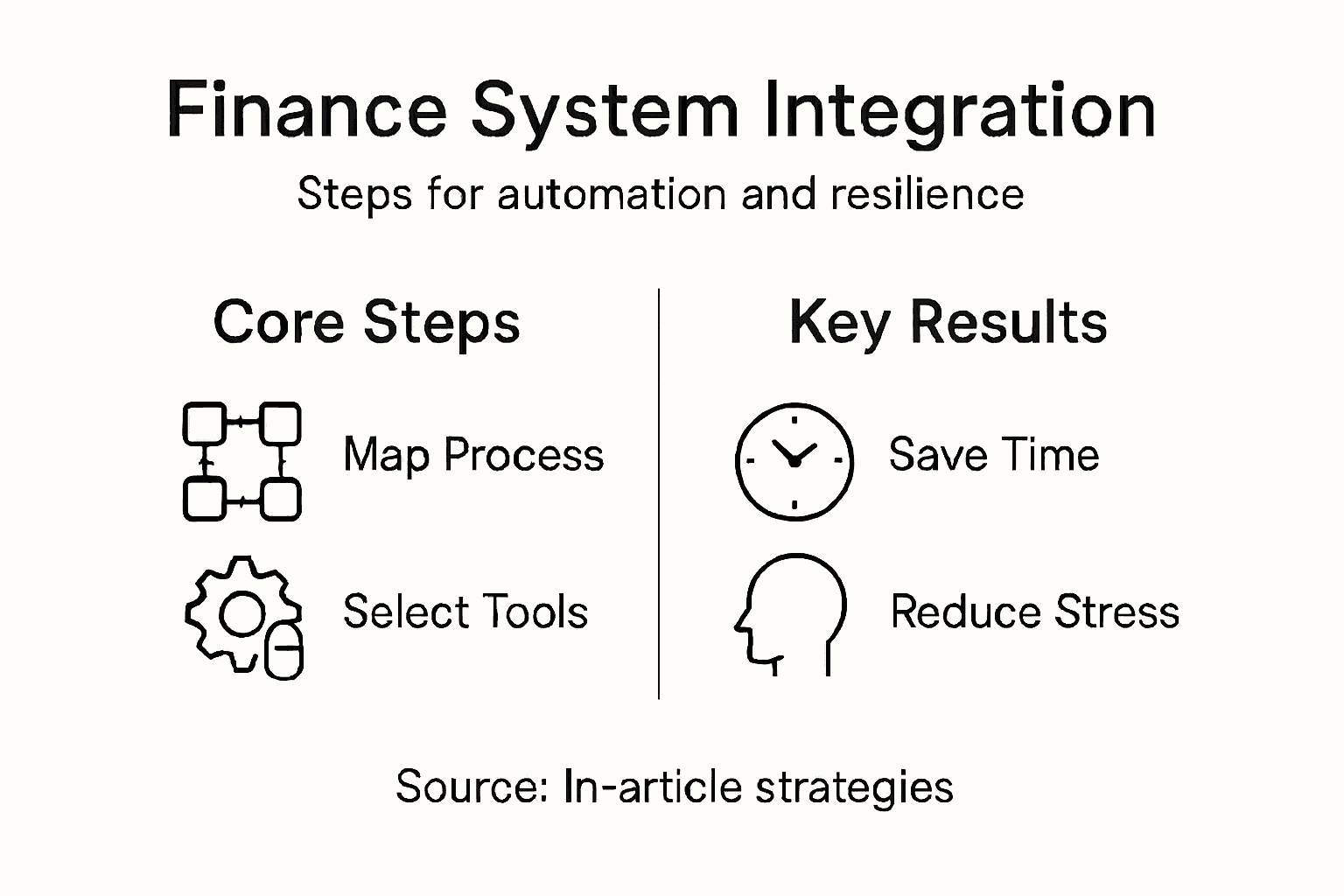
This integration also reshapes your relationship with complexity. Digital financial transformation requires both hard skills in automation and data analysis alongside soft skills like adaptability and emotional intelligence, because technology and human capability must evolve together. As your business scales, complexity increases whether you want it to or not. More customers, more transactions, more moving parts. Without integrated systems, automation, and mental resilience, that complexity crushes you. You hire more people to handle the work. Costs rise. Quality drops. With true integration, complexity becomes manageable. Systems give you leverage. Automation handles volume. Mental resilience lets you see patterns and opportunities instead of drowning in details. The difference between a founder at 10 million in revenue who feels calm and one who feels frantic often comes down to this integration.
Pro tip: Pick one financial process this month that causes you visible stress or wastes your team’s time, then map the three elements: What is the current system? Where could automation replace manual work? How will your team and you mentally approach trusting this new process? Building this integration muscle on one small process creates the template for scaling the approach.
Common Pitfalls and Strategic Solutions
Every founder hits the same financial walls. You start with good intentions. You hire an accountant. You set up systems. Then six months later, nothing’s changed. You still don’t understand your numbers. Your team still struggles with expense tracking. You still feel anxious about cash flow. The problem isn’t that you don’t know what to do. The problem is that most business finance training fails because it ignores the actual obstacles that prevent implementation. Understanding common pitfalls upfront lets you sidestep them instead of learning them the expensive way.
The most frequent pitfall is treating finance training as a one-time event instead of an ongoing system. You attend a workshop, feel energized for two weeks, then slip back into old patterns because nothing in your business structure changed to support new behavior. The solution requires intentional design. Training needs follow-up mechanisms built in. You need accountability check-ins scheduled. You need someone responsible for tracking whether new practices actually get implemented. Common corporate training challenges like employee resistance and difficulty measuring impact occur because organizations fail to articulate why the training matters and fail to establish clear metrics for success. For your business, this means defining upfront what will be different after training. Not vague goals like “better financial understanding.” Concrete changes like “we’ll close monthly financials in five days instead of fifteen” or “we’ll have a cash flow forecast that we update weekly.” When you define success that clearly, you can actually measure whether the training worked.
Another critical pitfall is trying to fix everything at once. You take a comprehensive finance course and try to implement accounting system overhauls, new reporting structures, and financial forecasting simultaneously. Your team gets overwhelmed. Nothing gets done well. The smarter approach is sequential implementation. Pick your biggest pain point first. Maybe it’s cash flow visibility. Build expertise and systems around that one thing. Get it working smoothly. Then move to the next priority. This phased approach lets you build momentum and learn from each phase before scaling complexity. A related pitfall is failing to align your leadership team on financial priorities. Your CFO wants detailed monthly forecasts. Your operations leader thinks that’s overkill and prefers a simpler approach. Your sales leader doesn’t believe the numbers at all. When leadership doesn’t speak the same language about financial strategy, nothing gets implemented consistently. The solution is explicit alignment meetings where you agree on financial priorities, confirm the metrics that matter most, and establish accountability for tracking those metrics.
Perhaps the subtlest pitfall is short-term thinking that sacrifices long-term wealth building. You focus on hitting monthly revenue targets and ignore whether you’re actually building profitable, scalable systems. Strategic pitfalls including short-termism and lack of focus require committed leadership, aligned teams, and clear performance measurement mechanisms to overcome. Real wealth compounds when you build systems that generate sustainable profit while your business scales. This requires resisting pressure to chase every opportunity and instead staying disciplined about what actually drives long-term value. You need financial resilience built into your strategy so that temporary market shifts don’t force reactive decisions that undermine your long-term direction. The way you solve this is by explicitly separating your monthly operating rhythm from your quarterly and annual strategy reviews. Monthly reviews focus on whether you hit targets. Quarterly reviews focus on whether your targets still make sense given market changes. Annual reviews focus on whether your strategy is actually building the business you want. When you have this rhythm in place, you stay accountable to near-term performance while staying committed to long-term wealth.
Pro tip: Before investing in any finance training or system, write down the three specific changes you want to see in your business within 90 days, assign a owner to each change, and schedule monthly check-ins to measure progress. This transforms training from theoretical knowledge into actual business capability.
Master Your Business Finance Systems for Lasting Wealth and Peace
If you are tired of feeling overwhelmed by financial chaos or frustrated by training that never leads to real implementation you are not alone. This article highlights how mastering core financial systems and integrating automation with mental resilience is the key to transforming your business from reactive firefighting to strategic growth. At Freedom Sun we help entrepreneurial founders like you move beyond surface-level financial literacy to build robust systems that deliver clarity profit optimization and sustainable decision-making confidence.
Through our unique Operating System framework you gain access to proven strategies that align with the article’s emphasis on resource allocation mechanisms information flow systems and risk management structures. Our approach supports your journey in building the MATH of financial clarity the MECHANICS of system infrastructure and the MINDset required for resilient leadership. Join a community focused on more than just knowledge but actual transformation and accountability. If you want to stop guessing your financial position forecast cash flow accurately and confidently lead your business to scalable success start your journey today with Freedom Sun and experience training that turns knowledge into profitable peace.
Take the next step now by exploring our interactive tools assessments and training designed specifically for leaders ready to conquer financial complexity without burnout at Freedom Sun. Your business systems clarity and long-term wealth depend on it.
Frequently Asked Questions
What is business finance training excellence?
Business finance training excellence is a systematic approach to building financial competency that enhances strategic decision-making and operational scaling, focusing on practical skills, effective systems, and building mental confidence around financial management.
How do I choose the right type of finance training for my business?
Choosing the right finance training involves identifying your specific financial challenges, such as cash flow management or financial visibility, and selecting a program that explicitly addresses these areas rather than opting for generic courses.
What are the core elements of mastering financial systems?
The core elements include resource allocation mechanisms, information flow systems, risk management structures, and institutional frameworks, all designed to ensure effective financial operations and clarity.
How can automation improve financial systems in my business?
Automation can streamline financial processes, reduce manual workload, and enhance accuracy. By integrating intelligent automation with solid financial systems, businesses can achieve real-time insights and minimize stress related to financial management.