Become a Better Leader: Strategic Success Shift

Many experienced coaches and consultants believe that you either have leadership in your DNA or you do not. This old idea keeps smart professionals grinding instead of growing. In truth, leadership is a skill set you develop, not a quality you are born with. Current research confirms that real leaders are shaped by practice, mentorship, and experience. If you are ready to move past hustle culture, you will discover how strategic leadership can be learned, not just inherited.
Table of Contents
- Defining Leadership and Common Misconceptions
- Leadership Styles and Systemic Approaches
- Core Traits and Strategic Practices for Success
- Roles, Responsibilities, and Sustainable Impact
- Common Leadership Pitfalls and What to Avoid
Key Takeaways
| Point | Details |
|---|---|
| Leadership Is a Learnable Skill | Contrary to popular belief, leadership traits can be developed through intentional practice and real-world experience. |
| Adapt Leadership Styles | Effective leaders use a variety of styles tailored to different situations, enhancing adaptability and team performance. |
| Focus on Systems | Building organizational structures that promote autonomy leads to sustainable leadership, allowing teams to thrive without constant oversight. |
| Invest in Personal Development | Continuous learning and self-awareness are crucial for successful leadership; effective leaders prioritize their own growth and seek feedback. |
Defining Leadership and Common Misconceptions
Leadership isn’t what most people think it is. The biggest misconception? That leaders are born, not built. This outdated belief keeps talented coaches and consultants from stepping into authentic leadership roles.
Here’s what actually happens: leadership is a skill set you develop, not an inherited trait. Research shows that leadership traits can be developed through intentional practice, mentorship, and real-world experience. That means you’re not stuck with your current leadership capacity.
What Leadership Actually Is
Leadership is about creating conditions where your team (or clients) can do their best work. It’s not about having all the answers or working harder than everyone else.
Think of it like this: a coach doesn’t win the game. The coach builds the system, develops the players, and makes strategic decisions that create winning opportunities. That’s leadership.
For coaches and consultants, leadership means:
- Creating clarity around vision and strategy so your team moves with purpose
- Building sustainable systems that don’t depend entirely on you
- Making decisions that prioritize long-term health over short-term hustle
- Communicating expectations clearly so people know what success looks like
- Handling difficult conversations and personnel decisions with integrity
Real leadership is measured by what happens when you’re not in the room, not by how hard you work.
Four Common Leadership Misconceptions
Misconception 1: Leaders Must Have All the Answers
Wrong. Strategic leaders ask better questions. They know when to delegate, when to seek expert advice, and when to admit uncertainty. Your team respects honest leadership more than false confidence.
Misconception 2: Good Leaders Never Rest
This is the hustle culture trap. Burned-out leaders burn out their teams. Most educators recognize that leadership requires sustainable practices, not constant overdrive. You can’t build a scalable business if you’re personally exhausted.
Misconception 3: Leadership Is a Title
A title is just permission to lead. Real leadership is influence. You can lead without a formal position, and you can hold a position without actually leading. The difference? Whether people follow because they want to or because they have to.
Misconception 4: Leaders Are Natural-Born Charismatic People
Some of the most effective leaders are quiet, introverted, and detail-oriented. Leadership isn’t about being the loudest person in the room. It’s about being the clearest thinker and the most trustworthy decision-maker.
Why This Matters for Your Business
If you believe leadership is fixed, you’ll stop developing it. You’ll stay stuck in execution mode, grinding away at your business instead of leading it. That’s how you end up exhausted, building a job instead of a business.
But if you see leadership as a learnable skill, everything changes. You can systematically build the communication skills, decision-making frameworks, and emotional intelligence that separate sustainable business owners from overworked solopreneurs.
Pro tip: Identify one leadership skill that’s weakest in your business right now—whether that’s delegation, difficult conversations, or strategic planning—and commit to developing it over the next 90 days through deliberate practice and feedback.
Leadership Styles and Systemic Approaches
There’s no single “right” way to lead. The coaches and consultants who thrive understand that effective leadership combines multiple approaches based on what your business actually needs in any given moment.
Think of leadership styles like tools in a toolbox. You wouldn’t use a hammer for every job. Similarly, you need different leadership approaches for different situations—crisis management, team development, strategic planning, and daily operations all require different energy and focus.
The Most Effective Leadership Styles for Coaches and Consultants
Research shows that multiple leadership styles create more adaptability when combined thoughtfully. Here are the core styles that work best for service-based businesses:
Transformational Leadership
This style focuses on inspiring your team toward a bigger vision. You’re not just managing tasks; you’re helping people grow and see how their work contributes to something meaningful. This works beautifully when you’re scaling or launching new offerings.

Instructional Leadership
You’re directly involved in improving how work gets done. You coach your team through systems, provide feedback on quality, and create clarity around standards. This style prevents mediocrity and ensures client outcomes stay strong.
Distributed Leadership
You empower others to lead within their domains. Your content manager owns content strategy. Your operations person owns client delivery systems. You’re not micromanaging; you’re building leaders around you.
Transactional Leadership
You set clear expectations and follow through with accountability. This keeps things predictable and prevents chaos. Use this when you need consistent execution of established processes.
Here’s a summary of core leadership styles and when they’re most effective:
| Leadership Style | Key Focus | Best Used For |
|---|---|---|
| Transformational | Inspiring vision and growth | Scaling, launching new offers |
| Instructional | Improving processes and quality | Team training, setting standards |
| Distributed | Empowering others to lead | Building team autonomy |
| Transactional | Clear expectations and accountability | Routine operations, consistency |
Why Systemic Thinking Changes Everything
Most burned-out coaches try to lead through personality alone. They show up, they inspire, they grind. That’s not sustainable leadership—that’s just exhaustion with charisma.
Systemic leadership means building organizational structures and processes that work without constant personal intervention. Your systems should serve your leadership, not the other way around.
Key elements include:
- Clear roles and decision-making authority so people know who decides what
- Documented processes that don’t require you to explain the same thing repeatedly
- Metrics and feedback loops that show progress without constant check-ins
- Delegation frameworks that build capability in your team
- Communication structures that prevent information silos
The best leaders build systems that outlast their personal effort. Your business should run on clarity and structure, not on your daily presence.
Combining Styles Into Your Unique Leadership Approach
Your leadership approach should flex based on context. When hiring a new team member, shift toward instructional and transformational. When executing a proven process, shift toward transactional. When building something new, distribute leadership to pull in diverse thinking.
This requires adapting leadership styles to address contextual challenges and organizational needs rather than forcing one style onto every situation.
Start here:
- Identify which style feels most natural to you (your default)
- Notice when that style creates problems or limits growth
- Deliberately practice one different style for 30 days
- Build awareness of which situations call for which approach
Pro tip: Audit your current leadership approach: Are you relying too heavily on personality and personal effort? If so, spend the next quarter documenting your unwritten systems and training someone else to execute them—this immediately frees you to lead strategically instead of operationally.
Core Traits and Strategic Practices for Success
Success as a leader isn’t random. The coaches and consultants who build sustainable businesses share specific traits and follow deliberate practices that compound over time.
The good news? These aren’t inherited talents. They’re skills you can develop systematically through intentional practice and strategic thinking.
Essential Leadership Traits
Research identifies self-efficacy and motivation as foundational traits that separate effective leaders from the rest. Self-efficacy is your belief that you can accomplish what you set out to do. Motivation is the fuel that keeps you moving when things get hard.
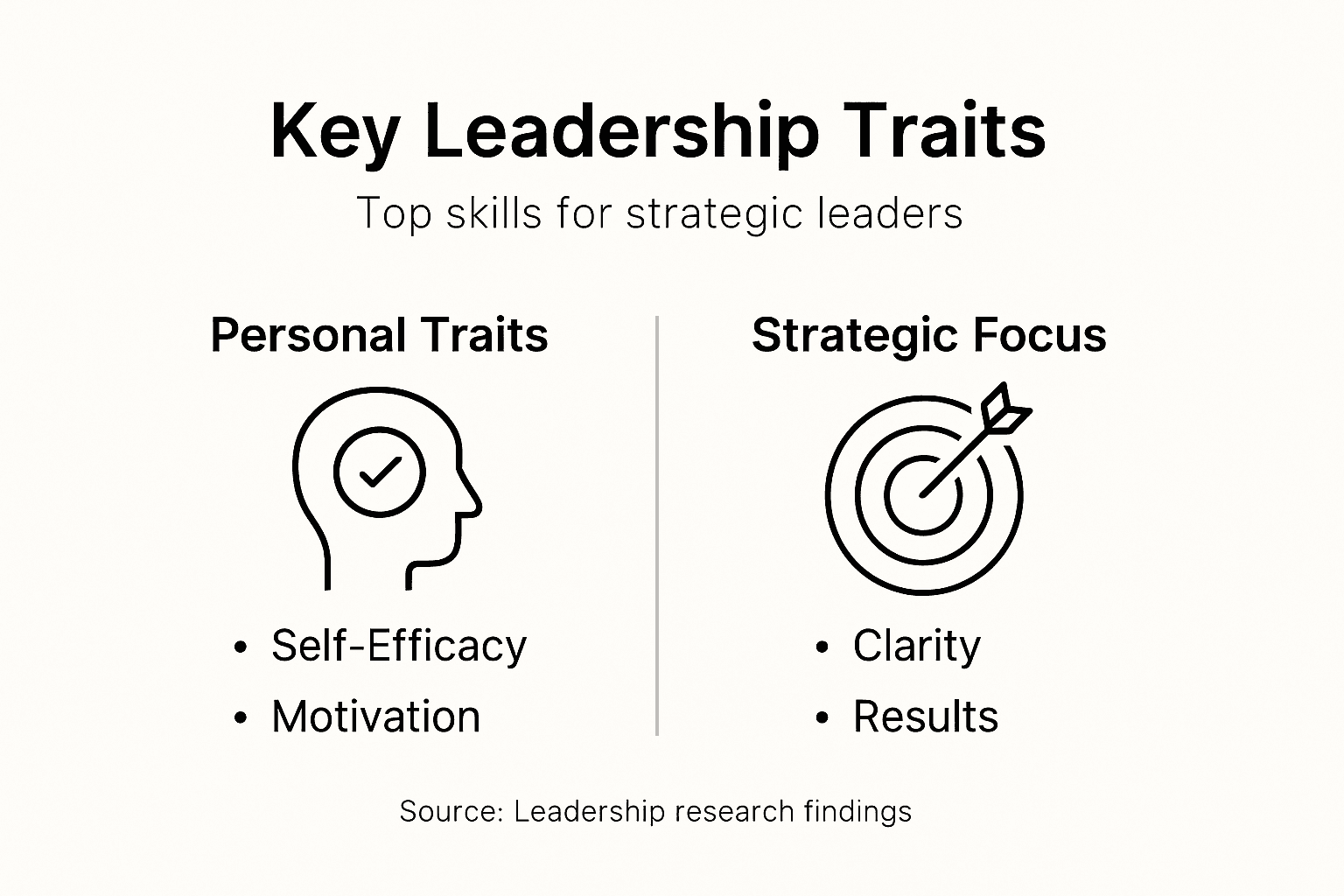
But there’s a third trait that matters equally: clarity of purpose. You need to know why you’re building your business and where you’re actually heading. Without it, you’ll respond to every opportunity instead of moving toward your vision.
Building these traits:
Compare foundational leadership traits and their business advantages:
| Trait | Description | Business Advantage |
|---|---|---|
| Self-efficacy | Confidence in your capabilities | Greater initiative and resilience |
| Motivation | Drive to achieve goals | Sustained effort under pressure |
| Clarity of Purpose | Knowing your vision/direction | Smarter decisions, less distraction |
- Start small and build evidence of your own capability (that’s self-efficacy)
- Connect your daily work to the bigger impact you’re creating (that’s motivation)
- Write down your three-year vision and review it monthly (that’s clarity)
Strategic Practices That Drive Results
Trait alone won’t carry you. You also need systems and practices that keep you on track. The most effective leaders use data-driven planning with measurable goals to ensure progress rather than guessing.
Core strategic practices include:
Clear Success Criteria
Define what success looks like before you start. Not “grow my business” but “add three new clients paying $5K annually by Q3.” Specificity creates accountability.
Formative Assessment and Feedback Loops
You need regular check-ins on how your strategies are working. Monthly reviews against your goals show what’s working and what needs adjustment. This prevents wasted effort on ineffective tactics.
Stakeholder Inclusion
Your team, clients, and trusted advisors see blind spots you can’t see. Engaging stakeholders in continuous improvement creates better decisions and stronger buy-in.
The leaders who succeed aren’t smarter; they’re more intentional about measuring progress and adjusting course based on real data.
Building Your Personal Leadership Foundation
Your leadership effectiveness starts with yourself. Before you can lead others sustainably, you need clarity on your own values, boundaries, and non-negotiables.
Start with one fundamental practice: weekly review. Every Friday, spend 30 minutes reviewing what worked, what didn’t, and what you’re learning. This single practice creates the self-awareness that separates strategic leaders from reactive operators.
Second, establish your decision-making framework. When faced with competing priorities or opportunities, what criteria do you use to decide? Without this, you’ll flip-flop based on emotion or whoever talked to you last.
- Identify your core values (what matters most to you)
- Define your decision criteria (what must be true for you to say yes)
- Review decisions quarterly to see if they align with your framework
- Adjust your framework as your business evolves
Pro tip: Block 90 minutes each Friday for weekly review and strategic planning. This single habit—protected and non-negotiable—will compound into the clarity and focus that separates sustainable leaders from those perpetually in crisis mode.
Roles, Responsibilities, and Sustainable Impact
Being a leader means embracing specific responsibilities that directly drive results. The difference between leaders who burn out and leaders who build sustainable impact comes down to knowing exactly what you’re responsible for—and what you’re not.
Most struggling coaches and consultants try to own everything. Client results, marketing, operations, team development, financial management. That’s not leadership. That’s exhaustion.
Core Leadership Responsibilities
Research identifies 21 core responsibilities linked to organizational success. For your coaching or consulting business, these translate into specific leadership roles you must intentionally develop.
Setting Clear Direction
Your first responsibility is establishing what you’re actually building and where it’s heading. Not vague aspirations, but concrete three-year goals with measurable milestones. Your team can’t follow a path they can’t see.
Building and Protecting Culture
Culture isn’t something that happens naturally. It’s intentionally shaped through how you make decisions, how you communicate, and what you celebrate. Every hire, every firing, every conflict resolution sends a message about your values.
Developing Your People
Your job is to make your team better. Stronger communicators. Better problem-solvers. More capable leaders themselves. This requires time, feedback, and genuine investment in their growth.
Managing Performance and Accountability
You need clear discipline and performance management systems. Not to be harsh, but to be clear. When expectations aren’t met, the conversation happens quickly and directly—not months later in a firing.
Protecting Operational Health
You’re responsible for ensuring your systems work, your financials are healthy, and operations run smoothly. This doesn’t mean you do it yourself. It means you own that it gets done.
The Sustainability Question
Here’s the hard truth: your leadership impact only scales if it survives without your daily effort. A business where you’re essential to every decision isn’t sustainable. It’s a job you’re trapped in.
Sustainable impact requires documenting your thinking, training your team on your frameworks, and building systems that work without constant explanation.
Your responsibilities break down like this:
- Strategic thinking and decision-making (you do this)
- Execution and implementation (your team does this)
- Oversight and adjustment (you do this quarterly)
- Daily operations and troubleshooting (your team does this)
Your job as a leader is to think strategically and build systems that make execution possible for others—not to execute everything yourself.
Shifting From Doer to Developer
This shift is where most coaches get stuck. You built your business through doing exceptional work. Now you have to lead others to do the same work. That’s a completely different skill.
Start with one area. Pick something your team needs to own but currently depends on you for. Document your approach. Train someone. Let them do it imperfectly. Coach them to competence.
One responsibility at a time. One person at a time. This compounds into sustainable leadership.
- Choose one responsibility to transition off your plate
- Document exactly how you currently handle it
- Train one person to the 80 percent level
- Coach them monthly until they hit 95 percent
- Move to the next responsibility
Pro tip: Identify the single responsibility that, if delegated well, would free you to focus most on strategic growth. Start there, and treat the delegation and training as your primary work for the next 90 days.
Common Leadership Pitfalls and What to Avoid
Every leader makes mistakes. The question is whether you learn from them or repeat them. The most destructive pitfalls tend to follow predictable patterns—and knowing them ahead of time can save you years of damage to your team and business.
Most coaches and consultants fall into these traps not from malice, but from ignorance. You don’t know what you don’t know. Until now.
The Toxic Leadership Trap
This is the most serious one. Harmful leadership styles including abusive and bullying behaviors destroy team morale, productivity, and organizational culture. They’re also surprisingly common in high-achieving people who mistake intensity for leadership.
Toxic leadership shows up as:
- Making decisions from ego instead of strategy
- Using shame or fear to motivate people
- Taking credit for team wins, blaming others for losses
- Creating an environment where people fear speaking up
- Treating people as replaceable resources instead of humans
The damage is real. People leave. Performance drops. Your business becomes known as a difficult place to work. Recovery takes years.
Common Operational Pitfalls
Beyond toxicity, research shows that leaders struggle with personnel matters, politics, and poor communication. These aren’t character flaws—they’re skill gaps that training and self-awareness solve.
Avoiding Clear Conversations
This is where most coaches fail. Someone underperforms and you avoid the conversation. Months pass. Resentment builds. Finally you explode or fire them suddenly. That’s not leadership—that’s emotional avoidance.
Good leaders have clear, direct conversations when issues emerge. Not harsh. Clear.
Not Adapting Your Approach
You lead your entire team the same way. But your operations manager needs different feedback than your client success person. Your new hire needs different support than your veteran.
Flexibility is a leadership skill. Use it.
Neglecting Your Own Development
You stop learning. You think you’ve figured it out. But leadership requires constant adaptation. The industry changes. Your team grows. Your challenges evolve.
Leaders who invest in their own development create better outcomes. Period.
The gap between good leaders and struggling leaders isn’t talent—it’s self-awareness and willingness to keep learning.
Egotism and Incompetence
Be honest: are you leading from confidence or from insecurity masked as certainty? Egotistic leaders make decisions to protect their image instead of serving their business. They surround themselves with yes-people and dismiss feedback.
Incompetent leaders make decisions from lack of skill. They don’t know what they don’t know and they’re too proud to ask.
Avoid both by:
- Seeking regular feedback from people who’ll tell you the truth
- Admitting what you don’t know and getting help
- Making decisions for the business, not your ego
- Building a team that will challenge you respectfully
Pro tip: Find one trusted advisor—someone who knows you well and has no filter—and ask them monthly: “Where am I leading poorly right now?” Then actually listen without defensiveness. This single practice prevents most leadership pitfalls before they happen.
Build Sustainable Leadership That Truly Works
Are you feeling stuck trying to lead your coaching or consulting business by sheer hustle and personality alone? The article shows that true leadership is a learnable skill focused on system health, clarity of purpose, and strategic delegation — not endless grinding or pretending to have all the answers. If you recognize the need to shift from a doer to a strategic leader creating scalable impact, this is your moment to act.
At Freedom Sun, we specialize in training coaches, consultants, and service-based entrepreneurs to build automated, resilient systems that free you from burnout and put you in control of your business. Our programs integrate proven leadership styles, practical frameworks, and community support designed to help you develop the core traits and strategic practices highlighted in the article. Discover how to delegate effectively, create clear decision-making frameworks, and cultivate sustainable growth without losing your wellbeing. Begin your leadership shift today by exploring Freedom Sun’s signature training, where strategic success meets profitable peace. Don’t wait until exhaustion forces change. Lead with clarity and purpose now.
Frequently Asked Questions
What are the key traits of an effective leader?
Effective leaders often share traits such as self-efficacy, motivation, and clarity of purpose. These traits help them to build sustainable businesses and lead their teams effectively.
How can I develop my leadership skills?
Leadership skills can be developed through intentional practice, mentorship, and real-world experience. Identifying specific skills to work on, such as delegation or strategic planning, can accelerate your growth as a leader.
Why is communication important in leadership?
Clear communication helps establish expectations and cultivates an environment of trust. When leaders communicate effectively, team members understand their roles and what constitutes success, leading to better performance.
How do I shift my focus from doing tasks to leading my team?
Start by delegating specific responsibilities to team members, documenting processes, and coaching them as they grow into their roles. This allows you to focus on strategic leadership rather than operational tasks.